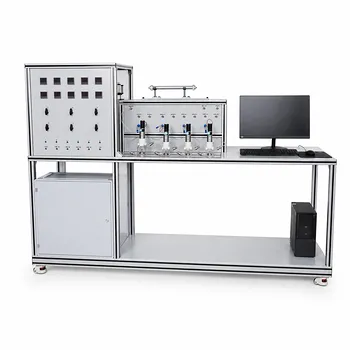
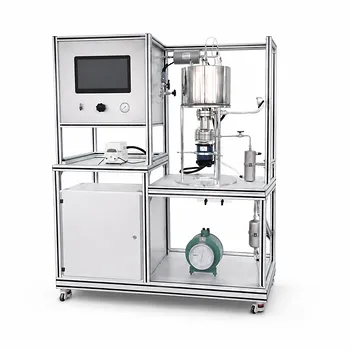
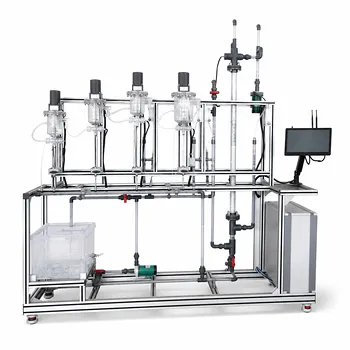
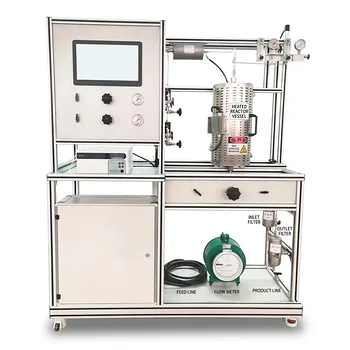
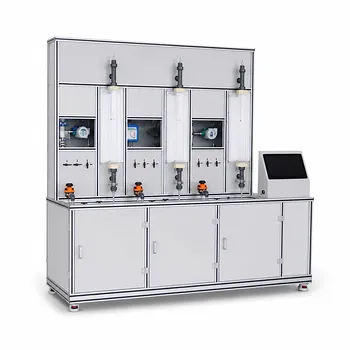
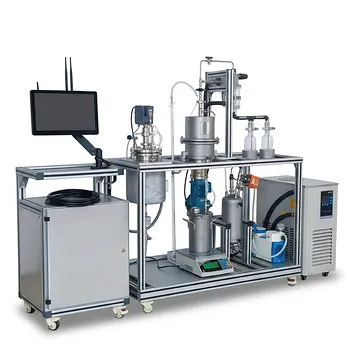
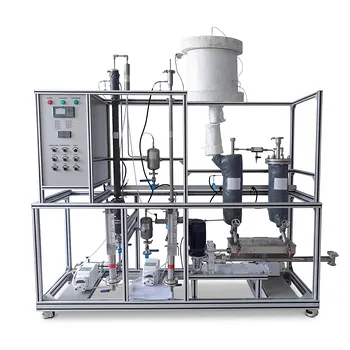
Running both reactor types on a pilot plant allows students to measure auxiliary time directly.
Chemical engineering unit operations pilot plants provide a hands-on platform to move beyond theory and quantify the real-world impact of auxiliary time—the loading, unloading, and cleaning steps that make a batch reactor’s effective volume requirement larger than a PFR’s. Students can operate both systems with the same chemistry, record the non‑productive time, and calculate how much extra reactor volume is needed in batch mode to match a given continuous throughput. This closes the gap between idealized design equations and practical industrial reactor selection.
The surface answer is that pilot plants let students time the complete batch cycle and compare it to the steady‑state output of a PFR. The deeper insight is that this hands‑on measurement teaches why volumetric efficiency is not just about reaction kinetics, but about how we manage time—and why continuous flow often wins for high‑volume production.
Turning Theory into Measured Reality
Reproducing the Same Kinetic Fingerprint
Before comparing volumes, students must first confirm that both reactors are working under equivalent kinetic conditions. A pilot plant makes this possible.
- Sampling profiles in a PFR: A tubular reactor with multiple sampling ports along its length allows students to withdraw samples at known residence times. This produces a concentration‑versus‑position profile that directly mirrors the time‑dependent profile inside a batch reactor.
- Verifying equivalent conversion: By running the same esterification or hydrolysis reaction in both modules, students can plot the data and see that the plug‑flow behavior and the batch time‑course yield the same conversion when the space time equals the batch reaction time.
This step establishes a common kinetic baseline. Only then does the comparison of volumetric efficiency become meaningful.
The Volumetric Efficiency Overshadowed in Lecture Halls
Equations for ideal reactors often suggest that a PFR and a batch reactor require the same reaction volume (for a given positive‑order kinetics and conversion). But that is only true if the batch reactor runs without any waiting.
- Real batch cycles include downtime: Loading the reagents, heating up, cooling down, discharging the product, and cleaning the vessel all consume significant time that produces no output.
- Pilot plants amplify this lesson: Students can use a stopwatch on a benchtop‑scale batch vessel. The time spent between “reaction complete” and “next batch charging” becomes a number they can measure—often 15–45 minutes, depending on the physical setup and the cleaning protocol.
- Translating time into volume: For a required annual production rate, students can calculate the effective batch cycle time (reaction + auxiliary) and compare the resulting equipment volume to that of a PFR providing the same output continuously.
Measuring Auxiliary Time in a Safe, Controlled Environment
Educational pilot plants are designed for visibility and flexibility, which makes auxiliary time a tangible variable rather than an abstract note in a textbook.
- Transparent vessels and modular fittings: Students can physically see when draining is complete, how long rinsing takes, or how solvent evaporation during cleaning extends the downtime.
- Manual vs. automated steps: Many pilot‑scale batch reactors require manual disassembly for cleaning, emphasizing how mechanical design and automation level directly influence the practical “batch factor.”
- Data‑driven comparison: Logging the exact start‑stop timestamps for each step, students can compute a throughput per hour for the batch setup and directly compare it with the steady‑state mass flow rate from the PFR. This numerical result makes the cost of auxiliary time concrete.
Understanding the Trade‑offs
When Batch Still Makes Sense
While the PFR wins on volumetric efficiency for a single product, the industrial world is full of exceptions. Students discover through pilot‑plant exercises that high volumetric efficiency is not always the primary goal.
- Multiproduct flexibility: Batch reactors can be cleaned and switched to a different recipe quickly. PFRs are often dedicated to a single product line, making them economical only at scale.
- Slow reactions and long hold times: If the reaction requires several hours regardless, the relative penalty of a 20‑minute auxiliary time becomes small, and the flexibility of a batch vessel might outweigh the PFR’s efficiency.
Common Pitfalls Students Should Avoid
Pilot‑plant measurements are only as good as the experimental discipline behind them, and there are a few traps that distort the comparison.
- Ignoring start‑up and shutdown transients in the PFR: A continuous reactor reaching steady state may need an initial period that mimics its own “auxiliary” loss. Students must reach steady‑state conditions before collecting valid throughput data.
- Assuming perfect plug flow: Real tubular reactors have some axial dispersion. Taking samples only at the inlet and outlet without measuring the actual residence‑time distribution can lead to over‑optimistic PFR volume estimates.
- Scaling auxiliary time incorrectly: What takes 5 minutes to clean in a 2‑liter pilot reactor may not scale linearly to a 2,000‑liter industrial vessel. The lesson is about the principle, not the exact minute count. Students must note that auxiliary times are highly equipment‑specific and need careful scale‑up consideration.
Making the Right Choice for Your Experiment
The pilot plant is an educational tool, and the experiments should be designed to answer the specific questions that matter most for your learning objectives.
- If your primary focus is reactor sizing and economics: Run an identical model reaction in both systems under the same temperature and conversion target. Record auxiliary time meticulously, then calculate the required reactor volume for the same annual throughput. Compare the capital cost implications.
- If your primary focus is understanding ideal flow behavior: Use the PFR with multiple sampling ports and a batch reactor running in parallel to verify that the concentration‑time profile in the BR is identical to the concentration‑length profile in the PFR when auxiliary time is set aside. This isolates kinetics from equipment operation.
- If your primary focus is process development and scale‑up: Deliberately vary the auxiliary time—for instance, by changing cleaning protocols—and observe how it impacts the overall batch‑cycle efficiency. Discuss what this means for moving from a single‑product pilot plant to a multipurpose fine‑chemicals facility.
By making auxiliary time a measured variable instead of an assumption, students transform an abstract textbook footnote into a powerful decision‑making criterion for real‑world reactor design.
Summary Table:
| Comparison Metric | Batch Reactor (BR) | Plug Flow Reactor (PFR) |
|---|---|---|
| Auxiliary Time | High (loading, cleaning, heating, cooling) | Low (continuous steady-state operation) |
| Volumetric Efficiency | Lower (due to non-productive downtime) | Higher (constant continuous throughput) |
| Flexibility | High (multiproduct, variable recipes) | Low (typically dedicated to a single line) |
| Key Application | Slow reactions, small-scale production | Fast reactions, high-volume production |
Elevate Your Chemical Engineering Lab with LABPARK
Bridge the gap between theoretical reactor design and real-world industrial operations. LABPARK provides premium Educational and Vocational Unit Operations Pilot Plants in chemical engineering, bioprocess & biotech, and environmental & water treatment for universities, research institutes, and enterprises.
Our pilot scale systems empower your students and researchers to:
- Hands-on measure auxiliary time, cycle steps, and reactor downtime.
- Compare batch vs. continuous flow (PFR) kinetics under realistic conditions.
- Train on industrial-grade automation and data logging tools.
Ready to enhance your teaching and research capabilities? Contact us today to request a quote or custom design solution!
Related Products
- Gas Phase Mixing and Residence Time Distribution Determination Educational Unit Operations Pilot Plant
- Fixed-Bed Chemical Reaction and Gas Dust Tar Removal Unit Operations Pilot Plant
- Tubular Reactor Flow Characteristics Determination Educational Unit Operations Pilot Plant
- Multi-Reactor Educational Pilot Plant for Reaction Engineering Unit Operations
- Internal Circulation Gradient Free Catalytic Reaction Educational Pilot Plant
People Also Ask
- Why do gas-flow unit operations pilot plants require an expansion factor? Achieve Precise Flow Calculations
- Pulse vs. Step Injection for RTD: Practical Differences in Pilot Plants Explained
- How do pressure changes affect gas-phase reaction rates? Safely Optimize Your Kinetics
- Why use an experimental factor for terminal velocity in gas flow pilot plants? Streamline Frictional Flow Analysis
- How is the pressure-volume extrapolation method applied in educational pilot plants to calibrate gas sensors?