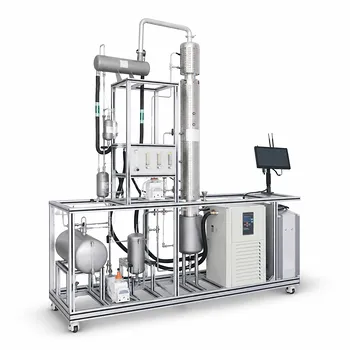
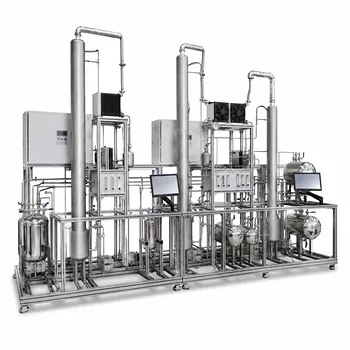
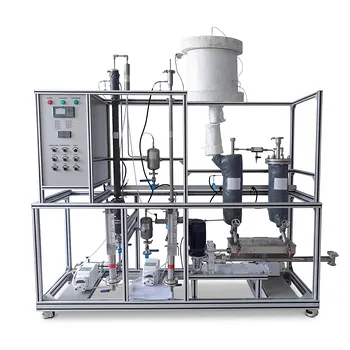
The direct answer is that a conventional rectifier or stripper will fail. You must configure the pilot plant for Batch Reactive Extractive Distillation (BRED). This technique introduces a continuous side-feed of a heavy entrainer into a batch rectifier. The entrainer alters the non-ideal vapor-liquid equilibrium (VLE) to circumvent the distillation boundaries, enabling you to recover those otherwise inaccessible saddle-point products.
Saddle points in a residue curve map represent a thermodynamic trap for simple distillation because mass balance lines cannot cross the distillation boundaries that define them. The core strategic shift is to stop trying to distill the mixture as-is and instead use a chemical agent—a heavy entrainer—to temporarily reshape the phase diagram, moving the separation into a feasible region before the agent is recovered.
Understanding the Thermodynamic Trap
The root of the problem is not your equipment, but the phase equilibrium itself. To solve it, you must first recognize why standard approaches fail.
The Boundary Problem
A residue curve map divides the phase diagram into distinct distillation regions. A simple mass balance line connecting your feed, distillate, and bottoms product cannot cross these boundaries. If your desired products are saddle points, they sit on these boundaries but do not represent the highest or lowest boiling point in any region. This means you cannot reach them as a pure distillate or bottoms stream in a standard continuous or simple batch column.
Why Pilot Plants Are Essential
You cannot resolve this in a spreadsheet simulation alone. The non-ideal thermodynamics are highly sensitive to concentration, temperature, and pressure. A unit operations pilot plant allows you to physically test the dynamic trajectory of the liquid composition in the still pot. It demonstrates that the boundary is a real physical barrier, not just a theoretical line, and provides the platform to safely test entrainer strategies before scaling up.
Configuring the Pilot Plant for BRED
The primary reference correctly identifies BRED as the solution. Your existing modular pilot plant can be adapted for this, but the physical configuration must be precise.
The Heavy Entrainer Delivery System
You are converting a batch rectifier into a hybrid column. The critical modification is adding a side-feed stream. You must set up a dedicated feed pump and line to continuously introduce a high-boiling entrainer at a specific tray location near the top of the column, below the total condenser. The entrainer must be heavier than both components, staying in the liquid phase as it moves downward, selectively altering the relative volatility of the original mixture and "breaking" the boundary.
Matching Operating Windows
This is where the reaction and separation must be harmonized. The column’s temperature and pressure profile must simultaneously do two jobs. It must satisfy the reaction kinetics, ensuring the reactants convert within the liquid holdup. At the same time, it must maintain the vapor-liquid equilibrium conditions that keep the entrainer flowing down while the corrected vapor composition moves up.
Catalyst Packing and Hydraulics
If the reaction itself is catalyzed, your packing is the heart of the process. The catalyst must have a specific morphology and packing structure to enable true reactive distillation. You need a countercurrent flow established: vapor rising, liquid with the entrainer cascading down. The structured packing must prevent column flooding while providing sufficient residence time for the reaction to reach completion, all while the entrainer is actively modifying the equilibrium.
Adapting for Intermediate Vs. Final Products
The supplementary references highlight a crucial nuance for consecutive reactions (A → S → R). Your target product—whether the saddle intermediate (S) or the final product (R)—dictates your column profile.
Targeting the Saddle Intermediate (S)
If the saddle product is the intermediate and is prone to reacting further, your strategy is active suppression. You need precise temperature profiling across multiple reaction zones to prevent over-reaction. This is done by continuously removing volatile by-products, like water, to accelerate the forward reaction while shortening residence time, "locking in" the intermediate before it converts to the final product.
Targeting the Final Product (R)
If your final product is the saddle, the bottleneck is the intermediate. Your column must be a bottleneck breaker. Configure the unit with flexible feeding points and adjustable liquid holdup. You must rapidly separate the intermediate from the reaction zone so it cannot accumulate and react further, requiring real-time monitoring of the temperature profile in both the stripping and rectifying sections.
Understanding the Trade-offs
Adopting BRED solves the thermodynamic problem but introduces a new layer of operational complexity you must manage.
Added Mass Transfer Resistance
The entrainer adds a third component, fundamentally changing the liquid-phase dynamics. The presence of the heavy agent can dilute the reactants at the catalyst site. You will likely observe slower apparent reaction rates because the liquid-phase diffusivity is altered. Your pilot plant training must account for this by testing different entrainer concentrations to find the tipping point between effective boundary crossing and kinetic suppression.
Entrainer Recovery and Purity
The entrainer is removed with the heavy components in the reboiler. You have now succeeded in isolating your saddle product, but traded one separation for another. The pilot plant must be modular enough to demonstrate the downstream step of recovering and recycling the entrainer. This is essential for any economic evaluation of the process.
Specialised Safety Integration
When operating with exotic entrainers or reactive mixtures, standard safety protocols are insufficient. The supplementary references on materials like Carbon Disulfide (CS2) are a stark reminder. If your mixture has a low boiling point or is flammable, your BRED setup must integrate explosion-proof (ATEX-rated) instrumentation and high-efficiency condensers. The entrainer feed itself must be managed within a closed-loop system to prevent environmental or chemical exposure hazards.
Making the Right Choice for Your Goal
Your choice of setup within the BRED framework depends directly on your research or training objective.
- If your primary focus is fundamental research on boundary crossing: Implement the BRED setup with a single, well-characterized heavy entrainer. Use the pilot plant to map the still pot’s composition trajectory over time, proving that the measured path defies the original residue curve map predictions.
- If your primary focus is process optimization for an intermediate saddle product: Prioritize multiple, precisely controlled temperature zones and the continuous removal of volatile by-products to demonstrate that you can halt a reaction at a saddle point that simple distillation cannot even isolate.
- If your primary focus is advanced student training in non-ideal thermodynamics: Use the modular piping and flexible control systems to first let students fail with a standard batch rectifier, hitting the boundary, and then add the entrainer feed to physically show how the boundary is circumvented, turning an abstract concept into a tangible result.
The true value of the unit operations pilot plant here is not just proving that a saddle point can be isolated, but demonstrating the engineering control required to temporarily and reversibly alter a system's fundamental thermodynamics to achieve it.
Summary Table:
| Configuration | Key Mechanism | Best For |
|---|---|---|
| Standard Rectifier | Simple distillation (bounded by VLE) | Baseline testing (fails at saddle points) |
| BRED Setup | Continuous heavy entrainer feed | Overcoming residue curve boundaries |
| Multi-Zone Control | Active temperature profiling | Isolating intermediate saddle products |
| Adjustable Holdup | Rapid product/intermediate separation | Isolating final saddle products |
Bring Advanced Thermodynamics to Life in Your Lab
Ready to demonstrate complex separations like BRED? LABPARK provides state-of-the-art Educational and Vocational Unit Operations Pilot Plants in chemical engineering, bioprocess & biotech, and environmental & water treatment.
Engineered specifically for universities, research institutes, and enterprises, our modular systems help students and researchers overcome thermodynamic challenges with hands-on, scalable technology.
Contact LABPARK today to customize the perfect pilot plant for your training and research goals!
Related Products
- Multi-Functional Special Distillation Educational Pilot Plant
- Continuous Sieve-Plate Distillation Pilot Plant for Unit Operations Laboratory Education
- Electrolyte Distillation Purification and Formulation Educational Pilot Plant
- Green Anhydrous Ethanol Purification Extractive Distillation Unit Operations Training Pilot Plant
- Dual-Mode Rectification Pilot Plant for Practical Training Unit Operations
People Also Ask
- Why does simple distillation yield higher efficiency than flash distillation? Key thermodynamic differences.
- How to Estimate Distillation Pilot Plant Tray Efficiency? O'Connell's Correlation Guide
- How to Integrate Spectroscopy in Distillation Pilot Plants for Advanced Process Control
- Why is the acentric factor important in pilot plants? Fluid property prediction.
- How to Verify Distillation Boundary Lines & Composition Regions with Pilot Plants