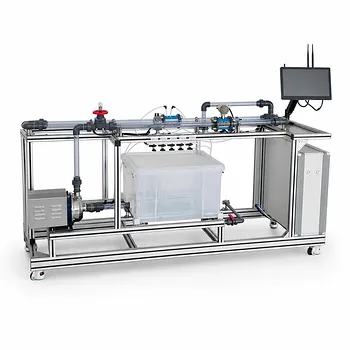
A vocational training plant handling high-pressure, corrosive chemicals must first eliminate the possibility of a catastrophic containment failure. The essential safety features are a combination of high-grade, corrosion-resistant materials (like 316L stainless steel), physical safety relief valves, an automated emergency shutdown system (ESD), and real-time monitoring of pressure and temperature limits. These elements work together to ensure that students learn industrial safety practices within a controlled, secure environment.
The cornerstone of a safe high-pressure training pilot plant is a layered defense strategy: start with inherently corrosion-resistant materials, add physical overpressure relief, automate emergency shutdowns, and continuously monitor critical limits. This combination transforms a hazardous process into a controlled learning environment while teaching the real-world discipline of risk management.
Understanding the Risks in a Training Context
High-pressure reactions and corrosion pose combined threats that can escalate rapidly in a pilot plant. Hydrogen embrittlement, high-temperature oxidation, and stress corrosion cracking can silently degrade vessel integrity until a rupture occurs. In a vocational setting, where operators are still developing their judgment, the margin for error is even smaller. The plant must be designed not just to protect equipment, but to protect learners who might make mistakes.
The Domino Effect of Pressure and Corrosion
Corrosion weakens walls while pressure stresses them. A vessel that might withstand one hazard alone can fail quickly when both act together. For training plants, this means design must assume that corrosive media will contact metal surfaces, and that students might accidentally exceed intended operating envelopes.
Why Training Plants Can’t Simply Mimic Production Units
Industrial plants often rely on deep operational experience and stable, optimized chemistries. In a teaching lab, process conditions change frequently, and inexperienced operators may introduce contamination or misalign controls. A vocational plant therefore requires a more conservative safety envelope—one that anticipates the “worst-case student error” rather than just the “worst-case process upset.”
The Safety Hierarchy: From Passive to Active Defenses
A robust safety architecture layers passive barriers, active controls, and mitigation systems. This hierarchy ensures that if one defense fails, the next one stops the escalation.
Material Selection: The First Line of Defense
High-grade, corrosion-resistant metals form the foundation. For most high-pressure corrosive environments, 316L stainless steel offers good resistance to pitting and chloride-induced stress corrosion cracking, and retains adequate strength at moderate temperatures. Where organic acids or chlorides are present, even higher alloys or liners may be needed. The key is to match the material to the specific process streams, not just to “stainless steel” in general.
Overpressure Protection: Relief Valves and Beyond
Physical safety relief valves are a non-negotiable requirement, sized to handle the worst credible overpressure scenario. They must be set to open at a pressure well below the vessel’s design limit, and discharge to a safe location. But a training plant needs more than a single relief valve: it should also include rupture discs for rapid pressure spikes, and safety vent systems with flame arrestors if flammable vapors are involved.
Automated Emergency Shutdown Systems (ESD)
An automated ESD acts as the brain of the safety network. When critical sensors detect a pressure, temperature, or flow excursion beyond safe limits, the ESD instantly closes feed valves, cuts off heat sources, and initiates cooling. This system must be fail-safe by design—meaning that any loss of power or signal triggers a shutdown, not an operator-dependent response.
Real-Time Monitoring and Alarming
Pressure and temperature limits are only useful if they are monitored continuously. The plant needs advanced instrumentation with high- and low-alarm setpoints that alert students to developing hazards before a trip occurs. Redundancy on critical measurements—like dual temperature probes or pressure transmitters—prevents a single sensor failure from leaving the plant blind.
Cooling and Thermal Management
Many high-pressure reactions are exothermic, and loss of cooling can lead to a runaway. Cooling jackets or internal coils, supplied by dedicated refrigerated loops, must be capable of rapidly absorbing heat. These circuits are interlocked with temperature alarms so that cooling starts automatically if a threshold is breached, buying time for the ESD to act.
Mitigation of Toxic and Flammable Releases
Training plants often handle volatile solvents or produce hazardous side products. An integrated small-scale scrubber or knock-out drum captures toxic vapors before they reach the lab atmosphere. If flammable materials are present, the system should incorporate explosion-proof electrical enclosures, flame arrestors on vents, and nitrogen purging connections to inert the headspace.
Understanding the Trade-offs
Safety features are not free; they add cost, complexity, and maintenance burden. In a training environment, you must balance absolute safety with pedagogical value.
Automation vs. Hands-On Learning
An entirely automated plant that shields students from every decision can prevent them from learning manual control, troubleshooting, and the “feel” of a process. A thoughtful design allows the ESD to act as a last resort, while students operate within guarded but direct control loops. The operator interface should show real-time trends and safety margins, so learners internalize the concept of staying within safe limits.
Material Cost and Compatibility
Specifying exotic alloys or PTFE linings for everything can blow a training program’s budget. The pragmatic approach is to map the corrosion profile of the specific teaching reactions. Use 316L stainless for the main wetted parts, and isolate aggressive feeds with small, replaceable high-alloy sections or lined batch vessels. This teaches material selection as an engineering trade-off while keeping capital reasonable.
The False Comfort of Alarms
Too many alarms, or alarms set too conservatively, can desensitize students. A flood of nuisance alarms trains them to ignore warnings. The alarm philosophy must be disciplined: only truly abnormal conditions generate audible and visual alerts, while lower-tier status indicators remain informational.
Common Pitfalls to Avoid
Neglecting Low-Temperature Embrittlement
Not all hazards come from over-temperature. If training includes cryogenic fluids or cold-wall reactors, carbon steel components can become brittle and fail. Low-temperature alarm setpoints must be enforced with material certifications that guarantee adequate toughness at minimum operating temperatures.
Underestimating the Risk of Vacuum
Operating below atmospheric pressure can be just as dangerous as high pressure—air ingress into flammable mixtures or collapse of a vessel not rated for external pressure. Interlocks and check valves that prevent backflow or vacuum formation are essential, and students must learn to recognize this often-overlooked hazard.
Relying on a Single Relief Path
A single relief valve can be blocked by polymerization, solids, or corrosion products. A training plant should include a secondary relief path—such as a rupture disc in parallel with the relief valve—so that overpressure protection remains effective even if the primary path fails.
Making the Right Choice for Your Training Program
The final configuration depends on what you want your students to master and the specific chemistries you intend to run.
- If your primary focus is teaching core high-pressure unit operations: Prioritize robust mechanical design with 316L stainless vessels, redundant relief devices, and a simple but fast-acting ESD. Keep student interaction high, with clear visual indicators of safe limits.
- If your primary focus is simulating an industrial process with corrosive streams: Invest in higher-grade alloys or liners for the wetted parts, pair them with automated corrosion monitoring loops, and ensure the ESD reacts to pressure buildup from unexpected side reactions.
- If your primary focus is demonstrating process safety and risk assessment: Design the plant with multiple independent protection layers, record all trips for after-action review, and give students exercises in consequence analysis—making sure they learn why each barrier exists.
The most effective vocational pilot plant doesn’t just keep students safe; it makes safety thinking instinctive, turning each feature into a lesson that will protect them throughout their careers.
Summary Table:
| Safety Feature | Primary Function | Practical Application |
|---|---|---|
| Corrosion-Resistant Materials | Prevents structural degradation | 316L stainless steel for wetted parts |
| Overpressure Protection | Relieves sudden pressure spikes | Safety valves and rupture discs in parallel |
| Automated ESD System | Initiates fail-safe shutdown | Instantly cuts feed and heat during excursions |
| Real-Time Monitoring | Alerts operators before limits are breached | Redundant sensors and dual temperature probes |
Bring Industrial-Grade Safety to Your Educational and Training Labs
At LABPARK, we specialize in designing and manufacturing high-quality Educational and Vocational Unit Operations Pilot Plants across chemical engineering, bioprocess & biotech, and environmental & water treatment. Built to meet the rigorous demands of universities, research institutes, and enterprises, our pilot plants prioritize student safety with multi-layered defenses, fail-safe automation, and robust materials.
Ready to equip your facility with safe, reliable, and industry-standard training systems? Contact LABPARK today to discuss your customized pilot plant requirements!
Related Products
- Multi Pump Fluid Transport Process Piping Unit Operations Training Pilot Plant
- Multimodal Absorption and Desorption Pilot Plant for Unit Operations Training
- Multi-Reactor Educational Pilot Plant for Reaction Engineering Unit Operations
- Natural Product Extraction Unit Operations Training Pilot Plant
- Ethyl Acetate Synthesis Unit Operations Pilot Plant for Practical Training
People Also Ask
- Why distinguish Newtonian & non-Newtonian fluids in pilot plants? Prevent design errors.
- Why is the chemical plant startup schedule crucial? De-risk scale-up with pilot plants.
- When to transition from PID to adaptive control in pilot plants? Key process indicators.
- How do deviations in estimating latent heat impact pilot plant thermal systems? Avoid hardware mis-sizing.
- Why Compare Predicted and Experimental Excess Enthalpy? Key to Accurate Pilot Plant Scale-up