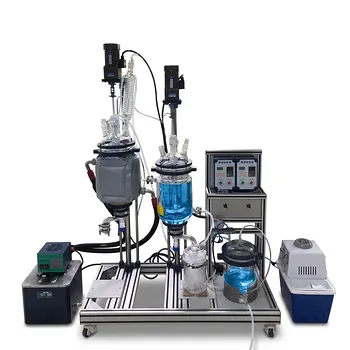
The thermodynamic properties of calcium salts are the non-negotiable blueprint for reactor design. For educational pilot plants demonstrating solid-state thermal decomposition or calcination, the decomposition temperature of the salt dictates the reactor’s minimum operating setpoint, while its reaction enthalpy defines the heating capacity and energy demand. Most educational units therefore standardize on calcium carbonate (CaCO₃) because its transition temperature of approximately 826°C sits comfortably within the 850–900°C capability of typical pilot-scale furnaces, whereas salts like calcium sulfate (CaSO₄) demand temperatures exceeding 1848°C that are energetic-ally and materially impractical for a teaching-scale environment.
The core takeaway is that thermodynamic feasibility directly translates into hardware requirements. In an educational pilot plant, you choose a salt whose decomposition temperature and enthalpy align with safe, observable, and cost-effective furnace operation. Calcium carbonate becomes the default because it offers a clean, endothermic breakdown at a temperature that makes the invisible forces of thermodynamics visible without destroying the equipment.
The Thermodynamic Foundation of Calcination Reactors
Every calcination reaction is an endothermic decomposition driven by heat. The salt’s thermodynamic fingerprint—its transition temperature and reaction enthalpy—becomes the minimum specification the reactor must meet.
The Critical Role of Decomposition Temperature
The transition temperature is the point where the Gibbs free energy of the decomposition reaction becomes negative, making the process thermodynamically spontaneous. For CaCO₃ decomposing into CaO and CO₂, that threshold is 826°C. The reactor must operate above this temperature to shift the equilibrium toward products.
In practical terms, that means the reactor setpoint is not a choice; it is a consequence of the salt. If you use CaSO₄, the reactor must exceed 1848°C. That single number eliminates all standard educational furnaces and demands exotic materials, instantly disqualifying the salt for most pilot-plant curricula.
Reaction Enthalpy Dictates Energy Input
The endothermic enthalpy change tells you how much heat must be continuously supplied to sustain the reaction. CaCO₃ requires +177 kJ per mole of carbonate decomposed. Calcium sulfate, by comparison, demands +403 kJ/mol—more than double the energy for the same molar throughput.
For an educational pilot plant with a fixed furnace power rating and a desire for visible, steady-state operation, the lower enthalpy of CaCO₃ means the reactor reaches its operating window faster and maintains it with less risk of thermal runaway or under-supply. The enthalpy value directly sizes the heating elements, insulation, and power supply.
Translating Salt Properties into Operating Parameters
Once the thermodynamics of a chosen salt are fixed, the reactor’s control philosophy and hardware are largely determined.
Temperature Setpoint and Control
With the CaCO₃ transition at 826°C, educational reactors are typically run at 850–900°C. This provides a safe margin above the thermodynamic minimum to ensure a practical reaction rate while staying within the limits of standard nickel-chromium alloy heaters and ceramic insulation. Attempting to approach 1850°C for CaSO₄ would require silicon carbide or molybdenum disilicide elements, specialized atmospheres, and substantially higher safety interlocks—far beyond the scope of a teaching unit.
Heating Capacity and Furnace Selection
The furnace’s wattage must deliver the required endothermic heat plus compensate for losses. A small pilot plant decomposing 100 g of CaCO₃ per hour needs roughly 50 W of net reaction power, a trivial load. The same mass flow of CaSO₄ would demand over 110 W just for reaction enthalpy, before accounting for the exponentially higher radiation losses at 1850°C. This makes CaCO₃ the energetically sensible—and educationally transparent—choice.
Residence Time and Kinetic Window
While thermodynamics set the floor, kinetics set the pace. Operating temperature directly influences the rate of decomposition, so the chosen setpoint also determines how long solids must remain in the hot zone. By running at 900°C instead of 830°C, students can observe the effect of temperature on decomposition rate, linking thermodynamic driving force to residence time requirements. This experimental flexibility is only safe and practical because CaCO₃’s thermodynamic baseline is so accessible.
Understanding the Trade-offs
Even with the “easy” salt, pilot-plant design involves navigating constraints that stem directly from thermodynamic properties.
Purity vs. Reactivity of the Solid Product
Higher operating temperatures accelerate decomposition but can cause sintering of the nascent CaO particles, reducing surface area and subsequent reactivity. Educational settings must balance demonstration of complete calcination against preservation of product quality—an object lesson in how thermodynamic drive and material science intersect.
Energy Efficiency and Heat Management
A CaCO₃ reactor set to 900°C loses heat through its walls and openings. Energy efficiency depends on insulation and throughput, not just the reaction enthalpy. Students learn that while thermodynamics gives you the bill of materials, engineering execution determines the final utility cost.
Safety Hazards of Byproduct Gases
CaCO₃ decomposition produces CO₂, which is inert but an asphyxiant—manageable with simple ventilation. In contrast, CaSO₄ decomposition yields corrosive SO₃ (which can further form sulfuric acid mist), demanding gas scrubbing and materials of construction that are wholly incompatible with an educational pilot plant. The toxicity of the off-gas is itself a thermodynamic consequence—the stable sulfate resists breakdown until conditions force the release of a highly oxidized sulfur species.
Making the Right Choice for Your Educational Goal
The selection of a calcium salt and its associated operating parameters must align with what you intend to demonstrate and the infrastructure you can safely support.
- If your primary focus is demonstrating standard calcination principles: Use pure calcium carbonate. Set your reactor to 850–900°C and size the heating system for the +177 kJ/mol endotherm. This provides a clear, repeatable window into thermodynamic limits and reactor control without exotic hardware.
- If your primary focus is exploring the limits of materials and energy: Present calcium sulfate as a theoretical case study. Compare its 1848°C transition and +403 kJ/mol enthalpy to CaCO₃ to teach why industrial choices are constrained by thermodynamics, without attempting to operate at those conditions.
- If your primary focus is safety and pedagogical simplicity: Avoid any salt that releases corrosive or acutely toxic gases. Carbonates are the ideal teaching vehicle because the CO₂ byproduct is chemically benign, the energy demand is modest, and the phenomenon is dramatic enough to be observed through simple instrumentation.
You design a reactor not for the salts you wish you could decompose, but for the thermodynamics that nature imposes. In an educational pilot plant, letting calcium carbonate’s accessible thermodynamic signature set your operating parameters turns an abstract equation into a working, visible proof.
Summary Table:
| Parameter / Property | Calcium Carbonate ($CaCO_3$) | Calcium Sulfate ($CaSO_4$) |
|---|---|---|
| Decomposition Temperature | ~826°C (Reactor setpoint: 850–900°C) | >1848°C (Requires exotic materials) |
| Reaction Enthalpy | +177 kJ/mol (Low energy demand) | +403 kJ/mol (High energy demand) |
| Byproduct Gas | $CO_2$ (Safe with simple ventilation) | $SO_3$ (Corrosive, toxic, requires scrubbing) |
| Educational Suitability | Ideal (Safe, observable, cost-effective) | Impractical (High safety risks & costs) |
Optimize Your Chemical Engineering Lab with LABPARK
Bring complex thermodynamic principles to life safely and effectively. LABPARK designs and manufactures premium Educational and Vocational Unit Operations Pilot Plants specializing in chemical engineering, bioprocess & biotech, and environmental & water treatment.
We help universities, research institutes, and enterprises bridge the gap between theory and industrial practice with robust, safe, and highly observable training systems.
Ready to upgrade your laboratory capabilities? Contact LABPARK today to find the perfect pilot plant solution for your curriculum!
Related Products
- Potassium Salt Thermal Dissolution and Crystallization Separation Educational Unit Operations Pilot Plant
- Carbon Material Thermal Pretreatment Multiphase Separation Educational Pilot Plant
- Thermal Desorption Exhaust Gas and Tail Water Treatment Educational Pilot Plant
- Multi-Stage Stirred Tanks in Series Residence Time Distribution and Mixing Performance Determination Educational Pilot Plant
- Residence Time Distribution and Reactor Flow Characteristics Determination Educational Pilot Plant
People Also Ask
- How does solubility modeling assist crystallization pilot plants? Master the BETA parameter.
- What are the benefits of integrating online PAT tools like ATR-FTIR into crystallization unit operations pilot plants?
- How do crystallization pilot plants improve student learning? Shift from manual observation to process control.
- Control Crystallization Pilot Plant Secondary Nucleation: 4 Key Adjustments
- Why is precise temperature control critical in crystallization pilot plants? Key to Scale-Up Success