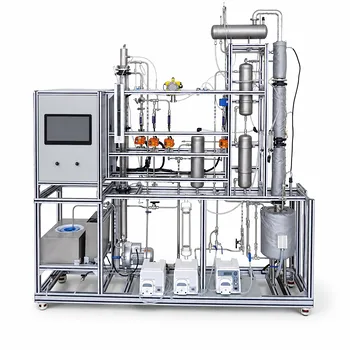
Selecting the wrong membrane material doesn't just compromise your experiment—it can destroy the membrane entirely. In chemical engineering pilot plants for solvent recovery, the membrane is in direct, prolonged contact with aggressive organic solvents. If the material isn't chemically compatible, it will swell, dissolve, or lose its selective nanoporous structure, making separation impossible and yielding useless data. The criticality lies in ensuring the membrane's structural integrity and consistent molecular weight cut-off (MWCO) under harsh process conditions, which is fundamental for safe, realistic, and repeatable pilot-scale research.
Conventional polymer membranes fail catastrophically in organic solvents, but solvent-stable materials like crosslinked polyimides and advanced composites maintain their separation properties. In a pilot plant, this stability directly determines whether your solvent recovery data is scalable, your experiments are safe, and your results are educationally meaningful.
Understanding the Core Problem: Membrane Failure in Organic Solvents
The explicit need is to recover solvents, but the deep need is to generate reliable process data that can scale. A membrane that is not solvent-stable endangers everything.
The Mechanism of Membrane Failure
Standard polymer membranes, such as polyamides or polysulfones, are a disaster waiting to happen when exposed to organic solvents. The solvent molecules penetrate the polymer matrix, causing it to swell uncontrollably. This swelling can collapse the selective pores or even dissolve the membrane completely.
Once the pore structure changes, the molecular weight cut-off (MWCO) becomes unpredictable. You might reject molecules you intended to pass, or worse, lose your product into the permeate stream. This instability makes designing a realistic process simulation impossible.
The Direct Impact on Pilot Plant Validity
A pilot plant's purpose is to mirror industrial reality at a smaller scale. If your membrane's performance drifts because the material is degrading, your material balance, mass transfer correlations, and pressure drop data are all corrupted. You are no longer studying solvent recovery—you are studying an uncontrolled material failure.
This is particularly critical in educational settings where students must observe steady-state unit operations. An unstable membrane undermines the learning outcome, turning a controlled experiment into an exercise in troubleshooting equipment failure rather than mastering separation science.
Selecting Materials That Withstand the Chemical Environment
The solution is to use solvent-stable membrane materials engineered at the polymer level to resist attack. This transforms the membrane from a liability into a reliable research tool.
How Advanced Polymers Maintain Performance
Advanced materials like polyphenylene oxide-derived composites, crosslinked polyimides, and polybenzimidazoles (PBI) are chosen because their molecular structure resists solvent penetration. The extensive crosslinking creates a rigid, network-like architecture that prevents swelling.
This structural rigidity directly preserves the consistent MWCO mentioned in the primary reference. Whether you are concentrating a catalyst or purifying a pharmaceutical intermediate, you can trust that the membrane will reject the same molecular weight range at hour one and hour one hundred of your pilot campaign.
Matching Material Chemistry to the Solvent Matrix
The chemical stability must be verified for your specific solvent mixture. A material stable in acetone might still degrade in toluene or tetrahydrofuran (THF). Crosslinked polyacrylonitrile (PAN) is one example of a polymer that provides stable performance across alcohols, ketones, alkanes, and aromatics, but this is not a universal rule.
You also need to match the hydrophilic or hydrophobic nature of the membrane with the target solute. A mismatch can cause fouling or a loss of selective transport even if the material remains structurally intact. The MWCO, typically in the 250–700 g/mol range, must align with the solute you aim to retain, ensuring an efficient and predictable separation.
Understanding the Trade-offs
No single material solves all problems. An expert view requires balancing competing priorities, which itself is a key learning objective in a pilot plant.
Polymeric vs. Inorganic/Ceramic Membranes
Polymeric membranes like crosslinked PVA offer processability and lower cost but have inherent temperature and chemical limits. While crosslinking with agents like glutaraldehyde improves thermo-mechanical stability, many solvent-stable polymers are still restricted to milder organic streams or require specific catalyst systems to prevent premature failure.
Inorganic ceramic membranes (silica, zeolite) provide near-universal chemical stability and high-temperature tolerance. They are the gold standard for emulating industrial esterification or harsh solvent processes. However, they are brittle, expensive, and require specialized module housing—a significant cost burden for an educational pilot plant. The fragility also increases the risk of catastrophic failure during student handling.
The Cost of Stability and Safety
Closed-loop recovery systems with explosion-proof (ATEX) components add to the capital cost but are non-negotiable when working with volatile solvents. Integrating a chemically stable membrane into a system with pressure relief valves, vapor monitoring sensors, and rupture discs is what separates a instructive pilot plant from a hazardous bench-top set-up.
The trade-off is between upfront investment and the ability to safely simulate industrial mass balances with real solvents. Cutting corners on either membrane stability or system safety leads to an experiment that teaches the wrong lesson—how to survive an avoidable failure rather than how to design an efficient, safe process.
Making the Right Choice for Your Pilot Plant Goal
The selection of a membrane material must be driven by the specific research or educational objective. There is no universal "best" material, only the most appropriate one for your context.
- If your primary focus is high-fidelity industrial simulation with harsh solvents: Choose inorganic ceramic membranes or the most chemically resilient crosslinked polyimides despite the higher cost. The data will be scalable, and the experiment will reliably mirror a production environment.
- If your primary focus is a cost-effective educational platform with common organic solvents: Opt for a well-characterized polymeric material like crosslinked PAN or polyimide composites, carefully matched to your specific solvent. This balances experimental validity with budget constraints.
- If your primary focus is teaching fundamental mass transfer relationships: Prioritize a membrane with a precisely known and unchanging MWCO. The material's absolute chemical rating is less important than its stability, which ensures students can calculate a meaningful separation factor (alpha) from steady-state data.
Ultimately, the membrane material is not a disposable component; it is the very heart of the separation. Selecting it critically means building a pilot plant that generates truth, not just data.
Summary Table:
| Membrane Type | Key Advantages | Main Limitations | Best Suited For |
|---|---|---|---|
| Solvent-Stable Polymeric (e.g., PAN, Polyimides) | Cost-effective, good processability, customizable MWCO | Limited temperature and chemical resistance | Educational labs, standard organic solvent recovery |
| Inorganic / Ceramic (e.g., Silica, Zeolite) | Near-universal chemical stability, high temperature tolerance | Brittle, high capital cost, requires specialized housing | Industrial scale-up simulation, harsh chemical reactions |
Need a high-performance pilot plant that guarantees accurate, safe, and scalable experimental data? LABPARK provides premium Educational and Vocational Unit Operations Pilot Plants in chemical engineering, bioprocess & biotech, and environmental & water treatment. Designed specifically for universities, research institutes, and enterprises, our systems feature robust, chemically compatible components to prevent equipment failure and ensure steady-state learning. Contact us today to customize your pilot plant solution!
Related Products
People Also Ask
- How does operating pressure influence the transition between absorption and desorption in a CO2 pilot plant?
- How do temperature variations affect CO2 transport models in pilot plants? Model vs Reality
- What unit operations are critical for CCUS training pilot plants? Build hands-on engineering expertise.
- How do electrolytes affect phase equilibrium in absorption pilot plants, and how to calculate it?
- Why is critical surface tension key in column internals? Optimize gas absorption pilot plant efficiency