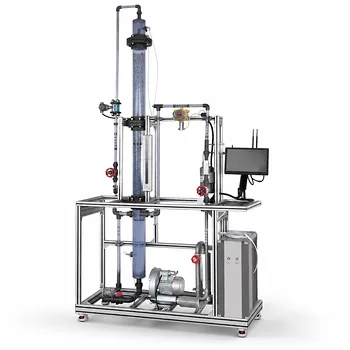
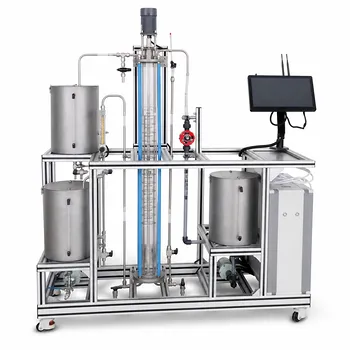
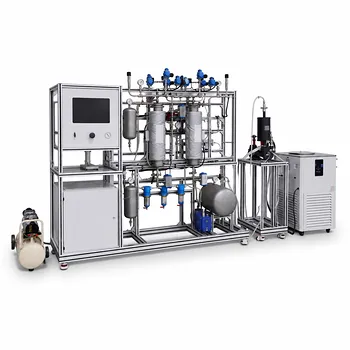
The single greatest threat to your pilot plant data is liquid channeling, and this is precisely why you must limit the height of a packed section. The necessity comes down to mass transfer physics: as liquid flows down, it naturally wants to find a preferential path. In a bed taller than about 10 feet, this maldistribution becomes severe enough to slaughter separation efficiency. Good engineering practice therefore dictates keeping individual packed beds between 6 and 8 feet, with a hard maximum of 10 feet, and installing a high-quality liquid redistribution tray between each section.
Pilot-scale packed columns fail when you treat them like scaled-down towers. The core rule is absolute: the height of any single packed bed must be physically limited to prevent liquid channeling. For pilot plants, this means enforcing a section height of 6 to 8 feet (max 10 feet). Without a liquid redistributor every 8 feet, your column’s efficiency plummets and your experimental data becomes meaningless.
The Fundamental Problem: Liquid Channeling and Maldistribution
In a packed column, the intimate contact between gas and liquid is what drives separation. Any disruption to that uniform contact directly undermines your pilot plant’s purpose.
What is Liquid Channeling?
Channeling is the natural tendency of liquid to flow toward the column wall and form localized, high-flow streams. As liquid moves down, it breaks free from the packing’s torturous path, migrating to the column’s perimeter where resistance is lower. This leaves large areas of the packing dry, drastically reducing the active surface area available for mass transfer.
Why Taller Beds Guarantee Failure
The problem is exponentially worse when liquid-vapor loading falls to 70% or less of the design capacity. In pilot plants, you are frequently operating at turndown ratios to simulate various scenarios, which makes this condition a common reality. With every extra foot of packing height, the liquid has more time and distance to consolidate into these destructive channels, rendering the bottom portion of the bed nearly useless.
The Cascading Consequences of Ignoring the Limit
Allowing a packed bed to exceed its recommended height doesn’t just reduce efficiency slightly; it creates a cascade of failures that can compromise safety and data integrity.
Degraded Mass Transfer Efficiency
The direct and measurable consequence is a collapse in your Height Equivalent to a Theoretical Plate (HETP). A 12-foot bed will not perform like a 12-foot bed; it might perform like a 6-foot one. Your empirical mass transfer correlations will show severe deviation from known models, and your separation will fail to meet its target. You won't just get worse data—you'll get the wrong data, leading to incorrect scale-up calculations.
Structural and Physical Risks
Beyond process efficiency, there is a purely mechanical limit. In larger pilot or demonstration columns, the weight of the packing itself becomes a risk. Excessively tall beds create immense compressive loads on the packing support plate and lateral stress on the column wall. This can physically crush the bottom layers of packing, leading to increased pressure drop, flooding, and catastrophic structural damage.
The Analog from Liquid-Liquid Extraction
The principle is universal across unit operations. In liquid-liquid extraction columns, the phenomenon is identical but the mechanism is coalescence. As dispersed droplets travel further, they coalesce into larger slugs, destroying the interfacial area for mass transfer. The industry’s solution is the same: limit bed height to 6 to 10 feet and install redistribution trays. This cross-discipline consensus proves the concept isn't a recommendation—it's a physical constraint.
The Design Prescription for Reliable Pilot Columns
Knowing the "why" dictates a very specific "how." Your primary defense is mechanical design, not operational hope.
The Golden Rule: 6 to 8 Feet per Section
Your default specification for any standard pilot-scale packed bed should be a depth of 6 to 8 feet. This is the proven range where the forces driving liquid distribution—surface tension and gravity—can be managed. Always treat 10 feet as an absolute maximum for a single bed without intermediate redistribution. Cross this line, and you are operating in a known failure zone.
The Critical Role of Liquid Redistributors
A packing support can't double as a redistributor; you need a dedicated device. A high-quality liquid redistributor must be installed at the top of every packed section. Its sole job is to collect the channeled wall-flow, remix the liquid, and distribute it uniformly back across the cross-section of the next bed below. This resets the clock on maldistribution for each section.
The Addendum for Different Packing Types
The exact allowable height can also be a function of the column’s diameter, depending on the packing you choose. For older, less efficient Raschig rings, the bed height should not exceed 3 times the column diameter due to their extremely poor liquid spreading capability. With high-performance Pall rings or modern structured packing, this ratio increases to 8 to 10 times the column diameter. This provides a useful secondary design check, but the absolute 8-foot-per-section limit remains the safest standard for a pilot plant.
Understanding the Trade-offs and Practical Nuances
The rule is firm, but its application requires a systems-thinking approach. Adding more redistributors isn't free.
The Geometry Balancing Act
Limiting section height directly impacts your total column height. Since you must add space for redistributors between each bed, a tower with three 8-foot beds will be significantly taller than a single 24-foot bed. This creates a trade-off against structural support, structural cost, and roof height limitations in the laboratory. For gas systems in particular, you must also maintain a minimum column height-to-diameter ratio of at least 3:1 to ensure a sharp mass transfer zone and prevent bypassing.
Distributors Are Not a Silver Bullet
A poorly designed or partially clogged distributor is worse than none at all. It can create a "hard" maldistribution that persists through the entire subsequent bed. The design challenge isn't just adding a device; it's ensuring the distributor operates within its turndown ratio and that the liquid feed is free of particulates. This places a high premium on distributor selection and maintenance in the pilot plant.
Making the Right Choice for Your Pilot Plant Goal
Your specific objectives will define how rigidly you must adhere to these limits. Use this guide to align your design with your end goal.
- If your primary focus is generating scalable data for process design: Respect the 6-8 foot section limit and ensure 100% redundancy in your redistribution design. Any efficiency lost to channeling here will multiply into a billion-dollar mistake at full scale.
- If your primary focus is operability and long-duration testing: Stick to the 8-foot maximum but prioritize structural robustness. Ensure your support plates and column wall can handle the weight, and schedule regular inspection of distributors for fouling or damage.
- If your primary focus is testing the physical limits of a new, high-efficiency packing: Use the 10-foot limit as a stress-test benchmark, but instrument each section with pressure taps and liquid sampling ports. This allows you to detect the precise onset of channeling and establish the true, data-backed limits for that specific packing type.
Your pilot column is a scientific instrument; don't let a fundamental design flaw in bed height destroy the signal before you even start collecting data.
Summary Table:
| Parameter | Design Recommendation | Key Purpose / Reason |
|---|---|---|
| Recommended Bed Height | 6 to 8 feet (10 feet absolute max) | Prevents severe liquid channeling and efficiency loss |
| Liquid Redistributors | Install at the top of every packed section | Collects wall-flow and resets liquid distribution |
| Height-to-Diameter Ratio | Minimum 3:1 for gas systems | Prevents bypassing and ensures sharp mass transfer |
| Packing Height Limits | ≤ 3x diameter (Raschig) / 8-10x (Pall/Structured) | Accommodates different packing liquid-spreading abilities |
Need Reliable Pilot Plants for Your Research or Training?
Ensure your experimental data is accurate and scalable with professionally designed systems. LABPARK provides premium Educational and Vocational Unit Operations Pilot Plants in chemical engineering, bioprocess & biotech, and environmental & water treatment.
Whether you are a university, research institute, or enterprise, we design and build systems that eliminate critical engineering flaws—like liquid channeling—to guarantee precise, repeatable results.
Contact LABPARK today to discuss your project requirements and get a customized solution for your lab!
Related Products
- Packed Bed Absorption Educational Unit Operations Pilot Plant
- Absorption and Desorption Educational Unit Operations Pilot Plant
- Multimodal Absorption and Desorption Pilot Plant for Unit Operations Training
- Continuous Batch Extractive Distillation Educational Pilot Plant
- Educational Rotary Disc Liquid-Liquid Extraction Pilot Plant
People Also Ask
- How Do Flow Regimes Transition in Packed Bed Pilot Plants? Key Scale-up Insights
- How does reactant concentration determine absorption column control? Gas-film vs. dual-film.
- How is the packing height of an absorption column calculated? Master HTU & NTU Concepts
- How does static vs. operating holdup affect pilot plant calibration? Avoid Critical Scale-Up Errors
- Why is counter-current flow selected for gas absorption? Maximize Pilot Plant Efficiency