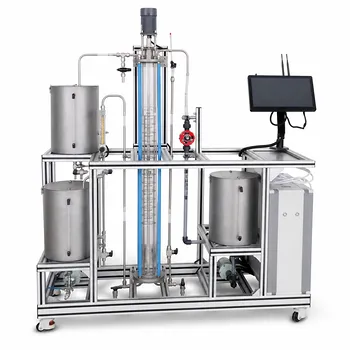
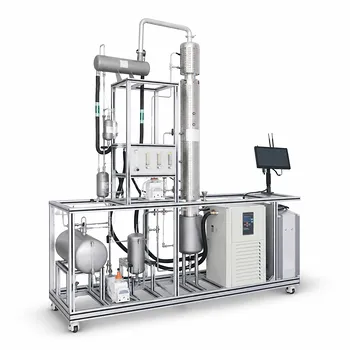
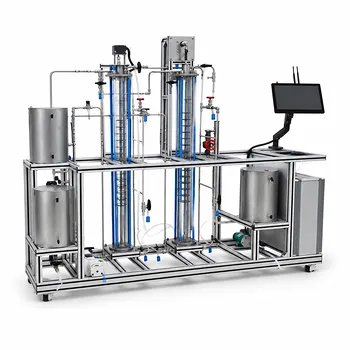
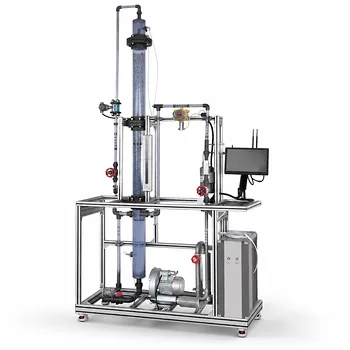
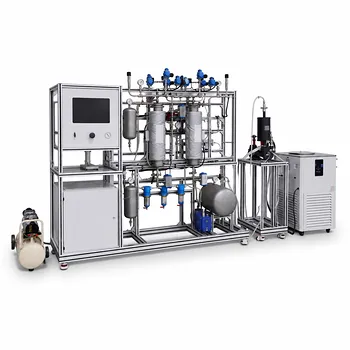
Nearly equal active area flood and downcomer flood percentages are not a design nicety—they are a fundamental requirement for stable, high-efficiency operation. When a fractionation tray is designed with a balanced flood percentage (for example, both hovering around 70–73%), neither the active area nor the downcomer becomes a premature hydraulic bottleneck. This balanced loading maximizes the tray’s overall vapor‑liquid contact effectiveness, prevents localized flooding, and ensures the pilot plant can collect reproducible, high‑quality separation data across a wide range of throughputs.
A truly efficient tray uses every inch of its capacity. Balancing active area and downcomer flood percentages ensures no single zone limits the column prematurely. This eliminates hydraulic weak points, delivers consistent efficiency from high rates down to low turndown conditions, and gives pilot‑plant operators the stable, interpretable performance needed for both research and education.
Understanding the Two Flooding Mechanisms
A tray in a fractionation column has two distinct zones that can fail under excessive traffic. Recognizing how each one floods is the first step to seeing why balance matters.
The Active Area (Jet and Entrainment Flood)
The active area is the region where vapor rises through the liquid on the tray, creating a froth. Flooding here occurs when vapor velocity becomes so high that it entrains significant amounts of liquid upward or when the froth level fills the entire tray spacing.
This jet‑flood mechanism is governed by the tray loading factor and the curve‑fitted capacity factor, which account for tray spacing and liquid surface tension. In a pilot plant, active area flood is often the limiting mechanism at high vapor loads.
The Downcomer (Backup Flood)
Downcomers convey liquid from the tray above to the tray below. If the downcomer’s cross‑sectional area is too small or the liquid flow is too high, the liquid backup height (the clear liquid level in the downcomer) rises. Once the backup exceeds the downcomer height plus the tray spacing, liquid spills onto the tray above, causing downcomer flood.
In multi‑pass trays, a mismatch between downcomer areas creates a choked downcomer—the smallest one floods first, dragging the entire column into failure even if other downcomers are underutilized.
Why Balancing Them Eliminates Hydraulic Bottlenecks
A tray’s true capacity is set by whichever mechanism hits its limit first. When active area flood and downcomer flood percentages are nearly equal, that limit is reached simultaneously, and the tray cannot be compromised by a weak link.
No Premature Capacity Limit
With an unbalanced design, a tray might show 85% active area flood while the downcomer floods at only 60%. At the 60% point, the column floods prematurely. An operator sees poor performance and may wrongly assume the entire tray is at its limit. Balanced percentages mean the observed flood point genuinely reflects the tray’s total hydraulic capacity.
Enhanced Vapor‑Liquid Contact
When both zones are equally loaded, the froth height on the active area remains even and the downcomers deliver a steady, non‑pulsing liquid seal. This uniformity maximizes interfacial area and mass transfer efficiency during experimental runs. Any imbalance leads to asymmetric flow patterns, dripping downcomers, or localized weeping, all of which degrade separation efficiency.
Smooth Operation Across Turndown
Pilot plants often need to operate at low loads—educational demonstrations may run below 50% flood. A design balanced at high loads translates proportionally to balanced behavior at low loads. The column avoids dead zones and maintains stable hydraulics, which is critical when teaching students about distillation fundamentals.
The Critical Impact on Experimental Reliability
A pilot plant’s primary purpose is to generate trustworthy data. Hydraulic imbalance introduces hidden variables that undermine experimental integrity.
Reproducible Rate‑Limiting Data
When active area and downcomer flood percentages are nearly equal, the maximum throughput is clearly defined by the tray’s inherent capability. Researchers can establish a true flooding point without confounding effects. Every experimental run operates under known, consistent hydraulic conditions.
Avoiding Misinterpretation of Flood Signs
If downcomer flood occurs first due to a poorly sized downcomer, an inexperienced operator might misinterpret the differential pressure spike and loss of efficiency as an active area limitation. Balancing the flood percentages removes this ambiguity, making the cause‑and‑effect relationship crystal clear for both teaching and data analysis.
Balanced Multi‑Pass Tray Behavior
In multi‑pass trays, equal flood percentages among all downcomers is a direct outcome of balanced design. This prevents asymmetrical loading that would distort measured tray efficiencies and confuse students learning about tray hydraulics.
Understanding the Trade‑offs
Balancing flood percentages is ideal, but every design decision involves compromises. Over‑emphasizing perfect equality can create other problems.
The Cost of Excess Downcomer Area
To pull a low‑flood downcomer up to match the active area’s percentage, you must reduce the active area. A larger downcomer region shrinks the bubbling area, potentially lowering tray efficiency. A truly optimized design finds the economic balance where removing a few percent of active area doesn’t cause an unacceptable efficiency drop, while gaining significant hydraulic stability.
Turndown and Weeping Limits
A tray balanced for high flood rates may weep excessively at extremely low loads if the active area is too small. Pilot‑plant trays must consider the entire operating range, not just the design point. Sometimes a slight imbalance is acceptable if it guarantees a minimum liquid seal down to the lowest expected throughput.
Conservatism in Educational Plants
In teaching labs, students intentionally push columns toward flood. An overly balanced design could mask early warning signs, making it harder to demonstrate the difference between active area and downcomer flooding. A controlled but observable separation between the two flood points can be an instructional advantage, as long as the tray never fails unexpectedly.
Making the Right Choice for Your Pilot Plant Goals
The optimal flood balance depends on what you need the column to do. These guidelines help you decide.
- If your primary focus is producing highly reproducible separation data across a wide throughput range: Aim for near‑equal active area and downcomer flood percentages at the design rate. This eliminates hydraulic bottlenecks and ensures every experimental run reflects the tray’s true intrinsic performance.
- If your primary focus is teaching and demonstrating hydraulic limits: A slight, observable separation between the two flood points can be beneficial. Just ensure the first flood occurs at a high enough percentage (>75%) that the column isn’t needlessly crippled, and always label the actual limiting mechanism for the students.
- If your primary focus is operating safely at very low turndown (below 40% flood): Prioritize minimum active area weeping resistance. A small downcomer flood percentage deficit at the high end is acceptable if it guarantees stable liquid flow at low loads.
- If your pilot plant uses multi‑pass trays: Downcomer balance is non‑negotiable. Design for equal backup height and flood percentage across all passes to avoid a single choked downcomer dragging the whole column down.
A fractionation column that balances its flooding limits transforms from a fragile, misunderstood system into a predictable, teachable, and powerful tool for separation science.
Summary Table:
| Flooding Type | Key Cause | Operational Impact |
|---|---|---|
| Active Area Flood | Excessive vapor velocity & liquid entrainment | Froth fills tray spacing; degrades separation |
| Downcomer Flood | Liquid backup due to flow restriction | Liquid overflows onto upper tray; column failure |
Optimize Your Unit Operations Training and Research
Are you looking to equip your laboratory with high-performance, reliable distillation systems? LABPARK provides premium Educational and Vocational Unit Operations Pilot Plants in chemical engineering, bioprocess & biotech, and environmental & water treatment.
Designed specifically for universities, research institutes, and enterprises, our systems ensure precise hydraulic control, reproducible experimental data, and stable operation for both advanced research and hands-on education.
Contact LABPARK today to discuss your laboratory requirements and get a customized pilot plant solution!
Related Products
- Multi-Modal Distillation Unit Operations Training Pilot Plant
- Educational Rotary Disc Liquid-Liquid Extraction Pilot Plant
- Continuous Sieve-Plate Distillation Pilot Plant for Unit Operations Laboratory Education
- Continuous Batch Extractive Distillation Educational Pilot Plant
- Comprehensive Liquid-Liquid Extraction Pilot Plant for Engineering Education
People Also Ask
- How can energy balance equations for condensers & reboilers be validated experimentally? Guide
- How can real-time carbon number prediction improve distillation pilot plants? Optimize control.
- Why is vacuum operation capability an essential feature for a distillation unit operations pilot plant? Unlock Efficiency
- How does catalyst water concentration affect distillation pilot plant design? Key separation train choices.
- What are the primary reflux ratio control strategies? Master Distillation Unit Operations