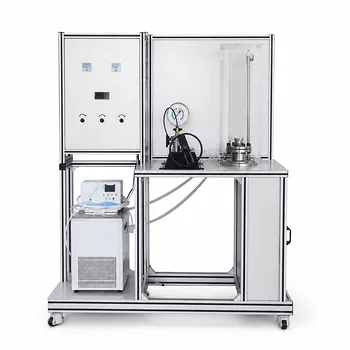
VSDs turn a pilot plant pump loop from an energy-wasting antique into a precision, future-ready teaching tool. Replacing traditional bypass control with variable speed drives in unit operations pilot plants directly eliminates the wasteful practice of recirculating fluid. This shift gives students hands-on experience with the dominant, energy-efficient flow control method used in modern industry, directly addressing green engineering and process optimization.
The core benefit of integrating VSDs over bypass control is twofold: it slashes energy waste by matching motor speed to actual demand, and it transforms a simple fluid loop into a powerful platform for teaching modern, sustainable process control. The pilot plant becomes a living lab where outdated practice meets future-ready technology, and students learn the “why” through direct measurement and comparison.
The Flaw with Traditional Bypass Control
Bypass control teaches the wrong lesson before a single data point is collected. It is a method of last resort that squanders energy while masking the true dynamics of a process loop.
How Bypass Wastes Energy
In a bypass loop, the pump runs at full speed continuously. The control valve simply recirculates a portion of the flow back to the suction side to achieve a lower net discharge. This means the motor is always drawing near-full-load power, even when the process only requires 20% of the design flow. The excess energy is dissipated as heat in the fluid, leading to poor overall system efficiency.
The Pedagogical Problem
Teaching by bypass alone presents an outdated industrial picture. Many legacy plants still use bypass lines for small, occasional trimming, but new process lines overwhelmingly favor variable speed drives. Relying on bypass control in a training environment fails to prepare students for the energy-conscious, digitally controlled world they will enter. It treats the pump as a black box, missing the opportunity to link motor speed, flow rate, and energy consumption.
How Variable Speed Drives Modernize Flow Control
A VSD changes the entire control philosophy. Instead of fighting a constant-speed pump with a valve, it directly regulates the pump’s motor speed, aligning the hydraulic energy delivered with what the process actually needs.
Direct Speed Regulation Eliminates Recirculation
A centrifugal pump’s flow is proportional to its rotational speed. A VSD adjusts the frequency of the power supplied to the motor, allowing the user to set any speed within the pump’s operating range. The control loop commands a speed, not a valve position. This makes the relationship between the control signal and flow inherently linear and stable. The bypass line is no longer the primary control element—it becomes a vestigial feature that can be shut off entirely.
Unlocking Radical Energy Savings
The affinity laws for centrifugal pumps show that power consumption drops with the cube of the speed. Reducing pump speed by 20% can slash power demand by nearly 50%. In a pilot plant running multiple experiments daily, the accumulated energy savings are significant and immediately measurable. Students can log electrical power at the VSD and directly contrast it with the fixed power draw of a bypass-controlled loop, turning an abstract principle into a hands-on sustainability lesson.
A Platform for Teaching Green Engineering
The VSD itself becomes a teaching instrument. Its display shows real-time frequency, current, and power data. Students can program speed profiles, simulate start-up curves, and study how process demand translates into electrical consumption. This bridges the gap between fluid mechanics and energy management, fostering a mindset where efficiency is designed into the process from the beginning—exactly the skill set demanded by modern industry.
The Educational Power of Side-by-Side Comparison
The greatest benefit in a pilot plant is the ability to run a controlled experiment, not just a single demonstration. Integrating VSDs unlocks the most impactful learning mode of all: direct, simultaneous comparison.
Demonstrating the Economic Trade-Offs
By equipping a pilot plant with both a VSD-driven pump loop and a traditional bypass or throttling valve loop, students can conduct side-by-side energy audits. They can measure the kilowatt-hours used to achieve the same flow rate in each configuration. One experiment reveals in minutes what textbooks require whole chapters to explain: that throttling losses and bypass recirculation carry a real, quantifiable cost. This transforms economic analysis from a spreadsheet exercise into a lab activity.
Teaching System Dynamics and Control
A VSD introduces new dynamics—acceleration ramps, deceleration control, and PID loop tuning on speed rather than valve position. When a pilot plant includes both a fast-acting control valve loop and a VSD loop, students can compare step-change responses, dead time, and system stability. This practical experience in tuning multi-loop systems and understanding actuator differences is directly transferable to process engineering roles.
Understanding the Trade-Offs
No technology is without its limitations. Presenting these honestly is essential for building genuine expertise, not just advocacy.
Increased Complexity and Initial Cost
A VSD is an electronic device with its own control parameters, cooling requirements, and potential failure modes. Teaching students to commission and troubleshoot a VSD is part of the value, but it adds complexity compared to a simple manual bypass valve. The capital cost of a VSD is also higher than a bypass line and valve. However, in a pilot plant environment where the primary goal is education, this cost is an investment in curriculum, not just hardware.
Not Every Application Favors VSD
For pumps that must run at full capacity for their entire service life, the payback from a VSD diminishes. Some high-pressure, low-flow duties may still require protection from minimum flow recirculation. A well-rounded unit operations program will acknowledge these edge cases and teach students when VSDs are the right tool and when they are not. Integrating bypass and VSD in the same skid allows exactly that nuanced discussion.
How to Apply This to Your Pilot Plant Design
Whether you are specifying a new unit ops plant or upgrading an existing one, the choice should always tie back to your learning objectives. Use the following guidance to shape your control architecture.
- If your primary focus is preparing students for modern industrial roles: Integrate VSDs as the primary flow control method for all centrifugal pump loops, and retain a manual bypass only for pump protection demonstrations. The exposure to drive programming and energy monitoring is non-negotiable for career readiness.
- If your primary focus is teaching energy management and sustainability: Include at least one side-by-side loop with a VSD-driven pump and a traditional bypass/throttling valve loop. Make the power meters prominently visible. Have students run an energy audit as a core laboratory and calculate the payback period for the drive.
- If your primary focus is in-depth process dynamics and control theory: Ensure the VSD can be switched between local speed control and a remote analog signal from your DCS. Pair it with a fast-acting control valve on another loop so students can compare the dynamic signatures and tune control loops on fundamentally different final control elements.
- If your primary focus is constrained by a tight budget: Prioritize one VSD on the most frequently used pump loop. Even a single drive transforms the plant’s teaching capability. The rest of the loops can use manual throttle valves, with the students calculating the energy that could be saved if a VSD were fitted, based on data from the instrumented loop.
A pilot plant that relies on bypass control alone is an archive; one that integrates VSDs is a laboratory for the future. The energy savings are real, but the learning outcome—producing engineers who instinctively optimize for efficiency—is the ultimate return on the investment.
Summary Table:
| Feature | Traditional Bypass Control | Variable Speed Drive (VSD) |
|---|---|---|
| Energy Efficiency | Low (continuous full-speed operation) | High (slashes energy waste by up to 50%) |
| Flow Regulation | Recirculates fluid via bypass valve | Directly regulates motor speed |
| Learning Value | Outdated industrial practice | Teaches green engineering & digital control |
| Initial Cost | Lower capital cost | Higher initial investment, but offers long-term ROI |
Ready to modernize your labs with energy-efficient, future-ready technology? LABPARK provides state-of-the-art Educational and Vocational Unit Operations Pilot Plants in chemical engineering, bioprocess & biotech, and environmental & water treatment. Tailored for universities, research institutes, and enterprises, our systems integrate modern VSD control loops to deliver hands-on, industry-aligned training. Contact our team today to find the perfect solution for your lab!
Related Products
People Also Ask
- How do temperature variations affect CO2 transport models in pilot plants? Model vs Reality
- What unit operations are critical for CCUS training pilot plants? Build hands-on engineering expertise.
- What are the applications and limitations of the Virial EOS? Enhance Your Pilot Plant Lab
- What precautions prevent sample loss when volatilizing silica with HF? Crucial Steps for Safe Lab Training
- Why is selecting the correct EOS critical in pilot plants? PR vs. SRK compared.