Agitation speed is not just a mixing parameter—it’s the master control knob for the crystal size, purity, and safety of your entire crystallization process.
In chemical engineering pilot plants, determining the correct agitation speed directly governs the particle size distribution (PSD) of the crystallized product. If the speed is too low, solids fail to suspend evenly, causing stratification and an undesirably broad PSD. If the speed is too high, excessive shear shatters crystals into fines, producing a bimodal PSD that ruins downstream processability. Getting this right is not just a tweak—it’s a foundational step that separates a scalable, robust process from a dangerous failure.
The correct agitation speed in a pilot plant ensures complete solids suspension without inducing crystal breakage—directly safeguarding the desired particle size distribution and preventing dangerous temperature gradients. Under-agitation leads to stratification, while over-agitation causes attrition; both sabotage product consistency and create significant safety risks.
How Agitation Directly Shapes Your Crystals
The primary reference makes it clear: agitation rate is the deciding factor between a uniform, workable product and a batch you can't filter, dry, or formulate. The physics at play are straightforward but unforgiving.
Under-Agitation: The Hazard of Stratification
When the impeller spins too slowly, it cannot lift all solid particles into a homogenous suspension. Crystals settle at the bottom, creating distinct zones of variable concentration.
This stratification starves some regions of fresh solute while overfeeding others, leading to growth dispersion. The result is a painfully broad particle size distribution—you get an unpredictable mix of fines and oversized particles. That mix will cause filtration times to skyrocket and batch-to-batch consistency to vanish.
Over-Agitation: When Shear Shatters Your Product
Crank up the RPMs too high, and the fluid dynamic forces become destructive. Crystal–impeller collisions and crystal–wall impacts dominate, with shear rates tearing corners off growing crystals.
The evidence is a bimodal particle size distribution: a population of undamaged large crystals alongside a spike of newly created fines. This attrition defeats the entire purpose of crystallization design, because fines create the same downstream headaches as excessive nucleation—including poor filtration and severe agglomeration.
The Hidden Consequences of Inadequate Mixing
While PSD is the headline metric, incorrect agitation speed creates secondary risks that are often more dangerous than a broad distribution. Pilot plant operators learn this fast: mixing isn't optional for thermal control.
Thermal Hazards: Why Agitation is a Safety Requirement
At larger scales, heat transfer is crippled without forced convection. Applying heat to a static or poorly agitated vessel creates a severe gradient: the liquid near the jacket or coil can far exceed the bulk temperature.
This localized overheating causes product baking, thermal decomposition, and even violent eruptions. Supplementary references highlight that without agitation, the temperature probe can’t read a representative value, masking a crisis until it’s too late.
Temperature Gradients and Out-of-Specification Products
Even if an eruption doesn’t occur, a stagnant zone’s temperature can alter solubility and nucleation rates locally. This leads to undesired polymorphs, unexpected crystal habits, or partial dissolution that ruins yield. The accurate temperature reading you rely on for cooling profiles depends on thorough mixing; poor agitation makes that reading a dangerous lie.
Leveraging Pilot Plants for Scale-Up Success
The reason we invest in unit operations pilot plants is precisely to find the agitation sweet spot before committing to production scale. The rules that keep a 1-liter beaker happy often fail at the 1000-liter reactor.
Three Key Agitation Scale-Up Criteria
The supplementary references outline three common strategies for scaling agitation, each with a specific formula and a specific weakness:
- Constant energy dissipation rate (P/V): Calculated as ( N_{\text{plant}} = N_{\text{lab}} \cdot s^{2/3} ), where (s) is the geometric scale factor (D_{\text{lab}}/D_{\text{plant}}). This is the preferred starting point because it balances mixture homogeneity and particle attrition.
- Constant just-suspended speed ((N_{js})): Scaled by ( N_{\text{js, plant}} = N_{\text{js, lab}} \cdot s^{0.85} ). It guarantees particles won't settle, but does not ensure chemical homogeneity at larger scales.
- Constant tip speed ((v_T)): Scaled linearly (( N_{\text{plant}} = N_{\text{lab}} \cdot s )). This almost always gives a speed that is too low to suspend solids, making it a frequent pitfall.
Using Agitation to Uncover Crystallization Kinetics
Beyond scale-up, pilot plants let you diagnose the rate-limiting step of crystal growth. By systematically varying stirrer speed and measuring how the growth rate responds, you can answer a critical question:
- If growth rate increases significantly with speed: The process is diffusion-controlled, meaning the boundary layer around each crystal is the bottleneck.
- If growth rate stays unchanged: The process is surface-reaction-controlled, and mixing alone won’t accelerate it.
This diagnostic capability transforms agitation from a guess into a scientific lever for process optimization.
Common Pitfalls to Avoid
Even with the right references, engineers fall into predictable traps. Here are the most damaging ones, pulled directly from the interplay of primary and supplementary data:
- Applying constant tip speed without verification: This scale-up criterion almost always undershoots the required suspension speed at larger scales, leading directly to stratification.
- Neglecting the heat transfer penalty: A speed that keeps solids suspended might still be insufficient for the convective mixing needed to avoid dangerous wall-to-bulk temperature differences.
- Focusing solely on PSD and ignoring kinetics: A perfect PSD obtained by sheer luck at one scale may stem from a diffusion-controlled mechanism that collapses at larger volumes. Use the pilot plant to identify the mechanism.
- Ignoring the balance of nucleation and growth: Too much agitation can shatter crystals into a cloud of secondary nuclei, effectively shifting the process toward excessive nucleation. This leads to fine particles that choke filters and ruin downstream handling.
Making the Right Choice for Your Pilot Plant Goal
Your next move depends entirely on what you’re trying to achieve. Frame your agitation study around these clear objectives:
- If your primary focus is product quality: Find the minimum agitation speed that guarantees complete suspension and no crystal breakage. Validate by checking PSD uniformity and checking for fines under the microscope.
- If your primary focus is creating a scalable recipe: Start with the constant P/V criterion, then verify minimum suspension visually and through temperature uniformity. Adjust upward only if needed.
- If your primary focus is fundamental understanding: Use variable speed sweeps to map the growth rate’s dependence on agitation and determine whether diffusion or surface integration controls your system.
- If your primary focus is safety: Never apply heat without agitation. Establish a low-speed alarm and interlock that cuts heat if stirring stops, because the temperature risk at pilot scale is orders of magnitude greater than in a flask.
Mastering agitation means balancing two opposing forces—suspension versus shear—with the full awareness that your choice also controls thermal safety and the very mechanism of crystal growth. Treat it as your primary design variable, and the rest of the process will follow.
Summary Table:
| Agitation Level | Crystal Size Distribution (PSD) | Thermal & Safety Risks |
|---|---|---|
| Under-Agitation | Stratification, broad PSD (uneven growth) | Localized overheating, product baking, hazard risks |
| Over-Agitation | Crystal breakage, bimodal PSD (fines increase) | Poor downstream filtration and agglomeration |
| Optimal Agitation | Uniform PSD, complete solids suspension | Stable heat transfer, representative temperature readings |
Scale Up Your Crystallization Studies with LABPARK
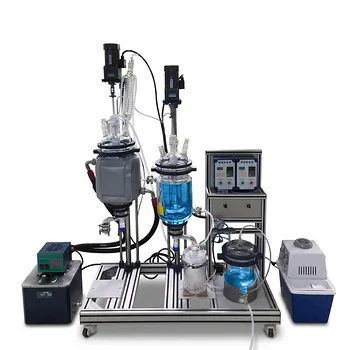
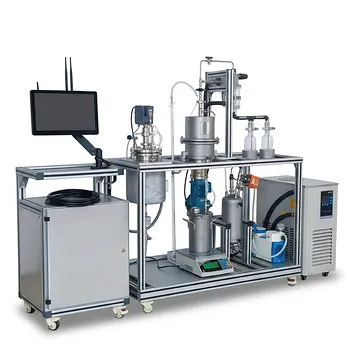
Achieving the perfect balance in crystallization kinetics and thermal safety requires reliable, industry-grade equipment. LABPARK provides state-of-the-art Educational and Vocational Unit Operations Pilot Plants specializing in chemical engineering, bioprocess & biotech, and environmental & water treatment.
Engineered specifically for universities, research institutes, and enterprises, our pilot plants empower you to accurately analyze critical parameters like optimal agitation speed, ensuring safe and seamless process scale-up.
Ready to elevate your research or vocational training? Contact LABPARK today to find the ideal pilot plant solution for your facility!
Related Products
- Potassium Salt Thermal Dissolution and Crystallization Separation Educational Unit Operations Pilot Plant
- Multi Functional Membrane Crystallization Educational Unit Operations Pilot Plant
- Supercritical High-Gravity Flash Evaporation Educational Unit Operations Pilot Plant
People Also Ask
- What are the benefits of integrating online PAT tools like ATR-FTIR into crystallization unit operations pilot plants?
- How do crystallization pilot plants improve student learning? Shift from manual observation to process control.
- Why is precise temperature control critical in crystallization pilot plants? Key to Scale-Up Success
- Control Crystallization Pilot Plant Secondary Nucleation: 4 Key Adjustments
- What key factors should be considered when configuring a crystallization unit operations pilot plant?