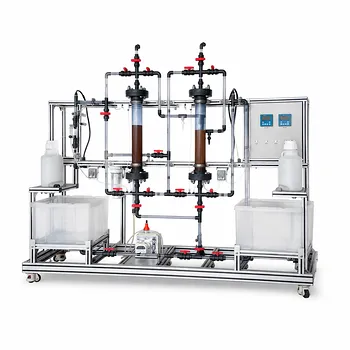
Tablet lamination is not a sign of insufficient pressure—it's a warning that you've pushed your material past its mechanical limit. In a unit operations compaction pilot plant, exceeding the optimal compressive force initially drives strong interparticle bonding by fracturing particles. But beyond a critical threshold, this force over-consolidates the powder bed, trapping internal stresses that exceed the material’s elastic recovery capacity. The result is a horizontal splitting of the tablet, known as lamination, as the compact cracks along weak shear planes during decompression.
Lamination from excessive force is fundamentally an over-consolidation failure. While moderate pressure increases bonding surface area, too much force reduces that area, causes particles to fuse into a brittle mass, and stores enough elastic energy to rip the tablet apart when the punch pressure is released.
The Two-Phase Relationship Between Compressive Force and Bonding
Initial Fracturing: The Bonding Boost
As compressive force rises, brittle powder particles fracture and deform. This fragmentation increases the specific surface area—the total surface available for interparticle contact. More fresh, clean surfaces mean more sites for van der Waals forces, mechanical interlocking, and solid bridges to form. The tablet’s tensile strength and hardness climb linearly through this phase.
The Over-Consolidation Collapse
The trend does not continue forever. Past an optimal force, the same compression that created bonding sites begins to destroy them. Extensive interparticle bonding can fuse particles together, causing a decrease in the specific surface area that was previously available. The particle bed enters a state of over-consolidation, where further force does little to increase true contact area and instead stores excessive elastic strain energy.
How Excessive Force Triggers Lamination
Exceeding the Material’s Elastic Limit
Every powder has a finite capacity to deform elastically and then recover. When compressive force is too high, the internal stress-strain indices—the stored energy per unit volume—cross this elastic limit. The material undergoes some irreversible plastic deformation, but a portion of the strain remains “locked in” as potential energy.
Release and Shear Failure
During decompression, the tablet expands as the punches retract. A well-compacted tablet relieves this stored energy uniformly. But an over-consolidated tablet cannot. The trapped elastic energy creates tensile stresses that are oriented perpendicular to the direction of compression. If these stresses exceed the weak interlayer bonding, horizontal cracks propagate, and the tablet splits into distinct horizontal layers—lamination. This is the same internal structural cracking described in pilot-scale observations.
The Role of Porosity Collapse
Higher compressive force drives down tablet porosity (Porosity = 1 – (apparent density / true density)). While reduced porosity initially strengthens the compact, it also makes the tablet less able to absorb and dissipate the stored elastic energy during decompression. The dense, brittle structure simply fractures rather than flexes.
Distinguishing Lamination from Capping
Different Defects, Different Drivers
Lamination (horizontal splitting) is often confused with capping (separation of the upper or lower tablet dome). While both can appear during ejection, their root causes differ. Lamination from excessive force is a volume-elastic-recovery problem, driven by the material’s inability to release stored stress. Capping, in contrast, is frequently tied to insufficient interlayer bonding from excessive fines, low moisture, or inadequate binders. The primary reference focuses on force-induced lamination, while supplementary references note that lamination can also be influenced by rapid compression speed and hydrophobic lubricants. In a pilot plant, isolating the cause is essential to avoid misdirected formulation changes.
Understanding the Trade-offs: When More Force Backfires
The Diminishing Returns of Hardness
Aiming for maximum hardness by simply raising compression force introduces a quality trap. Tablet hardness may plateau or even drop as microcracks form during lamination onset. The optimal mechanical strength sits within a narrow window where bonding is maximized but over-consolidation is not yet triggered.
Dissolution Rate Sacrifices
Lamination is not the only penalty. The extreme density reduction from over-consolidation slashes tablet porosity, which can severely hinder fluid penetration and slow drug dissolution. Balancing force to meet both mechanical and dissolution targets requires pilot-scale data, not guesswork.
Lubricant Sensitivity Magnified
High compression forces can exacerbate the effects of hydrophobic lubricants like magnesium stearate. Over-consolidation can spread lubricant films more uniformly across the fused particle surfaces, weakening interparticle bonds and collaborating with elastic recovery to cause lamination.
Applying This in a Pilot Plant Setting
Finding the Force Threshold
Pilot-scale compaction studies methodically identify the force at which lamination appears for a given formulation. By instrumenting the press to record punch force, displacement, and ejection stress, you can correlate force-displacement profiles with tablet integrity. The optimal region sits just before the point where elastic recovery causes measurable density reductions or visual cracking.
Crystal Structure Matters
The primary reference highlights that different crystal lattices (e.g., cubic vs. rhombohedral) exhibit different compression compatibilities. A rhombohedral material may fragment more readily and form strong bonds at lower forces, but also reach its elastic limit faster. Pilot plant runs with different polymorphs map these differences, preventing scale-up surprises.
Making the Right Choice for Your Compaction Process
- If your primary focus is preventing lamination: Target the compressive force that maximizes specific surface area without triggering over-consolidation. Use pre-compression, appropriate speed, and low lubricant levels to further reduce stored elastic energy.
- If your primary focus is achieving target tablet hardness: Map the hardness-force profile in the pilot plant, staying within the range where hardness increases linearly and no microcracks appear. Supplement formulation with dry binders if the optimal force window is too narrow.
- If your primary focus is balancing dissolution and mechanical strength: Use the porosity-force relationship to select a force that achieves the minimum acceptable porosity for dissolution while avoiding the drop-off in tensile strength that precedes lamination.
A successful compaction process treats compressive force not as a dial for more strength, but as a precise variable that must be tuned to the material’s inherent mechanical limits to build tablets that stay intact from press to patient.
Summary Table:
| Parameter | Optimal Compressive Force | Excessive Compressive Force (Over-Consolidation) |
|---|---|---|
| Specific Surface Area | Maximized through fracturing, increasing bonding sites | Decreased as particles fuse, reducing total bonding area |
| Elastic Strain Energy | Dissipated uniformly without damaging the tablet | High "locked-in" potential energy exceeding elastic limits |
| Tablet Porosity | Balanced to ensure mechanical strength and dissolution | Collapsed, creating a dense, brittle structure prone to cracking |
| Decompression Phase | Stable mechanical recovery and structure retention | Shear failure causing horizontal splitting (lamination) |
Master Unit Operations & Process Optimization with LABPARK
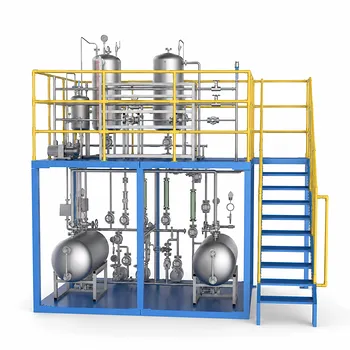
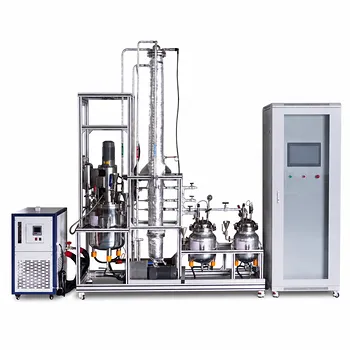
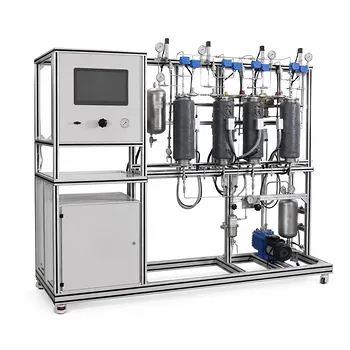
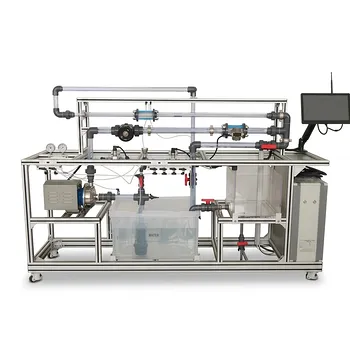
To prevent critical defects like tablet lamination, universities, research institutes, and enterprises need precise, hands-on control over compaction mechanics. LABPARK provides premium Educational and Vocational Unit Operations Pilot Plants in chemical engineering, bioprocess & biotech, and environmental & water treatment.
Our highly instrumented pilot plants enable students and researchers to analyze force-displacement profiles, identify material elastic limits, and scale up processes safely from lab to production.
Ready to elevate your department's research and training capabilities? Contact LABPARK today to explore our custom pilot plant solutions!
Related Products
- Natural Product Extraction Unit Operations Training Pilot Plant
- Fixed-Bed Chemical Reaction and Gas Dust Tar Removal Unit Operations Pilot Plant
- Multi Functional Membrane Crystallization Educational Unit Operations Pilot Plant
- Multi Pump Fluid Transport Process Piping Unit Operations Training Pilot Plant
- Constant Pressure Filtration Educational Unit Operations Pilot Plant
People Also Ask
- How to Demo Solubility Sensitivity in SFE Pilot Plants? Practical Thermodynamics
- How do pilot plants differentiate physical vs chemical extraction? Enhance Chemical Engineering Training
- How are HTU and NTU applied to determine extraction column height? Guide to Pilot Plant Scaling
- How can Hotelling's T² & Q statistics detect pilot plant abnormalities? Optimize Safety
- Why use split-plot designs in pilot plants instead of CRD? Optimize process parameters effectively.