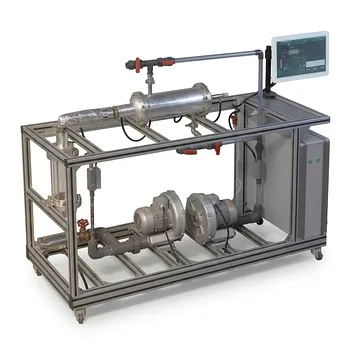
Spiral plate heat exchangers excel in pilot-scale unit operations training with high-fouling fluids or slurries because their single, curved channel inherently fights deposit buildup and delivers clear, analyzable heat transfer data.
A single, continuous spiral path replaces the many narrow gaps found in plate-and-frame or shell-and-tube designs. This geometry naturally creates high turbulence that scours the surface, while any initial deposition triggers a self-cleaning flushing effect that keeps the channel open. For educators and researchers, this means less downtime, simpler cleaning, and the ability to run long, repeatable experiments with challenging process fluids.
The defining advantage is the combination of a self-cleaning single spiral channel and pure counter-current flow with minimal pressure drop. In a pilot training system, this turns a hard-to-handle slurry or fouling stream into a teachable moment—showing how turbulence, residence time, and deposit formation directly impact thermal performance without constantly clogging the hardware.
How the Spiral Design Handles Fouling and Slurries
The Single-Channel Principle
A spiral plate heat exchanger is built from two long, parallel metal sheets rolled into a spiral to form one continuous flow channel for each fluid. There are no internal distributors, sharp corners, or stagnant zones where solids can settle.
This uninterrupted pathway keeps particles in suspension through consistent, high-velocity flow. In contrast, a shell-and-tube unit forces fluid through many small-diameter tubes that easily plug, while a gasketed plate exchanger has narrow, tortuous gaps that trap debris.
The Flushing Effect: Velocity as a Cleaning Mechanism
The spiral design’s signature self-cleaning behavior comes from a simple hydrodynamic feedback loop. If suspended solids start to form a deposit on the heat transfer surface, the local channel cross-section decreases.
Because the mass flow remains constant, the fluid velocity at the deposit immediately increases. This spike in velocity generates higher shear stress, which scours the fouling layer away and restores the channel opening. The exchanger effectively uses the very threat of clogging to prevent it—a key reason it can run long intervals with slurries that would blind most compact heat exchangers in hours.
Rapid, Accessible Cleaning When Necessary
Even when a full clean is required, the spiral format is easier to service than other compact options. The single, wide channel allows for flush cleaning or mechanical pigging if designed with an accessible cover.
In a training environment, this means students can disassemble (on selected models), inspect, and return the unit to service quickly. The absence of a bundle of hundreds of tubes or a stack of gasketed plates eliminates the tedious, error-prone reassembly typical of those designs.
Educational Value in Unit Operations Pilot Plants
Visualizing Heat Transfer Under Tough Conditions
Pilot-scale training systems are meant to mirror real industrial problems. Spiral plate exchangers let students observe how high-fouling fluids and slurries behave in a controlled way. Because the channel curvature continuously promotes secondary flow and turbulence, the thermal boundary layer remains thin, delivering heat transfer coefficients that are higher and more stable than in laminar-flow-prone designs.
This allows meaningful analysis of the overall heat transfer coefficient (U) and the impact of fouling resistance (Rf) over time. Students can track how U decays as a simulated fouling layer builds up and compare it to theoretical predictions.
Pure Counter-Current Flow with Low Pressure Drop
The spiral geometry naturally supports pure counter-current flow—a thermodynamic ideal that is often difficult to achieve in compact lab equipment. Combined with the relatively wide channel, the result is a low pressure drop that keeps pumping costs down and avoids disturbing the slurry’s settling behavior.
For an educator, this is a clean, well-defined system: the driving force for heat transfer is maximized and uniform, making energy balances straightforward to calculate and validate. The low pressure drop also means students can use small, safe pumps without compromising flow characteristics.
Understanding the Trade-offs and Limitations
Structural and Access Considerations
Not all spiral exchangers are created equal. A fully welded, non-dismantlable Type I design delivers the best pressure and leak integrity but makes internal inspection impossible. For training purposes, many pilot units instead use a Type II or III configuration where one channel is open along the side, allowing visual access or easier cleaning.
However, these open-side designs are typically reserved for vapor-liquid services like condensation. Selecting the right type for a slurry-based liquid-liquid experiment requires balancing the need for teaching flexibility against the risk of bypass leakage.
When Spiral Exchangers Are Not the Right Tool
While ideal for moderate flowrates and fouling-prone streams, spiral plate exchangers are not built for huge throughput. Their compact design inherently limits the flow cross-section, making them unsuitable for scaling up to full production capacities in a single unit.
Additionally, although self-cleaning is powerful, a sudden, massive solids dump (such as a test of an extremely thick, sticky slurry) can still overwhelm the flushing effect. In those cases, a wide-gap plate-and-frame or a scraped-surface exchanger might be a better demonstration tool. The key is to match the exchanger’s self-cleaning capability to the expected fouling rate and particle characteristics of the training fluid.
How to Specify a Spiral Exchanger for Your Training System
Choosing the right unit for a pilot-scale training module means aligning the hardware with your educational objectives and fluid challenges.
- If your primary focus is demonstrating self-cleaning behavior with slurries: Select a spiral exchanger with a single wide channel and, if teaching maintenance, a design that allows side-cover removal for visual inspection. Use fluids with known, reproducible fouling tendencies.
- If your primary focus is teaching heat transfer fundamentals under non-ideal conditions: Leverage the pure counter-current flow and low pressure drop to build clean energy balance experiments. Measure U and Rf over time and let students see the direct effect of fouling resistance on area margins.
- If your primary focus is easy turnaround between student groups: Prioritize models that can be flushed in-place or quickly opened. The single-channel path makes a high-velocity water flush far more effective than on multi-pass plate units, reducing lab downtime.
A spiral plate heat exchanger turns a complex, messy problem into a robust, predictable teaching tool—giving students the intuition they need to tackle real-world fouling in their future plants.
Summary Table:
| Feature | Mechanism / Advantage | Educational & Practical Value |
|---|---|---|
| Single-Channel Design | No bypass or stagnant zones; maintains fluid velocity | Prevents particle deposition and clogging |
| Self-Cleaning Effect | Velocity increases at restrictions to scour deposits | Minimizes downtime during student lab sessions |
| Counter-Current Flow | Maximizes thermodynamic driving force | Simplifies energy balance calculations for students |
| Low Pressure Drop | Employs a wide, curved channel path | Allows safe operation with smaller pilot pumps |
Elevate Your Engineering Labs with LABPARK
To prepare the next generation of engineers for real-world industrial challenges, you need reliable, industry-standard equipment. LABPARK designs and provides premium Educational and Vocational Unit Operations Pilot Plants in chemical engineering, bioprocess & biotech, and environmental & water treatment.
Our pilot systems—customized for universities, research institutes, and enterprises—ensure hands-on mastery of complex thermal, fluid, and biological processes.
Contact our experts today to design the perfect unit operations pilot plant for your curriculum!
Related Products
- Shell and Tube Heat Exchanger Heat Transfer Coefficient Determination Educational Pilot Plant
- Three-Tube Heat Transfer Educational Pilot Plant for Unit Operations Training
- Comprehensive Multi-Modal Heat Transfer Unit Operations Pilot Plant for Engineering Training
- Dual Mode Heat Transfer Pilot Plant for Unit Operations Training
- Solid Spherical Heat Transfer Coefficient Determination Educational Chemical Engineering Pilot Plant
People Also Ask
- Why Apply LMTD Correction in Shell-and-Tube Pilot Plants & How to Determine It
- Why adjust baffle spacing in shell-and-tube heat exchanger pilot plants? Master heat transfer & pressure drop.
- How to Estimate Shell-Side Pressure Drop in a Shell-and-Tube Heat Exchanger Pilot Plant: Key Parameters Explained
- How is the fouling factor (Rd) evaluated? Key Pilot Plant Insights for Students
- How is fouling factor demonstrated using shell and tube pilot plants? Practical Lab Guide