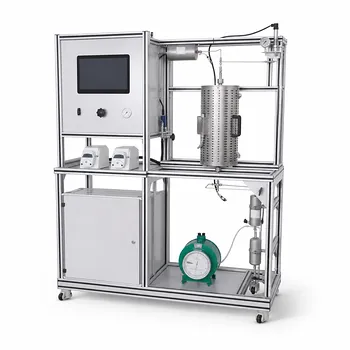
Unlocking efficient biocatalysis in a pilot plant hinges entirely on one critical factor: how well you can hold onto your enzyme. For bioprocess unit operations, the three primary reactor configurations integrated to optimize enzyme retention are membrane reactors for soluble enzymes, fixed-bed (packed bed) reactors for immobilized enzymes, and fluidized-bed reactors for suspended immobilized enzyme particles. Each of these systems solves the same core challenge—physically keeping the costly biological catalyst in a high-concentration reaction zone while letting reactants and products flow continuously through the system.
The fundamental goal is to decouple the catalyst's physical location from the product stream. Membrane reactors achieve this with a size-exclusion barrier, while fixed-bed and fluidized-bed reactors trap the catalyst within a stationary or suspended solid matrix. The choice between them dictates your process's mass transfer efficiency, pressure drop, and tolerance for substrate particulates.
The Three Pillars of Enzyme Retention in Pilot Plants
The primary reference defines these configurations clearly. To understand their integration, we must see each not just as a vessel, but as a specific strategy for enzyme lifecycle management.
Membrane Reactors: The Physical Barrier for Soluble Enzymes
This configuration is the method of choice when working with soluble enzymes that cannot or should not be immobilized. A semi-permeable membrane creates a selective physical barrier.
The reactor is coupled with a separation loop, typically using cross-flow filtration, ultrafiltration (UF), or nanofiltration (NF). The reaction mixture is pumped tangentially across the membrane surface. Smaller product molecules pass through as permeate, while larger enzyme molecules are retained and recycled directly back into the bioreactor.
The supplementary references break this down into three practical sub-configurations found in pilot plants:
- Retention of Mobile Catalysts: An external UF/NF membrane loop physically traps the enzyme in the system. This is highly relevant for aqueous-phase bioconversions common in bioprocessing.
- Immobilized Catalyst in Membrane: The enzyme is entrapped directly within the porous structure of the membrane, combining immobilization and separation.
- Catalytically Active Membrane: The membrane material itself acts as the catalyst, often seen with inorganic membranes like palladium or zeolites, though less common for classical enzymatic work.
Fixed-Bed Reactors: High-Density Entrapment
This configuration relies on packing a column with immobilized enzymes or whole cells. The solid catalyst particles are held stationary, creating a fixed bed through which the liquid substrate flows.
The key advantage for retention is its simplicity. The catalyst is permanently housed within the column, enabling truly continuous operations with easy separation of the product stream. There is no need for a downstream filtration unit to recover the enzyme from the product, as the product exits the column cell-free.
This is the ideal platform for studying immobilization efficiency. Pilot plant operators can directly assess catalyst life, analyze mass transfer resistance under plug flow conditions, and observe reactor fouling over extended continuous runs.
Fluidized-Bed Reactors: Solving the Clogging Problem
A fluidized-bed reactor suspends immobilized enzyme particles using an upward flow of liquid. This dynamic suspension offers a superior solution when a fixed bed fails.
The core benefit for retention and operation is the dramatic reduction in pressure drop compared to a tightly packed column. Because the particles are in constant motion, the bed does not compress or clog easily. This enhances mass transfer and makes this reactor ideal for handling substrates that contain particulates or are viscous, where a fixed bed would quickly foul.
The supplementary references also note the semi-fluidized-bed variant, which provides optimal fluidization and mixing, allowing researchers to investigate enzyme kinetics under more complex fluid dynamic regimes.
Understanding the Trade-offs
No single reactor offers a perfect solution. Objective selection requires navigating a matrix of operational tensions.
The Fouling vs. Purity Paradox
Membrane reactors face the constant battle against concentration polarization and membrane fouling. While they guarantee complete enzyme retention, the permeate flux will decline over time due to enzymes and other macromolecules accumulating on the membrane surface. In contrast, fixed-bed reactors produce a cleaner product stream without a fouling-prone membrane, but the enzyme must be immobilized, which adds a process step and may alter kinetics.
Pressure Drop and Particle Integrity
Fixed-bed reactors suffer from high pressure drops, especially if the immobilized enzyme particles are soft, compressible, or irregular in shape. This can physically crush the catalyst carrier. Fluidized beds solve the pressure drop issue but introduce particle attrition. The constant collision of suspended particles in a fluidized bed can grind them down, generating fines that escape the reactor and contaminate the product.
Mass Transfer vs. Operational Complexity
Fixed beds offer plug-flow kinetics, which can be highly efficient, but suffer from internal and external mass transfer limitations if the substrate doesn't diffuse well into the pores of the immobilized particle. Fluidized beds enhance external mass transfer significantly, but the back-mixing can reduce overall volumetric productivity compared to a true plug-flow column. Membrane reactor loops add pumping and cleaning system complexity that a simple packed column avoids completely.
Making the Right Choice for Your Pilot Plant Goal
Selecting your pilot plant configuration must start with the biological catalyst's physical state and your primary learning or process objective.
- If your primary focus is studying soluble, costly enzymes under continuous flow: Choose a membrane reactor with a cross-flow ultrafiltration loop. This configuration trains users on permeate flux optimization and enzyme retention efficiency, directly modeling industrial systems where the enzyme's native state must be preserved.
- If your primary focus is maximizing long-term catalyst life and operational simplicity: Integrate a fixed-bed reactor. This is the gold standard for demonstrating continuous operations with immobilized enzymes or whole cells, providing straightforward catalyst separation and life-cycle analysis without a membrane.
- If your primary focus is handling viscous streams or eliminating pressure drop: Deploy a fluidized-bed or semi-fluidized-bed reactor. This setup offers the most forgiving entry point for feed streams with suspended solids and provides a powerful visual and analytical platform to teach fluidization dynamics and enhanced mass transfer.
- If your primary focus is a comprehensive educational comparison: Integrate all three configurations into a single pilot plant skid. This allows for a direct, hands-on, side-by-side analysis of enzyme kinetics, mass transfer resistance, and the economic trade-offs of each retention strategy under identical feed conditions.
The ideal bioprocess pilot plant is not defined by a single configuration, but by the strategic flexibility to demonstrate that effective enzyme retention is the cornerstone of economically viable, continuous biomanufacturing.
Summary Table:
| Configuration | Enzyme State | Retention Mechanism | Key Advantage | Main Challenge |
|---|---|---|---|---|
| Membrane | Soluble | Size-exclusion barrier (UF/NF) | Retains native soluble enzymes | Membrane fouling & polarization |
| Fixed-Bed | Immobilized | Stationary solid column | Continuous, cell-free product | High pressure drop & clogging |
| Fluidized-Bed | Suspended | Upward fluid flow suspension | Handles particulates, low pressure drop | Particle attrition (fines generation) |
Accelerate Your Bioprocess Education and Research with LABPARK
Ready to bring hands-on bioprocess engineering to life? LABPARK provides state-of-the-art Educational and Vocational Unit Operations Pilot Plants in chemical engineering, bioprocess & biotech, and environmental & water treatment.
Whether you are a university training the next generation of engineers, a research institute studying enzyme kinetics, or an enterprise scaling up biocatalysis, our customizable pilot plants offer the perfect platform to compare enzymatic configurations side-by-side.
Explore how we can enhance your teaching and research capabilities—contact us today to get started!
Related Products
- Multi Functional Catalytic Reaction and Reactor Evaluation Educational Unit Operations Pilot Plant
- Fixed-Bed Chemical Reaction and Gas Dust Tar Removal Unit Operations Pilot Plant
- Ethylbenzene Dehydrogenation Educational Unit Operations Pilot Plant
- Methanol Synthesis and Catalyst Performance Evaluation Educational Unit Operations Pilot Plant
- Multi-Stage Stirred Tanks in Series Residence Time Distribution and Mixing Performance Determination Educational Pilot Plant
People Also Ask
- What reaction engineering principles are shown in a catalytic reactor pilot plant? SO2 Oxidation Guide
- Why is FTIR integration in catalytic pilot plants important? Real-Time Student Insights
- How to analyze active metal distribution & identify catalyst poisoning in pilot plants? Expert Diagnostic Guide
- How do temperature limits and WHSV influence catalytic reactor optimization? Scale-Up Guide
- What operational insights do catalyst pellet concentration profiles provide? Optimize Reactor Yield