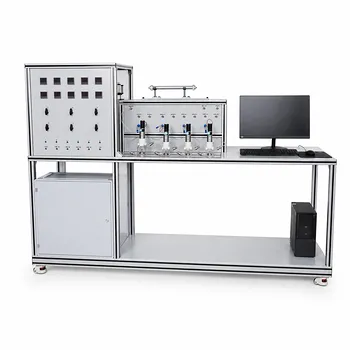
When teaching reactor design and maintenance economics, the choice between membrane-wall and refractory-wall gasifier configurations is a masterclass in balancing capital expenditure (CAPEX) against operational expenditure (OPEX). Refractory-wall systems offer a lower initial purchase price but demand frequent, costly lining replacements every 6 to 9 months, often requiring a redundant spare reactor to avoid crippling downtime. Membrane-wall designs invert this equation: they command a significantly higher upfront investment and suffer greater heat loss through the walls, yet the self-protecting slag layer eliminates refractory degradation, slashing long-term maintenance costs.
The defining trade-off is a classic CAPEX versus OPEX dilemma. Refractory-wall systems minimize initial cost but force a maintenance-heavy reality with built-in redundancy, while membrane-wall designs lock in long-term reliability at the price of a steep upfront commitment. In vocational training, this teaches that true equipment lifecycle economics are governed by total cost of ownership, not the sticker price.
Understanding the Two Gasifier Wall Configurations
Refractory-Wall: The Low-Cost Entry Point
A refractory-walled gasifier uses a thick insulating brick lining to protect the steel shell from high-temperature, corrosive slag. This lining is a consumable component.
The primary advantage is a lower initial capital investment. For a training environment, this makes it an attractive first build because equipment cost is immediately visible and seemingly manageable.
The glaring downside is extreme maintenance intensity. The refractory wears down rapidly, requiring complete replacement every 6 to 9 months under normal operation. In industrial practice, this forces plants to install a redundant spare reactor so that production continues while one unit undergoes relining.
Membrane-Wall: The High-Investment Long-Life Solution
A membrane-wall gasifier is constructed from a welded arrangement of high-pressure tubes. Cooling water or steam flows through these tubes, and the process instantly solidifies molten slag onto the inner surface.
This solidified slag forms a self-renewing protective coating that prevents the liquid slag from ever directly contacting the metal wall. The result is a near-elimination of corrosion and erosion—and therefore a dramatic reduction in maintenance events.
The trade-off is twofold: the initial capital cost is substantially higher, and the cooling system causes a greater heat loss through the walls. However, over a typical lifecycle, the avoided refractory replacement downtime and material costs build a compelling OPEX advantage.
The Economic Trade-offs That Shape Reactor Selection
Capital Expenditure (CAPEX) Realities
A refractory-wall gasifier typically presents a lower upfront purchase price. The materials and construction are simpler, with no complex tube-wall fabrication or steam-generation integration in the reactor shell itself.
Membrane-wall designs require precision welding and high-quality materials to handle the pressure and thermal cycling of the cooling circuit. This immediately inflates the CAPEX line item by 30–50% or more compared to an equivalent refractory design.
Operational Expenditure (OPEX) and Maintenance Disciplines
OPEX tells the opposite story. A refractory unit incurs major maintenance costs at least twice per year. Each shutdown requires draining the reactor, a long cool-down period, manual refractory removal, re-installation, and a controlled heat-up—a cycle that can eat into availability for weeks.
A membrane-wall unit sees marginal maintenance on the gasifier wall itself. The slag coating is continuously regenerated. The OPEX advantage is so strong that over a 5–10 year horizon, the total cost of ownership often swings decisively in favor of the membrane-wall design.
Reliability and the Spare-Reactor Imperative
The short refractory lifecycle introduces a critical reliability constraint. Without a complete spare gasifier train, the plant cannot operate continuously through a relining outage.
Vocational educators must drive this point home: choosing refractory-wall technology isn’t just buying one reactor—it’s committing to a multi-reactor strategy. Membrane-wall systems can often maintain targeted on-stream factors without a dedicated hot spare, simplifying the overall plot plan and reducing the cost of installed backup equipment.
Teaching Maintenance Economics with Vocational Unit Ops Equipment
Demonstrating the True Cost of Downtime
Even on a small-scale vocational gasification skid, the principle holds. You can assign a dollar value to each hour of downtime—including lost feedstock, labor to service the refractory, and idle operator time.
Students quickly see that a cheaper reactor that must be taken offline frequently generates a hidden cost that dwarfs its initial purchase savings. This transforms an abstract CAPEX/OPEX lesson into a tangible, hands-on experience.
Simulating Slag Protection and Wall Wear
Vocational units can be instrumented to demonstrate the thermal profile change across a refractory lining as it degrades. Thicker, newer linings show a larger temperature differential; thin, worn linings show higher outer shell temperatures and a dangerous erosion path.
To illustrate membrane-wall concepts, a cooling jacket can be simulated using a low-pressure water circuit. Students can observe how surface temperature stays stable and how the “loss” of energy to the cooling water represents a deliberate trade for mechanical integrity.
Common Misinterpretations When Teaching This Comparison
Assuming Refractory Replacement Is a Minor Expense
A frequent mistake is to treat refractory replacement as a simple, low-cost resurfacing job. In reality, it is a capital-intensive maintenance event that may require specialized crews, critical-path scheduling, and full reactor cooldown and heat-up cycles.
In a training setting, underplaying this cost leads to biased results that favor the refractory-wall design. Make sure students factor in both the labor and the lost production opportunity cost.
Overlooking Heat Loss in Membrane-Wall Designs
The other fallacy is ignoring that membrane-wall gasifiers deliberately sacrifice thermal efficiency for longevity. By extracting heat through the wall to generate steam, they reduce the amount of energy available to endothermic gasification reactions within the bed.
This means the reactor might require a slightly higher oxygen or fuel input to maintain the same reaction temperature. It’s an unavoidable efficiency penalty, not a sign of a poor design. Educators should ensure students quantify this heat loss in their economic models to maintain objectivity.
Making the Right Choice for Your Educational Goal
To extract maximum pedagogical value, align how you present the two configurations with your core learning objective.
- If your primary focus is total cost of ownership: Emphasize a multi-year cash flow model that stacks the refractory-wall’s lower purchase price against its high-frequency relining cycles and forced spare reactor cost, clearly showing where the membrane-wall design breaks even and then pulls ahead.
- If your primary focus is process reliability and plant availability: Use the need for a redundant refractory reactor as a case study in single-point-of-failure analysis, contrasting it with the membrane-wall’s ability to achieve long continuous runs without a hot spare.
- If your primary focus is heat integration and efficiency trade-offs: Use the membrane-wall’s heat loss and steam generation as a live example of exergy destruction versus equipment protection, requiring students to balance the energy penalty against the maintenance savings.
A single, well-instrumented vocational unit can bring these competing priorities to life, turning a textbook dilemma into a lasting engineering mindset.
Summary Table:
| Feature | Refractory-Wall Gasifier | Membrane-Wall Gasifier |
|---|---|---|
| CAPEX (Initial Cost) | Lower upfront investment | High investment (30–50% higher) |
| OPEX (Maintenance) | High (relining every 6–9 months) | Low (self-protecting slag layer) |
| Redundancy | Requires spare reactor to avoid downtime | Often operates without a hot spare |
| Thermal Efficiency | Higher (minimal heat loss) | Lower (sacrifices heat to cooling water) |
Equip Your Lab for Hands-on Reactor Economics
Ready to teach practical chemical engineering and process economics? LABPARK offers premium Educational and Vocational Unit Operations Pilot Plants tailored for chemical engineering, bioprocess & biotech, and environmental & water treatment. We help universities, research institutes, and enterprises deliver impactful, real-world training.
Contact LABPARK today to request a custom quote and elevate your educational programs!
Related Products
- Gas-Solid Heterogeneous Separation Demonstration Educational Unit Operations Pilot Plant
- Dual-Mode Gas Absorption and Desorption Unit Operations Training Pilot Plant
- Micro-Scale Gas-Solid Catalytic Reaction Educational Pilot Plant
- Fluidized Bed Gas Solid Catalytic Reaction Educational Pilot Plant
- Bench Scale Dual Column Gas Separation and Capture Educational Pilot Plant
People Also Ask
- Why is pressure drop characterization critical in separation pilot plants? Key operational insights.
- What are the key thermodynamic considerations for gas mixture modeling? Expert Guide
- What are the primary operational objectives and physical requirements when running heterogeneous separation pilot plants?
- What are the trade-offs in olefin-paraffin separation? Optimize Pilot Plant Performance
- What are the material limitations of gas separation pilot plants? Key factors to consider.