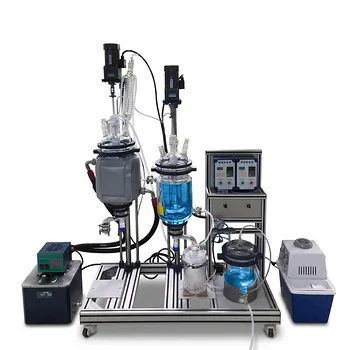
The defining operational difference is between managing a single, evolving batch and orchestrating a steady-state cascade of stages.
A batch vacuum crystallizer processes a fixed volume, relying on careful transient control—particularly a slow initial cooling rate—to prevent runaway nucleation and achieve a narrow crystal size distribution. A multistage continuous vacuum crystallizer, in contrast, flows feed through a series of compartments (typically 3–8) held at progressively lower pressures and temperatures. While this continuous train demands higher baseline energy consumption for steam and cooling water, splitting the process into stages can recover vapor heat, narrowing the efficiency gap and mimicking true industrial crystallizer trains.
The choice for a pilot plant hinges on your primary goal: dynamic process understanding versus steady-state industrial mimicry. Batch units excel at demonstrating transient crystallization behavior and crystal quality control. Multistage continuous units teach energy integration and scale-up principles, but they permanently carry a higher utility burden unless multiple stages are used intelligently.
Operational Philosophy: Transient Art vs. Steady-State Science
How Batch Crystallizers Teach Dynamic Control
Batch operation turns the crystallizer into a closed, unsteady-state system. The entire charge is loaded, and the operator must manually or programmatically manage the vacuum and cooling rate.
Early-stage control is critical. Rapid initial cooling causes excessive nucleation—a burst of tiny, unwanted crystals that ruins the final size distribution. Students learn to interpret concentration and temperature profiles over time, mastering transient process dynamics. This makes batch units unrivaled for teaching fundamental crystallization kinetics and cycle optimization.
How Continuous Multistage Units Replicate Industrial Reality
A multistage continuous vacuum crystallizer behaves as an open, steady-state system. Feed enters continuously, and product slurry leaves continuously. Each stage maintains its own vacuum level, creating a descending temperature staircase.
The primary control challenge shifts from time to residence-time distribution. Operators must stabilize flow rates, stage pressures, and the temperature gradient across the train. This configuration directly mirrors the industrial reality of large-scale continuous crystallization, making it ideal for vocational training on 24/7 process management.
The Energy Equation: Vacuum, Steam, and Staged Recovery
Why Batch Units Often Win on Energy at Pilot Scale
Batch crystallizers apply vacuum only during the active cycle. Once the batch is discharged, the system can be returned to atmospheric pressure, and steam and cooling water consumption cease.
This intermittent operation often translates to lower total utility consumption for small-scale, short-run pilot plants. Because there is no need to sustain high vacuum and condense vapor around the clock, the baseline energy footprint is smaller. In a teaching environment with frequent start-stop cycles, this can lead to significant operational cost savings.
The Role of Multiple Stages in Closing the Efficiency Gap
Continuous multistage crystallizers pay a permanent energy price: the vacuum system must run persistently, and vapor boiled off in one stage must be condensed in the next. Left unoptimized, this leads to higher steam and cooling water demand than a comparable batch run.
However, using 3–8 stages is the balancing mechanism. With enough stages, the vapor from a higher-temperature stage can provide the heating medium for a lower-temperature stage. This vapor reuse significantly cuts net energy consumption. The educational value is that students can observe energy recovery in action, but the hardware and controls required to achieve it are far more complex than a single batch vessel.
Understanding the Trade-offs
When Simplicity is Better: The Batch Advantage
For pilot plants focused on versatility and crystal-quality fundamentals, batch is the superior starting point. The equipment is easier to clean between runs, critical when switching between different solutions or demonstrating pharmaceutical-grade separations.
The tight control over initial nucleation gives students a direct, intuitive grasp of the relationship between cooling rate and particle size distribution—a lesson that can be lost in the steady-state hum of a continuous unit. The lower initial capital cost also frees up budget for other unit operations.
The Hidden Cost of Multistage Energy Integration
Adding stages to a continuous crystallizer reduces its energy penalty but introduces steep control complexity. Students must juggle maintaining stable vacuum levels across multiple vessels, balancing interstage vapor flows, and preventing encrustation in each compartment.
This can overwhelm a pilot plant curriculum if the goal is to quickly demonstrate the crystallization principle. The hardware overhead—multiple pumps, condensers, and vacuum lines—also increases the unit’s physical footprint and maintenance burden. Multistage energy recovery is only worth the complexity when the primary learning objective is industrial process design.
Making the Right Choice for Your Pilot Plant
Your final decision should be driven by the core skill you need to impart.
- If your primary focus is mastering crystallization fundamentals and crystal size control: Choose a batch vacuum crystallizer. Its transient nature forces students to engage directly with nucleation curves and cooling rate influences, and its lower energy draw suits intermittent use.
- If your primary focus is teaching industrial steady-state operation and energy integration: Choose a multistage continuous crystallizer. Use at least three stages to demonstrate vapor reuse and cut the inherent energy premium, making the unit a true mirror of plant-floor scale-up logic.
- If your primary focus is maximum curriculum flexibility across multiple products: Lean toward the batch unit. Its ease of cleaning, smaller footprint, and simpler utility setup let you run diverse experiments without the downtime penalties of a complex continuous train.
The right crystallizer does not just make crystals—it makes the invisible dynamics of heat, mass transfer, and phase change tangible for the operator. Follow your learning objective, not just the specification sheet.
Summary Table:
| Feature | Batch Vacuum Crystallizer | Multistage Continuous Crystallizer |
|---|---|---|
| Operation Mode | Transient (closed, unsteady-state) | Steady-state (open, continuous flow) |
| Control Focus | Time-based cooling rate & nucleation | Residence-time distribution & pressure gradients |
| Energy Footprint | Lower for intermittent/short runs | Higher baseline (reducible via stage vapor recovery) |
| Best Used For | Kinetics teaching & product flexibility | Industrial scale-up & energy integration training |
Bring Industrial-Scale Learning to Your Lab with LABPARK
Empower your students and researchers with hands-on experience using industry-grade technology. LABPARK provides premium Educational and Vocational Unit Operations Pilot Plants across chemical engineering, bioprocess & biotech, and environmental & water treatment.
Whether you are looking to demonstrate transient batch crystallization kinetics or complex multistage energy integration, our tailored systems help universities, research institutes, and enterprises achieve academic excellence.
Contact us today to discuss your laboratory specifications and request a customized quote!
Related Products
- Multi Functional Membrane Crystallization Educational Unit Operations Pilot Plant
- Potassium Salt Thermal Dissolution and Crystallization Separation Educational Unit Operations Pilot Plant
- Multi-Functional Special Distillation Educational Pilot Plant
People Also Ask
- Why is precise temperature control critical in crystallization pilot plants? Key to Scale-Up Success
- Control Crystallization Pilot Plant Secondary Nucleation: 4 Key Adjustments
- What key factors should be considered when configuring a crystallization unit operations pilot plant?
- What are the benefits of integrating online PAT tools like ATR-FTIR into crystallization unit operations pilot plants?
- How to use crystallization pilot plant agitation speed to identify diffusion vs reaction growth?