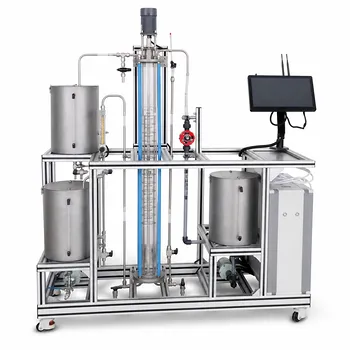
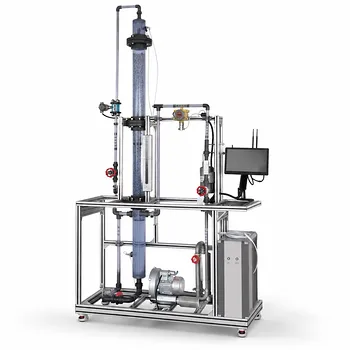
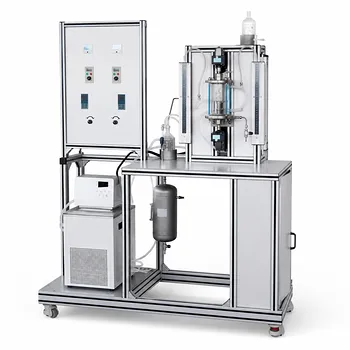
The heart of a gas-liquid pilot plant decision lies in reaction time and interfacial area. For slow liquid-phase reactions that require substantial residence, plate columns are the superior choice because they hold liquid on each tray, giving the reaction time to proceed. For very fast, mass-transfer-limited absorptions or when the gas stream carries solid particles, spray columns excel by instantly generating a large interfacial area with minimal pressure drop.
The core selection criterion is the Hatta number ($\sqrt{M}$). Fast reactions ($\sqrt{M} > 3$) complete in the liquid film and demand high interfacial area – embrace spray columns. Slow reactions ($\sqrt{M} < 0.3$) need bulk liquid holdup – choose plate columns. Solids-laden gas and low-pressure-drop mandates also tip the scale toward spray columns.
Understanding the Fundamentals: Plate and Spray Columns
Before layering on kinetics, it helps to see how these two contactors create gas-liquid contact in entirely different ways.
How Plate Columns Work
Plate columns force gas and liquid to meet on discrete stages – perforated, bubble cap, or valve trays. Liquid flows across each plate while gas bubbles up through it, creating a high liquid holdup on every stage. This stage-wise design delivers long, stable contact times, making the equipment robust for reactions that need residence time to reach equilibrium. The trade-off is a higher pressure drop compared to spray towers.
How Spray Columns Work
A spray column is elegantly simple: liquid is atomized from the top into an empty vessel while gas flows upward. The resulting fine droplets provide an enormous initial interfacial area for mass transfer. Because the column is empty, it imposes a very low pressure drop and handles gas streams containing solids without clogging. However, the droplets coalesce quickly, so the effective mass transfer area decays sharply – spray columns rely on short, intense contact.
The Decisive Factor: Reaction Kinetics and the Hatta Number
To move beyond gut feel, educators and researchers can use the Hatta number ($\sqrt{M}$) as a quantitative selector. This dimensionless group compares the maximum reaction rate in the liquid film to the mass transfer rate.
Fast Reactions Complete in the Liquid Film ($\sqrt{M} > 3$)
When $\sqrt{M}$ exceeds 3, the reaction is so rapid that it finishes inside the liquid film. Mass transfer becomes the rate-limiting step, not the reaction itself. The design must maximize the interfacial area to push reactant across the gas-liquid boundary. Spray columns, with their instant cloud of droplets, deliver exactly that high area for a short burst – an ideal match. The brief contact time is irrelevant because the reaction is effectively instantaneous.
Slow Reactions Happen in the Bulk Liquid ($\sqrt{M} < 0.3$)
When $\sqrt{M}$ falls below 0.3, the reaction proceeds slowly and needs bulk liquid volume to build conversion. Here, a plate column’s liquid holdup on each tray becomes invaluable. The gas passes through multiple liquid baths, giving the reaction the long residence time it demands. Spray columns, with their fleeting droplet life, would fail to provide enough time for the reaction to advance meaningfully.
Intermediate Reactions ($\sqrt{M} \approx 1$)
For reactions that sit in the middle ground, the system needs a balance of interfacial area and liquid volume. Plate columns are still a strong candidate because their holdup and bubbling area together can accommodate this regime, especially when the academic goal is to study stage-by-stage concentration profiles.
Critical Fluid Properties Beyond Kinetics
Reaction kinetics set the stage, but real streams introduce property constraints that can override the kinetic preference.
Solid Particles in the Gas Stream
If the gas carries dust, catalyst fines, or any solid particulates, spray columns are self-cleaning. The open vessel and falling liquid wash solids away. Plate columns, with their narrow passages and weirs, risk fouling and blockage, which complicates both operation and teaching schedules.
Pressure Drop Tolerance
A spray column’s open path creates a negligible pressure drop, important when the feed gas is already at low pressure. Plate columns, in contrast, incur a meaningful pressure drop across each tray. When a pilot plant must integrate with a low-head blower, the spray column’s hydraulic economy becomes decisive.
Liquid Distribution and Turndown
Plate columns maintain their efficiency over a wide operating range because the tray hydraulics self-regulate. Spray columns, however, depend on nozzle performance; at low liquid loads the atomization quality can deteriorate, quickly eroding the interfacial area.
Why the Educational Context Magnifies These Differences
Pilot plants in teaching and research settings are living textbooks. Plate columns make stage-wise mass transfer visible – students can physically trace the liquid flow path, sample from each tray, and see how equilibrium steps stack up. Spray columns demonstrate continuous contact and the dynamics of droplet dispersion, coalescence, and gas film control. Placing both in the same facility allows direct, side-by-side comparison of hydrodynamics and mass transfer behavior, turning a design choice into an experiment.
Understanding the Trade-offs
No single column type solves every problem. Awareness of these limits builds credibility in a research or instructional environment.
Spray Column Limitations
- Rapid area decay: coalescence shrinks the mass transfer zone, making them unsuitable for slow or intermediate reactions that need sustained contact.
- Short residence time: only fast, film-completing reactions benefit; physical absorption of sparingly soluble gases can suffer.
- Nozzle sensitivity: plugging or poor atomization at low liquid rates can shut down performance.
Plate Column Limitations
- Solids handling: not designed for particulate-laden gas; cleaning is more involved than a wash-down spray tower.
- Higher pressure drop: may require a compressor or blower upgrade, adding cost to the pilot plant.
- Liquid distribution challenges at extreme turndown: while better than spray in some ranges, severe flow reductions can cause weeping or entrainment.
How to Choose for Your Pilot Plant Goal
Align the column type with the primary educational or research objective to avoid a hardware mismatch.
- If your primary focus is slow, liquid-phase reaction kinetics: Select a plate column to provide the liquid holdup and long residence time necessary for the reaction to progress through several equilibrium stages.
- If your primary focus is fast, mass-transfer-limited absorption: Choose a spray column to generate the high initial interfacial area that drives reactant across the film in the split second available.
- If the gas stream contains solid particulates: Adopt a spray column to ensure reliable, non-fouling operation with low maintenance overhead.
- If low system pressure drop is non-negotiable: Lean on a spray column; its empty-column design keeps energy costs and equipment sizing minimal.
- If the teaching goal is to compare stage-wise and continuous contact principles: Incorporate both designs in the pilot plant to let students observe, measure, and debate the differences firsthand.
By matching the reaction’s Hatta number and stream properties to the contactor’s hydrodynamic signature, educators and researchers transform a simple column selection into a powerful, reproducible teaching moment.
Summary Table:
| Selection Criteria | Plate Columns | Spray Columns |
|---|---|---|
| Best for Hatta Number | Slow reactions ($\sqrt{M} < 0.3$) | Fast reactions ($\sqrt{M} > 3$) |
| Liquid Holdup & Time | High holdup, long residence | Low holdup, short contact |
| Pressure Drop | Higher (across trays) | Negligible (open vessel) |
| Solids Handling | Poor (clogging risk) | Excellent (self-cleaning) |
Optimize Your Lab with Custom Pilot Plants
Selecting the right unit operations equipment is critical for impactful education and research. LABPARK provides high-quality Educational and Vocational Unit Operations Pilot Plants in chemical engineering, bioprocess & biotech, and environmental & water treatment. Specifically designed for universities, research institutes, and enterprises, our pilot plants offer robust, hands-on learning and precise experimental control.
Ready to upgrade your facility? Contact LABPARK today to collaborate with our engineering experts and find the perfect pilot-scale solution for your curriculum or research.
Related Products
- Educational Rotary Disc Liquid-Liquid Extraction Pilot Plant
- Packed Bed Absorption Educational Unit Operations Pilot Plant
- Comprehensive Liquid-Liquid Extraction Pilot Plant for Engineering Education
- Dual-Drive Stirred Gas-Liquid Mass Transfer Coefficient Determination Pilot Plant
- Bench Scale Dual Column Gas Separation and Capture Educational Pilot Plant
People Also Ask
- How do density and IFT affect liquid-liquid extraction pilot plants? Optimize Column Performance
- How to Estimate KD for Liquid-Liquid Extraction Pilot Plants Using Henry's Law when Lab Data is Limited
- How to Select a Liquid-Liquid Extraction Pilot Plant with Space Constraints: Key Factors
- In a liquid-liquid extraction pilot plant, how is a ternary-phase diagram utilized to determine solvent feed requirements?
- How to resolve emulsion in liquid-liquid extraction? 5 ways to ensure efficient phase separation