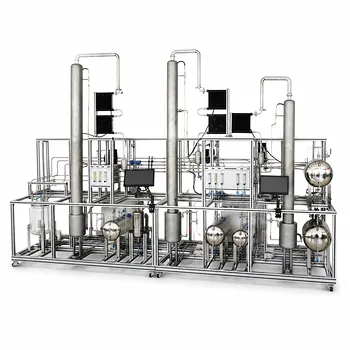
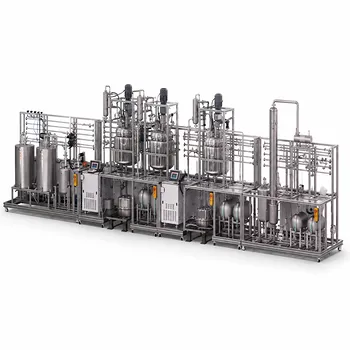
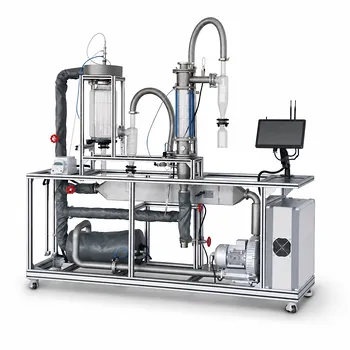
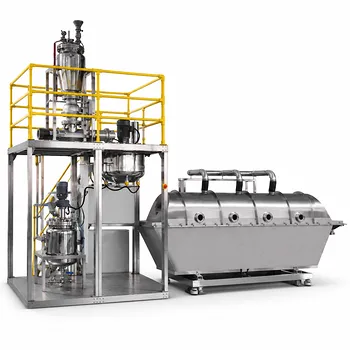
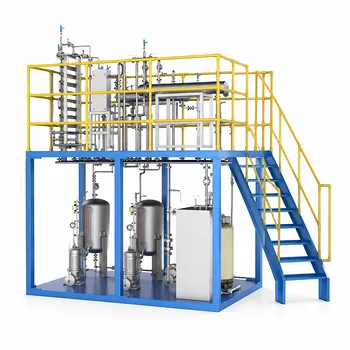
In a bioprocess training pilot plant, a stable abiotic culture environment depends on manipulating four core variables in real time: temperature, pH, dissolved oxygen, and foam.
Temperature is controlled by adjusting the coolant flow rate through the vessel jacket or internal coils. pH is maintained by regulating the addition rate of acid or alkali solutions. Dissolved oxygen (DO) is managed by varying agitation speed and gas flow rate (typically air or oxygen). Foam is suppressed using mechanical foam breakers or the controlled addition of chemical antifoam agents. In fed‑batch processes, a fifth critical action is the precise control of nutrient feed rates, based either on pre‑programmed schedules or real‑time online estimations.
Maintaining a stable abiotic environment is less about memorizing setpoints and more about mastering the dynamic cause‑and‑effect between a measured disturbance and the manipulative action that counteracts it. In a training pilot plant, this connection is the core lesson that builds operator intuition, ensures reproducible data, and bridges the gap between benchtop tinkering and industrial‑scale bioprocessing.
The Four Pillars of Abiotic Control
A pilot‑scale bioreactor is a highly instrumented living system without the organism. The sensors define what the operators perceive; the actuators define what they can change. Training must make the invisible visible.
Temperature: Managing Metabolic Heat Through Coolant Flow
Microbial or cell culture activity generates heat, and the optimal temperature window is often narrow.
The thermocouple or thermistor provides a continuous temperature signal. The control loop compares this to the setpoint and modulates a valve on the coolant supply.
In a training environment, operators learn to tune the PID loop to avoid overshoot while responding to the sudden heat surge of an exponential growth phase—first simulated, then real.
pH: Balancing via Acid and Base Addition
pH is controlled by the controlled injection of sterile acid or alkali.
A glass reference electrode measures the hydrogen‑ion activity. The error signal drives a peristaltic or diaphragm pump that adds small, discrete boluses.
The key manipulative skill is not just on‑off control but learning to set a deadband and anticipate the lag introduced by mixing time and probe position. A poorly tuned loop can oscillate wildly, stressing the future culture.
Dissolved Oxygen: The Agitation‑Aeration Duet
Maintaining DO is a dance between agitation speed and gas flow rate.
A polarographic or optical DO probe feeds back to a cascade or split‑range controller. As oxygen demand rises, the controller first increases agitation (lower shear risk) and only then ramps up gas flow (which can exacerbate foaming and evaporative cooling).
Training must demonstrate the trade‑off: higher agitation improves mass transfer but introduces shear stress; higher gas flow increases oxygen driving force but demands more aggressive foam control.
Foam: A Physical and Chemical Counterattack
Foam is not just a cosmetic nuisance—it can block exhaust filters, cause pressure build‑up, and lead to contamination.
The first line of defense is a mechanical foam breaker (a rotating disk on the headspace) that collapses bubbles physically. If foam persists, a capacitance or conductance probe triggers a pump that injects a measured dose of chemical antifoam.
In a training pilot plant, operators quickly learn that too little antifoam risks a blow‑out, while too much can coat the cells and reduce oxygen transfer—a subtle, feedback‑driven imbalance.
Extending Stability: Fed‑Batch and Dynamic Ratio Control
A stable environment in a batch process is a finite achievement. Real‑world bioprocess training must also cover the fed‑batch phase, where the environment is intentionally stretched.
Nutrient Feed: From Simple Profiles to Online Estimation
In fed‑batch, the feed rate is the strategic manipulative variable.
The primary reference highlights pre‑programmed schedules (e.g., a linear ramp) and real‑time online estimations (e.g., calculating the feed that maintains a constant specific growth rate based on off‑gas data). An operator must learn to switch between these modes and understand when a fixed profile fails to prevent overflow metabolism or oxygen limitation.
Borrowing from Chemical Reactor Intelligence
Pilot‑scale chemical reactors often use a cascade‑ratio structure to dynamically adjust one reactant ratio based on a critical process variable like catalyst bed temperature.
While the exact configuration differs, the principle translates directly to bioprocessing. For example, a temperature‑limiting controller could dynamically adjust the glucose feed rate to match the cooling capacity, preventing an overheating event during high‑demand phases. This teaches the concept of master‑slave loops and variable setpoints, elevating training beyond simple single‑loop control.
Understanding the Trade‑offs
No control action comes without a price. A training pilot plant is the ideal place to make these trade‑offs tangible before they become costly at scale.
- Agitation speed improves DO but generates shear that can damage mammalian cells or filamentous organisms.
- Gas flow rate boosts oxygen transfer but increases evaporation, cools the broth locally, and promotes foaming.
- Chemical antifoam suppresses foam but acts as a surfactant that can reduce the gas‑liquid interfacial area, ultimately hurting oxygen transfer.
- Rapid pH correction can create local concentration spikes that stress or kill cells near the injection port, while slow correction lets the culture drift.
- Fed‑batch feed rate that is too aggressive leads to acetate or ethanol accumulation; too conservative starves the culture and limits productivity.
Training must not hide these trade‑offs. It must make them the centerpiece of operator decision‑making: choosing the least‑harmful manipulative path for a given organism and process phase.
How to Apply This to Your Pilot Plant Training Program
The specific manipulative actions you emphasize depend on the goals of your facility and the organisms you plan to run.
- If your primary focus is foundational operator competency: Drill the four core variables—temperature, pH, DO, and foam—using single‑loop PID tuning exercises. Make sensor calibration a daily ritual, because a stable environment is impossible with drifting measurements.
- If your primary focus is advanced process development: Introduce fed‑batch strategies and cascade control. Let trainees design feed profiles, then challenge them with a simulated oxygen uptake spike that forces them to re‑set the DO cascade parameters without crashing the foam control.
- If your primary focus is scale‑up and tech transfer: Create a matrix of “what‑if” scenarios: what if the coolant supply pressure drops? What if the agitator seal leaks air? Train operators to diagnose the root cause from the sensor signatures and apply the correct manipulative variable, not just the first one they think of.
- If your primary focus is microbial vs. mammalian processes: Contrast the shear‑sensitive nature of mammalian cells (leading to gentler agitation, lower gas flow, different antifoam choices) with the robust oxygen demand of E. coli (high agitation, oxygen enrichment). The manipulative actions are the same tools, but the strategy changes.
Mastering these manipulative actions turns a pilot plant into a true teaching tool—one where every pump activation, valve adjustment, and setpoint change teaches a lesson about the delicate balance that keeps a bioprocess alive and productive.
Summary Table:
| Variable | Sensor / Indicator | Manipulative Action | Key Trade-off |
|---|---|---|---|
| Temperature | Thermocouple / Thermistor | Adjust coolant flow rate | Dynamic response vs. PID overshoot |
| pH | Glass reference electrode | Control acid/alkali pump speed | Local concentration spikes vs. slow drift |
| Dissolved Oxygen (DO) | Polarographic / Optical probe | Vary agitation speed & gas flow | High shear stress vs. excessive foaming |
| Foam | Capacitance / Conductance probe | Mechanical breakers & chemical antifoam | Filter blockage vs. reduced oxygen transfer rate |
| Nutrient Feed | Feed profiles / Online estimation | Adjust substrate/nutrient feed rate | Toxic metabolite accumulation vs. cell starvation |
Elevate Your Practical Training with LABPARK Pilot Plants
Mastering dynamic control loops and managing process trade-offs requires hands-on experience with industry-grade systems. LABPARK provides premium Educational and Vocational Unit Operations Pilot Plants across chemical engineering, bioprocess & biotech, and environmental & water treatment.
Designed specifically for universities, research institutes, and enterprises, our pilot plants empower students and operators to bridge the gap between benchtop theory and industrial-scale production.
Ready to upgrade your lab infrastructure? Contact LABPARK today to find the perfect pilot plant solution for your training program!
Related Products
- Bio-fermentation Ethanol Production Practical Training Unit Operations Pilot Plant
- Natural Product Extraction Unit Operations Training Pilot Plant
- Multi Pump Fluid Transport Process Piping Unit Operations Training Pilot Plant
- Multimodal Absorption and Desorption Pilot Plant for Unit Operations Training
- Dual-Mode Rectification Pilot Plant for Practical Training Unit Operations
People Also Ask
- Why Use PTFE & Hastelloy in Chemical Pilot Plants? Prevent Corrosion & Ensure Safety
- Why Compare Predicted and Experimental Excess Enthalpy? Key to Accurate Pilot Plant Scale-up
- Why is the chemical plant startup schedule crucial? De-risk scale-up with pilot plants.
- When to transition from PID to adaptive control in pilot plants? Key process indicators.
- Why must batch and fed-batch fermentation pilot plants be designed to accommodate changing rheological conditions?