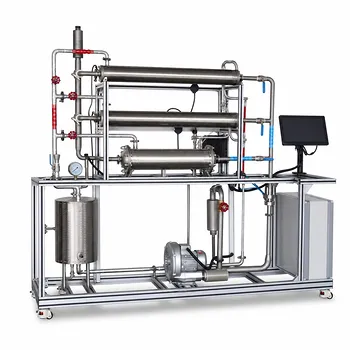
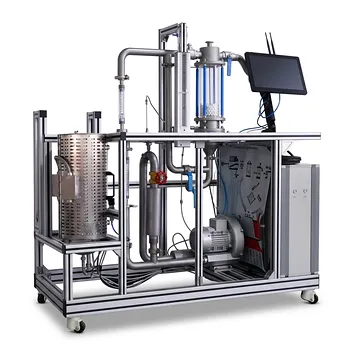
The pinch point is the thermodynamic heartbeat of heat exchanger network synthesis—it’s not just a design heuristic, but the fundamental constraint that determines whether a process achieves its maximum energy-saving potential. In the context of educational pilot plants, the pinch point defines a clear boundary that separates a heat sink region (above the pinch) from a heat source region (below the pinch). No heat should be transferred across this boundary; if it is, the system’s total utility consumption will rise by exactly that amount on both the hot and cold sides. Teaching this concept with physical pilot plants allows students to transform an abstract thermodynamic rule into a tangible, measurable reality.
At its core, the pinch point reveals an inescapable thermodynamic truth: every process has a bottleneck where the driving force for heat recovery reaches its minimum. Crossing that threshold with heat transfer destroys energy efficiency, and pilot plants prove this with real-time data. For educators, the pinch is the single most powerful concept for teaching students how to partition complex networks and instinctively avoid design errors that lead to wasted utilities.
The Pinch Point as a Thermodynamic Partition
The pinch point arises from the composite curves of hot and cold streams, marking the location where the temperature difference between them is smallest. At this point, the system’s ability to recover heat internally is exhausted.
A Hard Boundary Between Heat Sink and Heat Source
Above the pinch, the network behaves only as a heat sink—it requires external heating to satisfy its duty, and any cooling above the pinch is thermodynamically wasteful. Below the pinch, the network acts purely as a heat source that must reject heat to cold utilities; heating below the pinch is equally pointless. Students often struggle to internalize this until they stand in front of a pilot plant and see that when they open a bypass valve that sends a hot stream from above the pinch to preheat a cold stream below it, the steam consumption and cooling water flow both spike.
Why Cross‑Pinch Heat Transfer Doubles the Penalty
If you transfer 1 kW of heat across the pinch, the energy balance above the pinch suddenly lacks that 1 kW of cooling, so you must add 1 kW of extra hot utility to compensate. Simultaneously, the region below the pinch now has an excess 1 kW of heating, forcing you to reject an extra 1 kW to cold utility. The total utility load increases by double the amount of the cross‑pinch heat. On a pilot plant, watching the live process values confirm this—the same transferred heat shows up on both utility meters—creates an immediate, visceral understanding that a whiteboard diagram can’t replicate.
How Pilot Plants Bring the CP‑Matching Rules to Life
To avoid violating the minimum approach temperature (ΔT_min) at the pinch, specific rules govern the heat capacity flow rate (CP) matching immediately adjacent to it. Educational pilot plants make these abstract inequalities feel inevitable.
Above the Pinch: Cold Stream Must Dominate
Right above the pinch, the temperature change per unit heat duty is larger for the stream with the smaller CP. Since you cannot have the temperature profiles converge, the hot stream must have a lower or equal heat capacity flow rate: CPh ≤ CPc. In a pilot plant, students can flow a hot stream with a high CP against a low‑CP cold stream and watch the temperature difference collapse. They then swap to a configuration where CPc is larger and see the profiles stay safely apart, proving the rule is not just academic.
Below the Pinch: Hot Stream Must Dominate
Below the pinch, the opposite holds: CPh ≥ CPc. If a student tries to match a low‑CP hot stream with a high‑CP cold stream, the hot stream cools too quickly and the cold stream doesn’t warm enough, crushing the driving force. By physically swapping streams and measuring temperatures, they learn that the CP rule is the key to a feasible, low‑energy network. The pilot plant feedback is immediate—thermocouples show a dangerous approach temperature, and the plant may even trip alarms, teaching caution in design.
Understanding the Trade-offs and Limitations of Pilot Plant Demonstrations
While pilot plants are unparalleled for teaching the pinch concept, they also introduce compromises that instructors must manage.
Simplification Can Mask Real‑World Complexity
Pilot plant streams often have constant heat capacities and simple, linear profiles. Industrial processes frequently involve phase change, non‑linear enthalpy curves, and multiple temperature segments. If not addressed, students may assume the single‑pinch model always applies. A multi‑zone exchanger (preheater, evaporator, superheater) demonstration, where a single fluid’s temperature‑enthalpy curve has a “pinch” within the equipment itself, helps bridge this gap. But without careful framing, students might walk away with an over‑simplified view.
Data Noise and Equipment Constraints
Real pilot plants have measurement noise, imperfect insulation, and limited heat exchanger area. The pinch temperature measured may not perfectly match the theoretical value. This can be a powerful teaching moment about the difference between targeted design and practical instrumentation, but it can also confuse students who expect exact alignment. Instructors must decide whether to “sanitize” data or embrace the messiness as part of engineering reality.
The Risk of Losing the “System” Perspective
Focusing too tightly on the pinch can cause students to overlook how changing upstream streams or process conditions shifts the pinch location. A pilot plant with fixed configuration might make the pinch appear static, when in reality it’s a dynamic outcome of stream data. Connecting the experiment back to a full HEN synthesis exercise—where students recalculate the pinch after altering stream targets—is essential.
How to Leverage Pilot Plants for Effective Pinch Education
Briefly align the teaching strategy with student goals. The same pilot plant can serve different objectives depending on where you place the emphasis.
- If your primary focus is building thermodynamic intuition: Start with a misconfigured network that deliberately crosses the pinch. Have students measure the utility spike and then guide them to rearrange the exchangers to eliminate cross‑pinch transfer, letting them see the utility demand drop in real time.
- If your primary focus is mastering CP‑matching rules: Design two sets of stream pairs—one that obeys the rules and one that violates them—and let students prove to themselves that only the correct matching maintains ΔT_min. Use the pilot plant as a proof‑of‑concept engine.
- If your primary focus is bridging theory to industrial practice: Run the pilot plant first with a simple single‑pinch case, then introduce a second experiment with a non‑linear profile (e.g., a heating‑boiling‑superheating sequence). Show how the pinch concept extends to segmenting equipment, preparing students for real‑world complexity.
- If your primary focus is data‑driven energy targeting: Have students log temperatures and flows, import them into a spreadsheet, calculate composite curves and then physically test their target against the plant’s actual utility consumption. This teaches that pinch analysis is not approximation—it’s a rigorous target.
When you align the pilot plant experience with the true thermodynamic message of the pinch point, you turn a piece of equipment into a revelation about the fundamental limits of heat recovery.
Summary Table:
| Metric / Region | Above the Pinch | Below the Pinch |
|---|---|---|
| Thermodynamic Role | Heat Sink (requires external heat) | Heat Source (rejects heat to cooling) |
| Utility Requirement | Hot utility only; cooling is wasteful | Cold utility only; heating is wasteful |
| CP Matching Rule | $CP_h \le CP_c$ (Cold stream must dominate) | $CP_h \ge CP_c$ (Hot stream must dominate) |
| Cross-Pinch Transfer | Penalizes system by doubling utility demand | Penalizes system by doubling utility demand |
Bring Thermodynamic Principles to Life in Your Lab
Looking to bridge the gap between complex thermodynamic theory and practical engineering for your students?
LABPARK provides state-of-the-art Educational and Vocational Unit Operations Pilot Plants in chemical engineering, bioprocess & biotech, and environmental & water treatment. Designed specifically for universities, research institutes, and enterprises, our pilot plants empower students to visualize heat exchanger networks, test real-time energy targets, and master critical concepts like pinch analysis through hands-on learning.
Ready to upgrade your lab's educational capabilities? Contact us today to request a quote or customize your pilot plant system!
Related Products
- Shell and Tube Heat Exchanger Heat Transfer Coefficient Determination Educational Pilot Plant
- Comprehensive Multi-Modal Heat Transfer Unit Operations Pilot Plant for Engineering Training
- Dual Mode Heat Transfer Pilot Plant for Unit Operations Training
- Three-Tube Heat Transfer Educational Pilot Plant for Unit Operations Training
- Comprehensive Heat Transfer Coefficient Determination Educational Unit Operations Pilot Plant
People Also Ask
- Why Apply LMTD Correction in Shell-and-Tube Pilot Plants & How to Determine It
- How is the fouling factor (Rd) evaluated? Key Pilot Plant Insights for Students
- How is fouling factor demonstrated using shell and tube pilot plants? Practical Lab Guide
- Why is simulating and calculating fouling factors crucial when operating educational heat exchanger pilot plants?
- Why Estimate Tube Wall Temp in Heat Exchangers? Master Pilot Plant Thermal Resistance