Minimum wetting rate (Q_min) is not just a design parameter—it’s the operational floor for any packed absorption column. It defines the lowest liquid volumetric flow per unit cross-sectional area that can sustain a continuous, uniform film over the packing surface. Dropping below this threshold causes the film to break into rivulets, drastically shrinking the effective gas-liquid interface and slashing mass transfer efficiency. The choice of packing material directly determines where that floor sits, because surface chemistry and texture dictate how easily a liquid spreads and wets the solid.
Q_min is the critical liquid load your column must exceed to function properly. Material selection shifts this limit—rough, high-energy surfaces like ceramic or metal require far less liquid flow to stay fully wetted, while smooth, low-energy plastics demand significantly higher rates to avoid flow maldistribution and performance collapse.
What the Minimum Wetting Rate Really Means
Defining the Operational Threshold
Minimum wetting rate (Q_min) is the lower bound of liquid feed that prevents the liquid film from disintegrating. It is expressed as volumetric flow per unit cross-sectional area. In absorption columns, this liquid film is the primary vehicle for mass transfer, so maintaining a stable, unbroken layer is non-negotiable.
The High Cost of Falling Below Q_min
When liquid flow dips under Q_min, the film pulls apart into isolated streams. This “channeling” effect creates dry patches on the packing, where gas flows without contacting any liquid. The effective mass transfer area can drop by 50% or more, causing a sudden and severe loss of separation efficiency. The column doesn’t just perform below design—it can become functionally useless.
How Packing Material Dictates the Wetting Limit
The Role of Surface Energetics
A liquid’s ability to spread on a solid is governed by the balance of surface tensions. The key material property is critical surface tension (σ_c), the characteristic surface energy of the solid. When the liquid’s surface tension is lower than or close to σ_c, the liquid wets the solid easily. For aqueous systems with high surface tension (~72 mN/m), the packing must have a similarly high σ_c to promote wetting.
Materials like stainless steel (σ_c ≈ 75 mN/m) and glass (σ_c ≈ 73 mN/m) wet readily because their critical surface tension exceeds that of water. This allows them to maintain a film at lower liquid flow rates—effectively a lower Q_min. In contrast, polymeric packings such as polyethylene (σ_c ≈ 33 mN/m) or PTFE (σ_c ≈ 20 mN/m) strongly repel water, breaking the film at relatively high liquid loads and forcing operation at much higher Q_min values.
Why Roughness Also Matters
Beyond surface chemistry, the physical texture of the packing amplifies wetting. Rough, porous ceramics provide microscopic channels that help draw the liquid film across the surface, even if the base material’s σ_c is moderate. This mechanical spreading effect further reduces Q_min. Surface-treated metals can also enhance roughness and wettability without sacrificing the material’s bulk advantages.
This dual influence—chemical and physical—explains why two packings of the same nominal material can perform differently. A machined metal surface may have a higher practical Q_min than one that has been chemically etched or coated.
The Onda Correlation as a Predictive Tool
The Onda correlation formalizes these effects. It shows that the ratio of packing critical surface tension to liquid surface tension (σ_c / σ_L) dictates the effective wetted area (a_w). A ratio close to or above 1 promotes full wetting; a ratio well below 1 leads to wetting failure. Since a_w feeds directly into both gas-side and liquid-side mass transfer coefficients, the material’s σ_c becomes a design variable that directly shapes column performance.
For example, a ceramic ring (σ_c ≈ 61 mN/m) yields a ratio of about 0.85 with water, indicating good but not perfect wetting. Stainless steel gives a ratio >1, enabling near-complete film coverage. Polypropylene, with a ratio near 0.46, will struggle to wet at all without excessive liquid flow or chemical surface treatment.
Understanding the Trade-offs
When Low Q_min Isn’t Everything
Choosing a packing solely for minimal Q_min can backfire. Ceramic materials, while excellent wetters, are brittle and heavy. They add structural load and can fracture under thermal shock. Stainless steel resists breakage but is expensive and susceptible to corrosion in harsh chemical environments.
Plastic packings offer compelling benefits: they are lightweight, chemically inert, and significantly cheaper. Their higher Q_min is not necessarily a flaw if your process can economically accommodate higher liquid circulation rates. In many scrubbers and cooling towers, this trade-off is perfectly acceptable.
The Cost of Surface Modification
Hydrophilizing treatments can raise the critical surface tension of plastics significantly—for instance, from ~33 mN/m to ~54 mN/m. This improvement lowers Q_min, but the treatment may degrade over time, adds manufacturing cost, and can be compromised by aggressive cleaning chemicals. This creates a lifecycle trade-off between initial capital savings and long-term performance stability.
Common Pitfalls in Material Selection
Ignoring the liquid’s own surface tension is a frequent mistake. An organic solvent with low surface tension will wet polyethylene just fine, making the high σ_c of metal irrelevant. Another error is overlooking liquid distribution design—even the best-wetting packing can’t compensate for an uneven initial distribution. The material choice must align with both the fluid properties and the whole system design, not just the Q_min number in isolation.
Making the Right Choice for Your Goal
The optimal packing material emerges from a balanced analysis of wetting, mechanical integrity, chemical compatibility, and lifecycle cost. Here is how to orient that decision:
- If your primary focus is maximizing mass transfer efficiency with aqueous liquids: Select a packing with high critical surface tension, such as etched stainless steel or rough ceramic, to minimize Q_min and ensure full wetting from the start.
- If your primary focus is corrosion resistance or lightweight column design: Choose plastic packings and accommodate a higher operating liquid flow rate, or invest in a durable hydrophilizing treatment to bring the Q_min into a workable range.
- If your primary focus is educational demonstration or process research: Use a side-by-side comparison of materials (e.g., metal vs. untreated plastic) to make the impact of surface chemistry on operational limits tangible and measurable.
Understanding Q_min and its deep connection to packing material selection turns column design from a guess into an engineering lever you can pull deliberately.
Summary Table:
| Packing Material | Critical Surface Tension ($\sigma_c$) | Wetting Ability (with Water) | Q_min Requirement |
|---|---|---|---|
| Stainless Steel | ~75 mN/m | Excellent (Full film coverage) | Low |
| Glass | ~73 mN/m | Excellent | Low |
| Ceramic | ~61 mN/m | Good (Enhanced by roughness) | Moderate-Low |
| Polypropylene | ~33 mN/m | Poor (Hydrophobic) | High |
| PTFE | ~20 mN/m | Very Poor | Very High |
Optimize Your Mass Transfer Operations with LABPARK
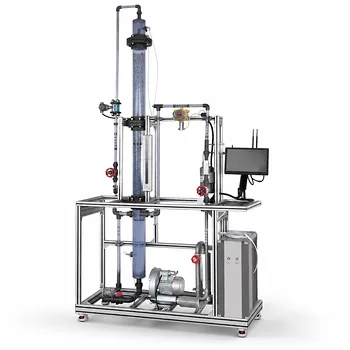
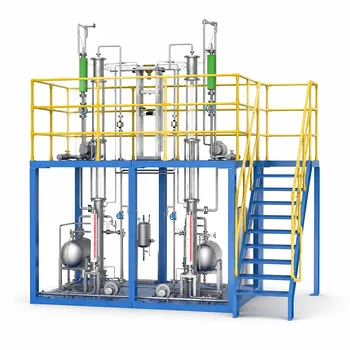
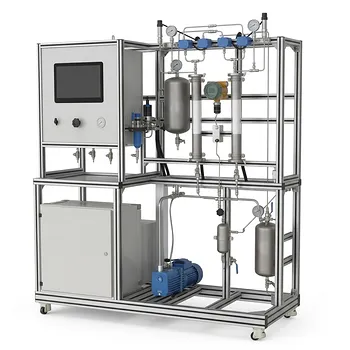
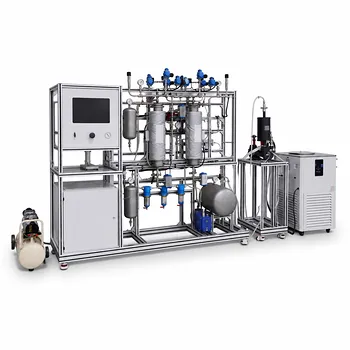
Are you looking to demonstrate advanced mass transfer and column hydraulics in your laboratory? LABPARK provides state-of-the-art Educational and Vocational Unit Operations Pilot Plants in chemical engineering, bioprocess & biotech, and environmental & water treatment.
We design high-quality, transparent, and fully instrumented pilot systems that help universities, research institutes, and enterprises bridge the gap between theoretical calculations and practical application.
Ready to elevate your teaching or research capabilities? Contact our experts today to find the ideal pilot plant solution for your facility!
Related Products
- Packed Bed Absorption Educational Unit Operations Pilot Plant
- Absorption and Desorption Educational Unit Operations Pilot Plant
- Multimodal Absorption and Desorption Pilot Plant for Unit Operations Training
- Pressure Swing Adsorption Educational Unit Operations Pilot Plant
- Bench Scale Dual Column Gas Separation and Capture Educational Pilot Plant
People Also Ask
- How Do Flow Regimes Transition in Packed Bed Pilot Plants? Key Scale-up Insights
- How does reactant concentration determine absorption column control? Gas-film vs. dual-film.
- How is the packing height of an absorption column calculated? Master HTU & NTU Concepts
- How does static vs. operating holdup affect pilot plant calibration? Avoid Critical Scale-Up Errors
- Why is counter-current flow selected for gas absorption? Maximize Pilot Plant Efficiency