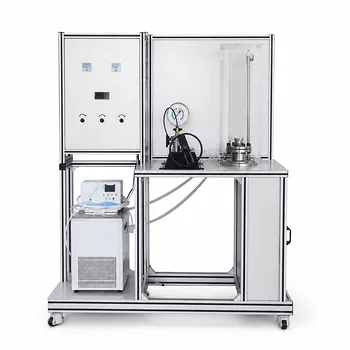
The educational significance is a fundamental shift in student cognition—from manual procedural execution to sensor-based systems thinking. Transitioning from manual acid-base titration to automatic potentiometric and coulometric methods in a chemical engineering lab is not merely an equipment upgrade. It represents a critical pedagogical pivot from teaching basic analytical chemistry procedures to cultivating the core competencies required for modern automated process control, sensor integration, and real-time quality analytics that define contemporary industrial pilot plants.
Traditional manual titration builds a necessary scientific intuition, locking concepts like stoichiometry into a student's "muscle memory." However, the deep educational necessity of switching to automated methods is to dismantle the "black box" of process analytical technology. It forces students to connect the abstract laws of electrochemistry directly to a live, software-driven signal, bridging the critical gap between bench-scale fundamentals and automated plant-wide operations.
The Pedagogical Limits of the Manual Benchmark
Manual titration is the undisputed starting point for any analytical chemist. Its educational role is foundational but ultimately incomplete for the modern chemical engineer.
Building Chemical Intuition Through Physical Action
The act of swirling a flask and carefully manipulating a stopcock teaches volumetric accuracy and the physical reality of an equivalence point. A student sees the flash of color and connects it directly to the stoichiometric calculation in their notebook.
This physical, sensory experience burns the concept of the mole and reaction ratios into the learner’s core understanding in a way a digital readout never can. The struggle with the burette is a feature, not a bug, at this stage.
The Critical Missing Link: Dynamic Process Representation
The manual method inherently fails to model a continuous industrial process. It provides a single, static data point—the final volume—after the reaction is complete.
This snapshot approach completely bypasses the dynamic reaction curve that governs real-world process control. In a chemical plant, engineers don't just need to know the endpoint; they must understand the entire reaction trajectory to predict behavior and control feeds, making this static training insufficient for advanced unit operations.
Engineering a New Cognitive Framework with Automation
Automating the titration forces the student to stop thinking about glassware and start thinking about signal chains. This is the core pedagogical transformation.
From a Bench Procedure to a Sensor-Driven System
The central educational object of study shifts from the analyte solution to the analytical instrument loop. A student must now configure a sensor, an amplifier, a data acquisition system, and the software that interprets the data.
This teaches process integration explicitly. They are no longer just an analyst; they become a process engineer troubleshooting a measurement system, tracing a problem from an unstable pH reading back to a fouled electrode or a ground loop—the exact skill needed to manage an automated pilot plant.
Decoding the Nernst Equation in Real-Time
Potentiometric titration makes the abstract Nernst equation concrete and observable. Students watch the electrode potential change in millivolts, live, as the titrant is added.
They are no longer solving for E in a textbook problem but watching it drive an algorithm. The steepest slope of that potential curve, mathematically derived by software, becomes the endpoint, directly linking electrochemical potential to analytical decision-making and providing an immediate, visual proof of a core thermodynamic law.
The Electrochemical Deep Dive: Potentiometry vs. Coulometry
While both are automated, potentiometry and coulometry train fundamentally different technical mindsets, both crucial for industrial practice.
Mastering Absolute Measurement with Coulombic Precision
Coulometric titration introduces an absolute method that discards the very concept of a standard solution, which is a profound conceptual leap. Students learn that an electron is the ultimate primary standard.
This method directly applies Faraday's law of electrolysis, where the total charge passed is precisely measured to calculate the quantity of the analyte. For a student, designing a system that generates its own titrant in-situ demands a deep understanding of current efficiency, electrode surface kinetics, and preventing unwanted side reactions—skills central to electrochemical sensor design and trace analysis.
The Challenge of Real-Time Process Analytics Integration
Coulometry’s value in pilot plant training is its direct relevance to trace component monitoring, like water content by Karl Fischer titration. Students learn to manage a flow-through system, a miniaturized version of an on-line analyzer.
The educational challenge here is managing the system's complexity: configuring generator and indicator electrodes, maintaining ideal current efficiency, and integrating the analyzer’s output into a plant-wide supervisory control and data acquisition system. This trains the students in the critical skill of managing autonomous analytical loops for quality control.
Understanding the Trade-offs
The transition is not without pedagogical risk, and a savvy educator must manage these inherent trade-offs.
- The Danger of Black-Boxing: The most significant risk is that a highly automated push-button system will completely abstract the chemistry. The student is lulled into a false sense of security, trusting a number on a screen without understanding the potentiometric curve or the electrochemical process that generated it.
- Loss of Manual Dexterity and Troubleshooting Grit: Manual titration teaches a unique problem-solving patience. When a color change is missed, the student must start over, building resilience. A failed automated run can often be dismissed as "sensor drift" without the same learner accountability to fundamental error analysis.
Making the Right Choice for Your Educational Goal
Your curriculum design must balance these methods not as a simple chronological progression, but as integrated tools for different learning objectives.
- If your primary focus is building an unshakeable stoichiometric and volumetric foundation: Begin with manual titration. Do not abandon it, but tightly couple it with direct instruction on the pH/voltage curve it represents, priming students for the automation to come.
- If your primary focus is training process engineers for an automated pilot plant or Industry 4.0 facility: Prioritize potentiometric and coulometric integration. Force students to configure the entire signal chain, write the data processing logic, and validate the system against a known standard, focusing their assessment on their troubleshooting of the sensor loop, not just the final answer.
- If your primary focus is high-precision trace analysis or electrochemical sensor design: Build a module around coulometry. Have students calculate expected charge from Faraday’s law before the experiment and then obsess over the electrochemical cell design variables (electrode material, current density, cell resistance) that cause deviations from that theoretical ideal, unlocking the deepest level of analytical understanding.
This progression is the journey from learning to follow a recipe to engineering the kitchen itself.
Summary Table:
| Titration Method | Educational Focus | Key Principle | Learning Outcome |
|---|---|---|---|
| Manual | Volumetric accuracy | Visual equivalence | Stoichiometric intuition |
| Potentiometric | Sensor loops & signals | Nernst equation | Process troubleshooting |
| Coulometric | Precision trace analysis | Faraday's law | Electrochemical control |
Bring Modern Process Automation to Your Curriculum
Equip your students with the practical skills required for Industry 4.0. LABPARK provides high-quality Educational and Vocational Unit Operations Pilot Plants in chemical engineering, bioprocess & biotech, and environmental & water treatment. Designed specifically for universities, research institutes, and enterprises, our hands-on systems bridge the gap between laboratory chemistry and automated industrial operations.
Ready to upgrade your department's training capabilities? Contact LABPARK today to explore our custom pilot plant solutions!
Related Products
People Also Ask
- How do temperature variations affect CO2 transport models in pilot plants? Model vs Reality
- What unit operations are critical for CCUS training pilot plants? Build hands-on engineering expertise.
- What are the applications and limitations of the Virial EOS? Enhance Your Pilot Plant Lab
- What precautions prevent sample loss when volatilizing silica with HF? Crucial Steps for Safe Lab Training
- Why is selecting the correct EOS critical in pilot plants? PR vs. SRK compared.