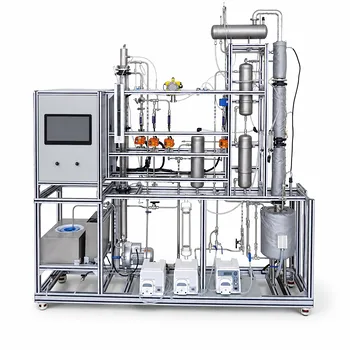
Dissolved carbon dioxide isn't just a nuisance—it's a silent aggressor that carves grooves into your condensate pipelines. The corrosion mechanism is straightforward: CO₂ dissolves in the condensate to form carbonic acid, which increases the oxidizing power of hydrogen ions and directly attacks the steel. This attack creates the tell-tale physical grooving, especially at bends and threaded connections where tensile stress concentrates. Mitigation in chemical engineering pilot plants relies on neutralizing amines to raise the pH and eliminate the acidic condition, combined with smart physical design to remove stress and stagnation points.
The core issue is an acidic assault driven by dissolved CO₂. Left unchecked, it channels deep grooves into stressed metal. The solution is twofold: chemically neutralize the acid with the right amine for your system, and physically engineer the pilot plant to drain fully, keep surfaces smooth, and relieve fabrication stresses.
The Corrosion Mechanism: How CO₂ Attacks Your Pipeline
The primary reference makes it clear: the culprit is carbonic acid formation. But the attack is not uniform—it preferentially gouges the metal where mechanical forces concentrate.
Carbonic Acid Formation and the Acidic Assault
When CO₂ dissolves in condensate, it reacts to form carbonic acid (H₂CO₃). This weak acid doesn't just sit there passively.
The acid increases the oxidizing effect of hydrogen ions. In simple terms, it makes the water more aggressive at stealing electrons from iron. The metal surface becomes the anode, and the acidic condensate becomes a highly efficient cathode for hydrogen evolution.
This is an electrochemical reaction where iron goes into solution as Fe²⁺, leaving behind deep, localized material loss. In pilot plants with cycle concentration effects, the condensate can become even more aggressive over time.
Why Grooving Occurs at Bends and Threads
The primary reference explicitly points to grooving at bends and threads. This isn't random; it's a stress-corrosion interaction. Tensile stress—whether from fluid pressure, thermal expansion, or residual fabrication—pulls the metal's atomic lattice apart slightly, making it more vulnerable to acidic attack. The carbonic acid then carves out a channel along this weakened zone, creating a smooth-bottomed groove that follows the stress line. In pilot plants with vibration from pumps and frequent batch cycling, this stress concentration accelerates the damage.
Chemical Mitigation: The pH Shield
Raising the pH eliminates the acidic driving force. But in a chemical engineering pilot plant, the choice of neutralizing agent is not one-size-fits-all.
The Role of Neutralizing Amines
Ammonia or organic neutralizing amines are injected to react with the carbonic acid and boost the condensate pH above 7.4. This converts free hydrogen ions to water, effectively shutting down the acidic corrosion mechanism. The amine travels with the steam, condenses in the lines, and provides protection exactly where it's needed.
Amine Selection: Matching Pressure and Metallurgy
The supplementary references add critical nuance:
- For low-pressure systems (below 15 psi): Cyclohexylamine is preferred because it has a more favorable vapor-liquid distribution ratio at those conditions.
- For high-pressure systems: Morpholine is more effective; it remains in the condensate phase at elevated temperatures and provides consistent pH control.
- If your pilot plant contains copper or copper alloys (e.g., in preheaters or instrument tubing): Do not use ammonia. Ammonia reacts with copper and dissolved oxygen to form stable, soluble cupric complexes, aggressively removing copper metal from surfaces. A filming or neutralizing amine that is non-complexing with copper must be used instead.
Physical Mitigation: Designing Stress Out
Pilot plants uniquely combine process flexibility with intense monitoring. This creates specific design vulnerabilities that chemicals alone cannot fix.
Complete Drainage and Smooth Surfaces
Any pocket of stagnant condensate becomes a concentrated carbonic acid reservoir. Pilot plants must be designed for complete drainage—no dead legs, no bellies in piping. Internally, surfaces must be smooth and joints should be welded butt joints, not lap joints. Lap joints create crevices where acidic condensate stagnates and concentrates, initiating crevice corrosion that can undercut the pipe wall.
Avoiding Galvanic and Stress-Assisted Cracks
Dissimilar metals in contact form a galvanic cell that dramatically accelerates the anodic partner's dissolution. In a condensate system with carbon steel piping and brass valves, the steel will corrode far faster if not electrically isolated. Additionally, the supplementary references highlight stress corrosion cracking (SCC) from fabrication: welded components without post-weld heat treatment (PWHT) harbor residual tensile stress. Combined with even trace amounts of chlorides or the acidic condensate itself, this can lead to sudden, brittle failure. PWHT relieves these residual stresses and is a critical manufacturing step for all pressurized pilot plant components.
Balancing Flow Velocities
The supplementary references emphasize that flow velocity must be managed. Too low, and solids drop out and create under-deposit acid cells; too high, and the protective iron carbonate scale (if any) is eroded away, exposing fresh metal. Pilot plant designs must keep velocities within a range that prevents both deposition and erosion-corrosion.
Understanding the Trade-offs
No single solution is perfect. Every choice involves practical compromises that a technical advisor must weigh.
- Ammonia is cheap but dangerous with copper. Its cost advantage disappears instantly if your pilot plant uses copper alloy heat exchangers, because it will destroy them. The trade-off is simple: never use ammonia near copper.
- Amine selection reduces freight and handling complexity but adds cost. High-quality neutralizing amines are more expensive per pound, but they require less volume and avoid collateral damage to downstream process sensors and analytical instruments that can be sensitive to ammonia off-gassing.
- Physical design modifications increase initial CAPEX. Full-penetration butt welds, PWHT, and sloped drainage cost more upfront than threaded connections and lap joints. However, in a pilot plant where downtime distorts research data and halts student learning, the lifecycle reliability gain vastly outweighs the fabrication cost.
- Over-neutralization can cause caustic issues. Pushing the pH too high (above 9.5) can induce its own form of corrosion or scaling, especially if dissolved oxygen is present. Accurate dosing with pH monitoring is non-negotiable.
Making the Right Choice for Your Pilot Plant
The correct mitigation strategy depends on your plant's primary operational characteristics. Choose the path that matches your deepest need.
- If your primary focus is protecting a low-pressure copper-containing system: Use cyclohexylamine and ensure all copper alloy surfaces are wetted with a non-ammoniacal neutralizing film. Physically isolate any brass components with dielectric unions.
- If your primary focus is a high-pressure all-ferrous steam/condensate loop: Select morpholine as the neutralizing amine, and mandate PWHT on all welded joints to eliminate SCC threats from residual stress in the aggressive condensate environment.
- If your primary focus is building a new educational pilot plant for corrosion studies: Integrate test coupons in removable racks, install deaerators and ion-exchange columns, and design the loop with variable-speed pumps so students can safely explore the boundaries of flow-accelerated carbonic acid attack and the effectiveness of different amine dosing strategies.
- If your primary focus is maximum operational uptime and data integrity: Start with complete drainage design, smooth butt welds, and no crevices. Then layer on a robust amine dosing system with online pH monitoring. This two-pronged approach eliminates the root cause mechanically and chemically, ensuring that your pilot plant produces reliable data, not premature failure histories.
Every piping groove tells a story of stress and acid working together. By understanding that relationship, you can turn your pilot plant into a model of resilience, not a cautionary tale.
Summary Table:
| Mitigation Type | Strategy / Agent | Key Function / Application | Key Considerations |
|---|---|---|---|
| Chemical | Cyclohexylamine | Neutralizes acid in low-pressure systems (<15 psi) | Avoid in systems containing copper |
| Chemical | Morpholine | Neutralizes acid in high-pressure systems | Higher cost; prevents sensor interference |
| Physical | Smooth Butt Welds & Slope | Eliminates stagnant condensate & crevice corrosion | Increases initial CAPEX |
| Physical | Post-Weld Heat Treatment | Relieves fabrication stresses | Essential to prevent stress corrosion cracking |
Prevent pipeline corrosion and ensure reliable research data with professionally engineered systems. LABPARK provides premium Educational and Vocational Unit Operations Pilot Plants in chemical engineering, bioprocess & biotech, and environmental & water treatment. Tailored for universities, research institutes, and enterprises, our pilot plants feature optimized physical designs and advanced corrosion-resistant configurations to maximize operational uptime and safety. Contact our technical experts today to design or upgrade your pilot plant system!
Related Products
People Also Ask
- How does operating pressure influence the transition between absorption and desorption in a CO2 pilot plant?
- How do temperature variations affect CO2 transport models in pilot plants? Model vs Reality
- What unit operations are critical for CCUS training pilot plants? Build hands-on engineering expertise.
- How do electrolytes affect phase equilibrium in absorption pilot plants, and how to calculate it?
- Why is critical surface tension key in column internals? Optimize gas absorption pilot plant efficiency