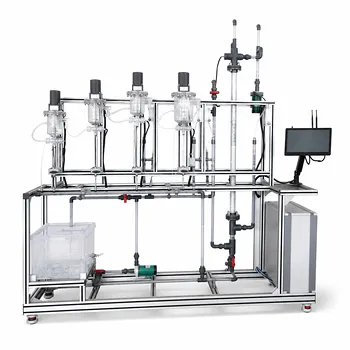
Mass balance equations and statistical methods are the two primary mathematical frameworks for analyzing and predicting polymer chain-length distributions in chemical engineering reactor unit operations. The mass balance approach systematically translates reaction kinetics into an infinite set of deterministic equations, while the statistical approach models chain growth as a stochastic process with probability distributions. Both are essential for validating reactor models against experimental data from pilot plants.
The core decision in polymer reactor modeling is not which method is "better," but which one aligns with your need for reactor-specific detail versus computational simplicity. Mass balances offer a mechanistic, configurable foundation, while statistical methods trade some realism for elegant, faster insights.
The Mass Balance Approach: Mechanistic Rigor
This method builds directly from the chemistry of polymerization. It is the go-to framework when you need a reactor-specific, high-fidelity prediction.
Building the Equations from Reaction Kinetics
The process starts with writing molecular species balances for each chain length. Each reaction step—initiation, propagation, termination, transfer—becomes a rate term in differential or algebraic difference equations.
The result is an infinite set of coupled equations. Because a polymer chain can theoretically be any length (from 1 to millions), you get one equation for each integer chain length n. This reflects physical reality but creates a formidable mathematical challenge.
Solving the Infinity: Analytical and Transform Techniques
Directly solving an infinite system is rarely feasible. Instead, engineers resort to a family of solution strategies that condense the information.
Moment generation is a workhorse method. It replaces the infinite set with a few ordinary differential equations describing the statistical moments of the distribution (total concentration, average molecular weight, polydispersity). This drastically reduces computational load while preserving key averages.
For full distribution shapes, generating functions or Laplace transforms convert the difference equations for chain length into algebraic forms. Solving in the transform space and then inverting yields the complete chain-length distribution, though the inversion can be mathematically intensive.
Continuous variable approximation is a powerful shortcut for large chain lengths. By treating chain length as a continuous variable, the discrete difference equations become partial differential equations resembling population balance models. This opens the door to analytical solutions for ideal reactors.
Validation in the Pilot Plant
The true test of any mass balance model is comparison with experimental gel permeation chromatography (GPC) data from a reactor pilot plant. Researchers adjust kinetic rate constants to minimize the error between predicted and measured distributions, a process that rigorously validates both the reaction mechanism and the reactor mixing assumptions.
Statistical Methods: Probabilistic Simplicity
Statistical methods take a top-down view. Instead of tracking every reaction, they ask: "What is the probability that a randomly selected polymer chain has a certain length?"
Modeling Chain Growth as a Stochastic Process
The polymerization is framed as a random walk or a Markov chain. Each monomer addition is a probabilistic event, determined by relative reaction rates. The sequence of additions builds the chain.
The primary advantage is conceptual clarity. The chain-length distribution emerges directly as a discrete probability distribution—for example, the geometric distribution for condensation polymerization or the Flory most-probable distribution. The calculations often reduce to simple closed-form expressions that instantly reveal the relationship between conversion and polydispersity.
A Trade-off in Reactor Flexibility
The statistical toolkit shines in ideal, well-mixed batch or CSTR environments where the probability of monomer addition remains stationary. Its core formulas often assume instantaneous initiation and homogeneous conditions.
However, adapting these methods to non-ideal reactors or complex configurations (like tubular reactors with axial dispersion, or reactors with strong viscosity gradients) is difficult. The probability parameters become functions of local, time-varying conditions, and the elegant closed forms break down. You are then forced into hybrid or simulation-based approaches that lose the original simplicity.
Understanding the Trade-offs
Choosing between these two approaches forces you to prioritize.
Reactor Configuration: The Deciding Factor
Mass balance models are inherently flexible. You can write them for a CSTR, a plug flow reactor, or a recycled loop with equal methodological rigor. The equations directly embed the reactor's residence time distribution and mixing pattern.
Statistical methods, in contrast, are configurationally brittle. Their classic forms are tied to specific, idealized mixing assumptions. Extending them outside a well-defined continuous stirred tank often requires rebuilding the statistical framework from scratch, negating their advantage.
Computational Cost and Depth of Insight
If you only need average properties—number-average molecular weight (Mn) and polydispersity index (PDI)—the moment method from the mass balance family is exceptionally efficient. Yet, statistical methods often give you these averages with a single algebraic equation, no ODE solver required.
But if you need the entire distribution shape to predict mechanical or rheological properties, mass balance/simulative approaches (like Monte Carlo kinetic models, which blur the line) offer the richest detail. The trade-off is computational expense: solving thousands of mass balance equations versus evaluating a probability formula.
Hybrid Reality in Modern Practice
In practice, the boundary is blurring. Many researchers now use Monte Carlo stochastic simulations that are effectively a brute-force statistical method, sampling individual chain growth histories based on deterministic reaction probabilities. This illustrates that the two methods are complementary viewpoints rather than competing doctrines.
Making the Right Choice for Your Modeling Goal
Your specific objective should dictate the primary method, and often a hybrid strategy emerges.
- If your primary focus is designing a new reactor geometry with complex flow: Start with the mass balance approach. Write the species balances for your specific configuration. Use the moment method first to converge on rate constants with your pilot plant data, then expand to full distribution prediction if needed.
- If your primary focus is quickly screening catalyst performance or benchmarking ideal reactor performance: Use statistical methods. The closed-form distributions for living or free-radical polymerization will let you instantly compare expected polydispersity and chain-end fidelity across experiments.
- If your primary focus is predicting the complete molecular weight distribution curve, including low-molecular-weight tails: Combine a mass balance core for the bulk distribution with a statistical model for oligomer formation, or employ a full kinetic Monte Carlo simulation that bridges both worlds.
The models are validated not by their mathematical elegance, but by their ruthless agreement with the distribution measured on your pilot plant’s GPC detector.
Summary Table:
| Feature | Mass Balance Approach | Statistical Methods |
|---|---|---|
| Core Principle | Mechanistic kinetics & species balances | Stochastic probability & random walks |
| Best Suited For | Complex reactor geometries & non-ideal flows | Ideal, well-mixed systems (Batch/CSTR) |
| Key Advantage | High-fidelity, reactor-specific flexibility | Low computational cost, elegant closed forms |
| Output Detail | Full distribution shape or statistical moments | Discrete probability distributions (e.g., PDI) |
Bring Theory to Life with LABPARK Pilot Plants
Validating complex polymer distribution models requires precise, reliable reactor data. LABPARK provides state-of-the-art Educational and Vocational Unit Operations Pilot Plants in chemical engineering, bioprocess & biotech, and environmental & water treatment. Designed specifically for universities, research institutes, and enterprises, our pilot plants bridge the gap between mathematical modeling and physical reality.
Ready to enhance your research and training capabilities? Contact us today to explore our custom pilot plant solutions!
Related Products
- Polymerization Granulation and Pellet Processing Educational Unit Operations Pilot Plant
- Residence Time Distribution and Reactor Flow Characteristics Determination Educational Pilot Plant
People Also Ask
- How do educational unit operations pilot plants address safety and waste management when scaling up?
- How do educational unit operations pilot plants bridge theory and design? Bridge the Engineering Gap
- Why Compare Predicted and Experimental Excess Enthalpy? Key to Accurate Pilot Plant Scale-up
- When to transition from PID to adaptive control in pilot plants? Key process indicators.
- How to study gasification in pilot plants? Compare exit gas composition & efficiency