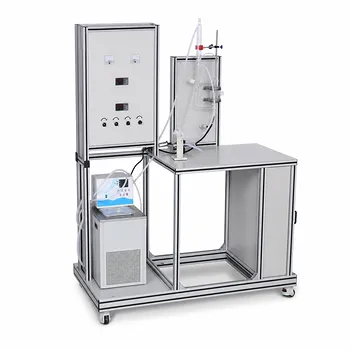
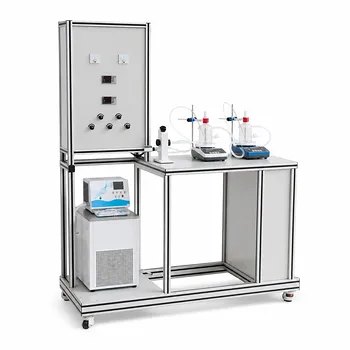
The fundamental difference isn't just about a pump—it's about whether you're simulating a dynamic engineering process or isolating a fundamental physical truth.
A vapor-circulation still creates a continuous, steady-state flow loop. You actively boil a liquid, condense the vapor, and mix the condensate back in to reach a cycling equilibrium representative of a single distillation stage under constant pressure. A static equilibrium cell, by contrast, has no net flow. A degassed mixture sits in a sealed chamber, held at a constant temperature until the molecules reach a true, static equilibrium, where you then measure the pressure that naturally develops. The former gives you direct boiling points (T-x-y) for distillation design; the latter delivers high-purity P-x data for testing thermodynamic models.
While both systems measure vapor-liquid equilibrium, they solve fundamentally different problems. The vapor-circulation still is a dynamic analog for an isobaric distillation stage, prioritizing direct measurement of vapor composition (
y) at a set pressure. The static cell is a pure thermodynamic measurement device, prioritizing the high-precisionP-xrelationship under strict isothermal conditions, withyderived later via calculation.
The Fundamental Operating Principles
To understand which tool to use, you must first see them not as related cousins, but as entirely different physical experiments. Their operating cycles dictate their strengths, weaknesses, and data types.
The Dynamic Loop of Vapor-Circulation Stills
The defining feature is the Cottrell pump, a mechanism that literally lifts boiling liquid and vapor to create a dynamic, circulating mixture. This isn't just a kettle; it's a controlled thermodynamic engine.
How the Cycle Reaches Steady State
The continuous loop blends two core processes. Active phase mixing occurs as the pump sprays a superheated mixture onto a thermometer, ensuring the measured boiling temperature corresponds precisely to the equilibrium state. Simultaneously, the condensate return redirects the condensed vapor back to the boiling flask, preventing the liquid composition from drifting. The system runs until this loop chemically stabilizes at a fixed pressure, which is when true steady-state sampling begins.
Why the Steady State Mimics One Distillation Stage
You are directly simulating a single theoretical tray. The boiling liquid you sample is the x composition leaving the stage, and the condensed vapor is the y composition leaving the stage above. The measured temperature is the bubble point of the liquid with composition x at the set pressure. This direct, isobaric T-x-y linkage is the still’s greatest practical value for process engineers.
The Sealed World of Static Equilibrium Cells
A static cell abandons all notion of flow. Its operating principle is one of absolute physical stillness and thermal uniformity, transforming the cell into a miniature system at rest.
The Rigor of Degassing and Isochoric Stabilization
Strict isothermal control is the absolute prerequisite. The entire cell sits in a bath, and the experimental protocol begins by removing all non-condensable air through vacuum degassing. This is critical because a foreign gas would corrupt the pressure reading. The mixture is then stirred internally, and you wait—there is no forced external circulation—for molecular diffusion to achieve a true, homogeneous equilibrium at a known overall composition.
Isothermal Measurement and the Invisibility of Vapor
Herein lies the core measurement trade-off. You get a supremely accurate total pressure (P) for a precisely known liquid composition (x) at a set temperature (T). However, you typically do not directly sample and analyze the vapor phase, as doing so would disturb the delicate equilibrium. The vapor's composition (y) is left unknown, to be calculated later using a thermodynamic model, unlike a still where you might directly analyze it.
Understanding the Trade-offs and Measurement Gaps
The choice between these methods forces you to embrace one set of compromises over another. No single device is universally superior.
The vapor-circulation still’s primary source of error is the physical flow itself. Channeling or partial condensation in the Cottrell pump can prevent true equilibrium, while pressure control fluctuations can shift the steady-state point. You also consume a relatively large volume of chemicals.
The static cell’s Achilles' heel is its absolute intolerance for air. Even a micro-leak or imperfect degassing results in a partial pressure of air that adds to the total pressure, rendering the data useless for model fitting. Furthermore, the vapor phase is never explicitly validated, meaning your model's ability to predict y can only be checked indirectly or via integration tests, like verifying thermodynamic consistency with the Gibbs-Duhem equation.
Making the Right Choice for Your Goal
Your specific research or teaching objective dictates the hardware, not the other way around. Frame your decision around what dependent variable you most need to measure directly.
- If your primary focus is designing or understanding a distillation column: Choose the vapor-circulation still. It directly generates the
T-x-yisobaric data that forms the graphical heart of the McCabe-Thiele method. - If your primary focus is regressing binary interaction parameters for an equation of state (like NRTL or UNIQUAC): Choose the static equilibrium cell. Its high-precision, isothermal
P-xdata provides the most stringent, unambiguous target for fitting activity coefficient models. - If your primary focus is measuring systems with extremely low relative volatilities or azeotropes that are sensitive to sampling: Lean toward the static cell. Its non-invasive pressure measurement avoids the compositional distortion that withdrawing a vapor sample can cause in a dynamically balanced still.
The true expert knows each device reveals a different facet of the same thermodynamic truth. Your task is to pick the lens that brings your specific problem into the sharpest focus.
Summary Table:
| Feature | Vapor-Circulation Stills | Static Equilibrium Cells |
|---|---|---|
| Operating State | Dynamic, continuous steady-state flow | Static, sealed chamber with no net flow |
| Primary Data Output | Isobaric $T-x-y$ data | Isothermal $P-x$ data ($y$ is calculated) |
| Equilibrium Mechanism | Cottrell pump & active phase mixing | Thermal uniformity & internal stirring |
| Primary Application | Distillation column design (McCabe-Thiele) | Fitting thermodynamic models (NRTL, UNIQUAC) |
| Key Limitation | Risk of partial condensation / high volume | Intolerant to trace air / no direct $y$ measurement |
Scale Up Your Chemical Engineering Lab with LABPARK
Choosing the right experimental setup is critical for accurate thermodynamic data and effective student learning.
LABPARK designs and delivers premier Educational and Vocational Unit Operations Pilot Plants in chemical engineering, bioprocess & biotech, and environmental & water treatment. Built for universities, research institutes, and enterprises, our pilot plants translate complex thermodynamic principles into hands-on, industry-ready expertise.
Ready to upgrade your laboratory capabilities? Contact LABPARK today to discover our customized VLE and unit operations solutions!
Related Products
- Binary System Vapor Liquid Equilibrium Data Determination Educational Unit Operations Pilot Plant
- Ternary Liquid-Liquid Equilibrium Educational Pilot Plant
People Also Ask
- For VLE Experiments: Fugacity vs. Activity Coefficient Method Selection Criteria
- Why correlate VLE pilot plant data using Wilson, NRTL, and UNIQUAC? Achieve Accurate Column Scale-Up
- How do pilot plants assist in teaching & researching non-ideal VLE? Bridge Theory & Physical Validation
- How to Model VLE for Supercritical & Unstable Components? Pilot Plant Methods
- Why is accurate VLE data critical? Optimize Unit Operations & Process Scale-Up