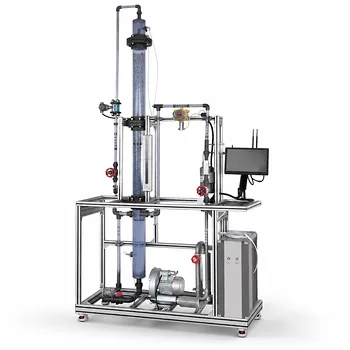
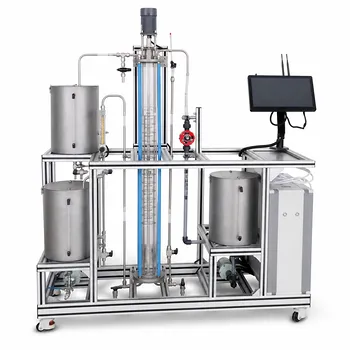
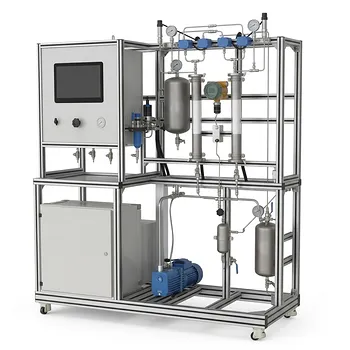
The key difference lies in which phase is continuous. In packed column unit operations, trickle flow defines a regime where gas is the continuous phase and liquid merely forms a thin film over the packing (the liquid level remains below the packing top). Bubble flow, by contrast, occurs when the packing is fully submerged—the liquid becomes the continuous phase, and the gas rises through it as bubbles. Packed columns are the preferred choice when handling corrosive materials and when the process demands minimal heat exchange during gas-liquid contacting.
At its core, a packed column’s flow regime dictates whether the gas or the liquid occupies the majority of the void space. Trickle flow delivers thin films for rapid mass transfer with low pressure drop, while bubble flow trades that for high liquid holdup and longer residence time. The decision to use a packed column in the first place often comes down to material compatibility and the thermal demands of the process.
The Two Regimes Inside a Packed Column
To truly understand when a packed column is the right tool, you must first grasp how the gas and liquid phases organize themselves inside it. The critical pivot point is the position of the liquid level relative to the packing.
Trickle Flow: The Gas-Continuous Film Regime
In this regime, the gas flows freely through the continuous void spaces of the packing. Liquid is introduced from the top and distributes itself as a thin film flowing downward over the external surface of each packing element.
The liquid level is deliberately kept below the top of the packing. This means the packing is merely irrigated, not flooded. Because the gas occupies the vast majority of the cross-section, the liquid holdup is extremely low. This configuration is the foundation of trickle-bed reactors (often co-current downflow for reactions like hydrodesulfurization) and countercurrent absorption columns.
Bubble Flow: The Liquid-Continuous Flooded Regime
Here the dynamic inverts. The liquid level is deliberately maintained above the packing, completely submerging it. The liquid now forms the continuous phase, and gas is sparged in from the bottom, rising as a dispersed swarm of bubbles through the packed bed.
This regime creates a high liquid holdup, providing a much longer residence time for the liquid phase. The packed bubble column geometry (often operated with co-current upflow) supports reactions where the liquid-phase kinetics are slow enough to require significant bulk volume. The price you pay is a higher pressure drop, driven primarily by the hydrostatic head of the liquid column above the gas sparger.
Why Packed Columns Are Preferred for Certain Applications
Selecting a packed column over a tray column or an empty bubble column is not arbitrary. It’s a targeted decision based on specific process needs, as highlighted by the primary reference and reinforced by the dynamics of interfacial contact.
Handling Corrosive Materials
Corrosive services demand construction materials that can withstand chemical attack. Packed columns shine here. The packing itself can be manufactured from highly resistant ceramics, specialized plastics, or exotic alloys. Unlike tray columns, where the complex hardware (trays, downcomers, weirs) represents a massive, expensive fabrication challenge in corrosion-resistant materials, a packed column is primarily a simple shell filled with relatively easy-to-manufacture packing elements. This makes them inherently more economical and safer for aggressive chemicals.
When No Significant Heat Exchange Is Required
This indication is a direct consequence of geometry. Packed columns are poor heat transfer devices. The low liquid holdup, the lack of large metal surfaces in direct contact with the bulk liquid, and the insulating nature of many packing materials make it incredibly difficult to add or remove heat effectively.
If your process is highly exothermic or endothermic and requires intermediate cooling or heating, a tray column with external heat exchangers or dedicated cooling coils on the trays is a much more practical choice. The packed column’s thermal limitation is a fundamental design constraint you must respect.
Maximizing Interfacial Area for Fast Reactions
For rapid gas-liquid reactions, the chemical reaction often completes entirely within the liquid film adjacent to the gas-liquid interface. In the film model, the concentration of the absorbed gas in the bulk liquid drops to zero.
Under these conditions, the total liquid volume is irrelevant; the rate-limiting factor is the gas-liquid interfacial area. Packed columns are the undisputed champions here. They distribute liquid as a thin film over an immense surface, achieving a specific interfacial area far greater than a stirred tank or an open bubble column. This is reflected in the dimensionless ratio $\alpha_1$ (bulk liquid volume to film volume), which is typically $10$ to $100$ for packed columns, versus $100$ to $10^4$ for bubble columns. A lower $\alpha_1$ means a larger fraction of the liquid is in the active film, exactly what a fast reaction demands.
Favorable Pressure Drop and Continuous Contact
Packed columns operate under continuous differential contact, where the gas and liquid compositions change smoothly along the column height. This results in a significantly lower overall pressure drop compared to the staged, stepwise contact of tray columns, where gas must repeatedly overcome the hydrostatic head on each tray.
This characteristic makes packed columns the go-to for vacuum distillation, where minimizing pressure drop is critical for maintaining relative volatility, and for absorption processes with low liquid flow rates that would struggle to seal a tray.
Understanding the Trade-offs and Limitations
No single equipment choice is universally optimal. Recognizing when not to use a packed column—or which flow regime to avoid—is a hallmark of sound engineering.
The Penalty of Longer Liquid Residence Time
The very feature that makes trickle flow ideal for fast reactions—a thin, low-volume film—becomes a liability for slow reactions. If the reaction requires significant residence time in the bulk liquid phase to reach completion, a trickle-bed packed column of equivalent volume will underperform dramatically.
A packed column operated in bubble flow (flooded) or a conventional bubble column offers a much larger liquid holdup. Their high $\alpha_1$ values ($100$ to $10^4$) provide the necessary capacity for bulk-phase reaction.
Flooding and Phase Distribution Headaches
The trickle flow regime has an operational ceiling. Increasing the liquid or gas flow rate beyond a critical point causes a transition to flooding, where the liquid accumulates catastrophically, pressure drop skyrockets, and the column becomes inoperable.
Even before flooding, poor initial liquid distribution can cause channeling—where liquid flows down preferential paths, starving large portions of the packing. This severely reduces effective interfacial area. Packed columns demand well-designed liquid distributors to perform as expected.
When to Avoid a Packed Column Entirely
Beyond heat exchange limitations, packed columns struggle with liquids containing suspended solids, which can clog the packing bed and require frequent maintenance. Furthermore, for operations requiring extremely high liquid flow rates, tray columns are often more robust and can handle a wider turndown ratio without distribution failure. Finally, if your primary need is a long, well-mixed liquid residence time for a slow reaction, a simple continuous stirred-tank reactor or an open bubble column without packing will likely be a more cost-effective and simpler solution than a flooded packed column.
Making the Right Choice for Your Goal
The selection of a flow regime and reactor type depends entirely on your process’s dominant requirements.
- If your primary focus is handling corrosive fluids or minimizing pressure drop: A packed column with chemically inert packing in a trickle flow regime is the superior, most reliable choice.
- If your primary focus is a fast, film-limited gas-liquid reaction: Choose a trickle-bed packed column to exploit its exceptionally high interfacial area and low bulk liquid volume.
- If your primary focus is a slow reaction requiring long liquid residence time: Opt for a column with high liquid holdup, such as an open bubble column or a packed column deliberately operated in a flooded bubble-flow regime.
- If your primary focus is a process demanding significant heat addition or removal: A packed column is generally unsuitable; direct your design toward tray columns with integrated cooling or external heat exchange loops.
- If your primary focus is educational flexibility in a pilot plant: Select a unit that can be configured for both trickle and bubble flow, enabling direct measurement of how holdup, pressure drop, and mass transfer coefficients shift with the phase continuity. Understanding the fundamental link between flow regime, liquid holdup, and mass transfer is the key to unlocking the right gas-liquid contacting strategy for any unit operation.
Summary Table:
| Regime | Continuous Phase | Liquid Holdup | Best Suited For | Key Advantage |
|---|---|---|---|---|
| Trickle Flow | Gas | Low (thin film) | Fast, film-limited reactions | Low pressure drop, high interfacial area |
| Bubble Flow | Liquid | High (submerged) | Slow, bulk-phase reactions | High residence time for liquid phase |
Bring Hands-On Unit Operations to Your Lab with LABPARK
To truly master packed column dynamics like trickle and bubble flow, students and researchers need hands-on experience with industry-grade equipment.
LABPARK provides state-of-the-art Educational and Vocational Unit Operations Pilot Plants in chemical engineering, bioprocess & biotech, and environmental & water treatment. Designed specifically for universities, research institutes, and enterprises, our pilot plants deliver safe, transparent, and highly adjustable platforms to study mass transfer, fluid dynamics, and regime transitions.
Ready to elevate your engineering training and research capabilities? Contact us today to find the perfect pilot plant setup for your facility!
Related Products
- Packed Bed Absorption Educational Unit Operations Pilot Plant
- Absorption and Desorption Educational Unit Operations Pilot Plant
- Multimodal Absorption and Desorption Pilot Plant for Unit Operations Training
- Educational Rotary Disc Liquid-Liquid Extraction Pilot Plant
- Continuous Batch Extractive Distillation Educational Pilot Plant
People Also Ask
- How Do Flow Regimes Transition in Packed Bed Pilot Plants? Key Scale-up Insights
- How does reactant concentration determine absorption column control? Gas-film vs. dual-film.
- How is the packing height of an absorption column calculated? Master HTU & NTU Concepts
- How does static vs. operating holdup affect pilot plant calibration? Avoid Critical Scale-Up Errors
- Why is counter-current flow selected for gas absorption? Maximize Pilot Plant Efficiency