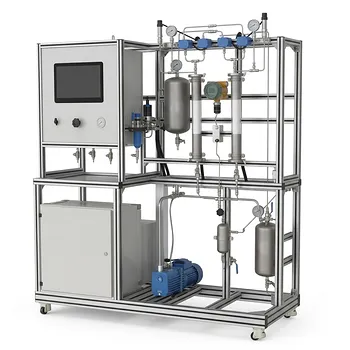
The lab-scale reaction of copper with nitric acid is a classic chemistry demonstration, but its scale-up reveals a critical lesson in industrial pollution control. In educational pilot plants, toxic nitrogen dioxide (NO₂) is not simply diluted and vented. Instead, the process is transformed into a hands-on unit operation where students channel the gas through a packed-bed absorption column. A counter-current stream of alkaline liquid, typically a sodium hydroxide solution, chemically neutralizes the NO₂, converting it into harmless salts. This setup directly teaches the engineering behind flue gas treatment and gas-liquid mass transfer.
The core insight is that educational pilot plants use this hazardous reaction not as a risk to be minimized, but as a powerful teaching tool. They bridge the gap between laboratory safety practices and industrial-scale pollution control, immersing students in the design, operation, and monitoring of scrubbing systems while also introducing proactive source reduction strategies.
Scaling Up Safety: From Fume Hood to Packed-Bed Scrubber
The way NO₂ is managed on a bench top versus in a pilot plant represents a fundamental shift in engineering mindset. It moves the focus from containment to controlled, chemical transformation.
The Bench-Scale Baseline
In a standard laboratory, the only required control is a fume hood. The reaction with nitric acid is conducted inside the hood, relying on high airflow to capture and dilute the gas below exposure limits. The toxic gas is physically removed, but its chemical hazard is not intrinsically eliminated.
The Pilot Plant Approach
A teaching pilot plant rejects simple dilution as a complete solution. It integrates the reaction with a downstream gas absorption unit. The NO₂-rich off-gas is directed into the bottom of a column packed with inert materials, while a liquid scrubbing solution is pumped in from the top. The gas and liquid flow counter-currently, maximizing contact.
The Chemistry of Neutralization
Inside the column, nitrogen dioxide reacts with the alkaline scrubbing liquor. For example, using sodium hydroxide (NaOH), the NO₂ is converted into a mixture of sodium nitrite (NaNO₂) and sodium nitrate (NaNO₃). The final liquid effluent is a non-volatile, salt-laden solution that is far safer and simpler to handle for subsequent disposal or recovery studies.
The Engineering Fundamentals Taught Through NO₂ Scrubbing
This setup is an ideal vehicle for teaching core chemical engineering principles because it is visually intuitive yet mathematically rigorous. Students see the brown gas disappear as they simultaneously collect quantitative data.
Gas-Liquid Mass Transfer
The driving force for absorption is the concentration gradient between the gas phase and the liquid phase. Students learn to calculate the overall mass transfer coefficient (KGa) by measuring inlet and outlet gas concentrations. They can alter gas or liquid flow rates and instantly see the effect on removal efficiency.
Packing and Column Design
The performance of the scrubber is heavily dependent on the internal packing material. Students learn to evaluate different packing types (Raschig rings, structured packing) and calculate critical design parameters.
- Packing height: How tall must the column be to achieve a target removal efficiency?
- Pressure drop: How does packing geometry affect energy consumption?
Hydrodynamic Limits: Flooding and Loading
A key safety and operational lesson is identifying the hydraulic limits of the column. By increasing the liquid or gas flow too much, students can purposely induce flooding, where liquid backs up and the column becomes inoperable. This teaches them to design around safe operating ranges using pressure drop correlations.
Process Control and Safety Instrumentation
Unlike a simple fume hood, the pilot plant is instrumented. Students learn to manage pressure monitors, temperature sensors, and flow controllers. Safety is managed through a sequence of devices: a safety trap to prevent liquid backflow into the reactor and controlled venting systems to manage any pressure build-up, ensuring airtight integrity during operation.
Moving Beyond End-of-Pipe: Teaching Source Reduction
Advanced teaching programs layer another critical concept onto the scrubbing exercise: that the best pollution control is to avoid creating the pollutant in the first place. The same pilot plant can be used to contrast different operational philosophies.
The Green Chemistry Alternative
Once students understand the cost and complexity of the scrubbing system, the curriculum often pivots to source reduction. They are asked to redesign the reaction to run under catalytic conditions, use an alternative oxidizing agent, or optimize for a high atom-economy pathway that minimizes NO₂ by-products.
Process Parameter Optimization
Using a pilot-scale reactor, students can manipulate temperature, pressure, feed ratios, and residence time to study how these variables influence the selectivity of the reaction. The goal shifts from scrubbing more gas to generating less. This directly demonstrates how efficient process design lowers both environmental impact and downstream treatment costs.
Sequential Purification as a General Model
The NO₂ scrubbing column is often presented as just one stage in a broader, multi-unit purification train. In analogous gas synthesis experiments, students first pass gases through a liquid washing bottle for chemical absorption, then through a drying column packed with a solid desiccant. This teaches them to think holistically about gas-phase management as a sequence of targeted unit operations, not a single fix.
Understanding the Trade-offs and Operational Limits
Managing gas-phase pollution at pilot scale comes with inherent challenges that are as important to teach as the theory. Objective assessment of these pitfalls builds real operational competence.
The Waste Liquid Stream Problem
The scrubbing column solves the air pollution problem by transferring it to a liquid waste stream. The resulting nitrite/nitrate solution must still be handled, stored, and disposed of responsibly. This is a powerful lesson in the concept of pollution transfer, not elimination.
Incomplete Neutralization
Systems can fail. If the scrubber is undersized, the pH is not properly controlled, or the temperature fluctuates, brown NO₂ can break through at the column outlet. Troubleshooting this teaches students to check liquid distribution and to verify that the reaction stoichiometry is being met with an adequate excess of scrubbing reagent.
Material Corrosion
Concentrated nitric acid and nitrogen dioxide are aggressively corrosive. The selection of wetted materials—from the reactor vessel to the column body, gaskets, and piping—is a critical safety and economic decision. Students learn that a seemingly perfect process design can be impractical without using specialized alloys or fluoropolymer linings.
How to Apply This to Your Program
Whether you are designing a new pilot plant or revamping a curriculum, the focus should be on aligning the equipment with your core educational objectives.
- If your primary focus is teaching classical unit operations: Build the plant around a well-instrumented packed-bed absorption column and have students generate full KGa and pressure drop curves under varying flow conditions.
- If your primary focus is process safety and plant integrity: Integrate a multi-stage setup with safety traps, automated pH-controlled scrubbing liquor dosing, and a pressure relief system. Emphasize hazard analysis protocols before any experimental run.
- If your primary focus is modern green engineering: Initially run the traditional scrubbing experiment as a baseline, then task students with modifying the reactor design and chemistry to measurably reduce NO₂ formation at the source before the gas ever reaches the column.
The ultimate goal is to use the vivid visual of a vanishing brown gas to etch into students’ minds that industrial pollution control is neither a passive nor a single-step endeavor, but a calculated, layered engineering challenge.
Summary Table:
| Key Learning Unit | Technical Focus & Parameters | Educational Objective |
|---|---|---|
| Gas-Liquid Absorption | Mass transfer coefficient ($K_G a$), packing height, pressure drop | Understand mass transfer & column design |
| Chemical Neutralization | Counter-current NaOH scrubbing of $NO_2$ into salts | Learn chemical containment & effluent handling |
| Hydrodynamic Limits | Column flooding, loading, & pressure drop correlations | Master safe operating ranges & limits |
| Process Safety & Control | Safety traps, venting, pH controllers, sensors | Implement instrumentation & process safety |
| Source Reduction | Green chemistry, catalyst optimization, feed ratios | Design cleaner, low-emission processes |
Bring Industrial-Scale Pollution Control to Your Lab
Looking to equip your students or research team with hands-on experience in gas-liquid absorption, chemical process safety, and environmental engineering?
LABPARK provides state-of-the-art Educational and Vocational Unit Operations Pilot Plants across chemical engineering, bioprocess & biotech, and environmental & water treatment. Designed specifically for universities, research institutes, and enterprises, our pilot plants deliver:
- Real-world experience: Safe, fully-instrumented systems for teaching gas absorption, mass transfer, and process safety.
- Industry-ready skills: Hands-on training on packed-bed columns, hydrodynamic limits, and environmental controls.
- Robust & safe design: Built with premium corrosion-resistant materials and advanced process safety controls.
Ready to upgrade your engineering curriculum or research capabilities? Contact LABPARK today to discuss your pilot plant requirements!
Related Products
- Packed Bed Absorption Educational Unit Operations Pilot Plant
- Absorption and Desorption Educational Unit Operations Pilot Plant
- Multimodal Absorption and Desorption Pilot Plant for Unit Operations Training
- Pressure Swing Adsorption Educational Unit Operations Pilot Plant
- Bench Scale Dual Column Gas Separation and Capture Educational Pilot Plant
People Also Ask
- How Do Flow Regimes Transition in Packed Bed Pilot Plants? Key Scale-up Insights
- How does reactant concentration determine absorption column control? Gas-film vs. dual-film.
- How is the packing height of an absorption column calculated? Master HTU & NTU Concepts
- How does the wall effect impact packed-bed conversion? Essential pilot plant scale-up tips.
- How does static vs. operating holdup affect pilot plant calibration? Avoid Critical Scale-Up Errors