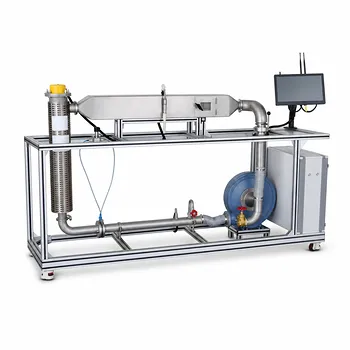
The essential design of a lab-scale industrial cooling water system must replicate a closed-loop utility process to deliver meaningful, real-world data. This requires integrating a cooling tower with a water basin, a circulation pump and modular piping network, a fan system for heat rejection, electrical switchgear for control, and chemical injection systems for water treatment. These core elements allow you to study pump hydraulics, thermal energy balances, and water chemistry kinetics simultaneously.
A functional lab simulation isn’t just about having a small tower; it’s about creating a stable, controllable, closed-loop system where mass and energy balances can be closed. The most critical factor is the integration of thermal rejection (the tower and fan) with water chemistry management (chemical dosing), as these two subsystems constantly influence each other.
The Core Components of a Closed-Loop System
To move beyond a simple "water-on-a-bench" experiment, the apparatus must physically represent the primary unit operations found in a chemical plant. Each component is a variable you need to control.
The Thermal Rejection Loop
The cooling tower is the heart of the system. For a modern, durable setup with a long service life, construction using fiberglass-reinforced plastics (FRP) is standard. FRP resists the corrosive environment created by treated water and prevents rust that would skew water chemistry data.
A water retention basin sits at the base of the tower. Its purpose is not just storage; it provides the net positive suction head required for the main circulation pumps to operate without cavitation.
The Circulation and Control Network
Modular piping is essential. Unlike a fixed residential setup, industrial simulation requires the ability to change flow paths, add inline sensors, or install different types of heat exchangers downstream. This flexibility is what enables true unit operations training.
The main circulation pumps must be sized to overcome the static head of the tower. But the real teaching value comes from the electrical switchgear. Integrating a variable frequency drive (VFD) allows you to manipulate flow rates precisely, letting students generate pump curves and calculate energy consumption in real-time.
The Air and Chemistry Interface
Fans dictate the driving force for heat transfer. Induced-draft fans pull air through the tower, and controlling their speed allows you to simulate different ambient conditions or part-load scenarios. You can demonstrate the link between wet-bulb temperature and cooling range.
Crucially, the system must include chemical treatment injection systems. In an open recirculating loop, you lose water to evaporation but leave behind minerals and solids. Without chemical injection and blowdown control, scaling and biological growth will invalidate your experiments within days.
Capturing the Full Picture: Beyond the Hardware List
Building the physical loop solves the surface need of having a cooling medium. However, the deep need in a lab setting is generating mass and energy balance data that reflect reality. This requires monitoring the "makeup" and "blowdown" streams.
The 5% Mass Balance Rule
You cannot simulate a utility without accounting for water loss. As confirmed by supplementary design rules, cooling tower makeup water generally requires about 5% of the total circulation rate. In a closed loop, this 5% is consumed by evaporation, drift, and deliberate blowdown.
If your lab tower circulates 100 gallons per minute, you must dose roughly 5 gallons per minute of fresh makeup water. Your lab design must explicitly include a flow meter on this makeup line. Closing the mass balance requires students to reconcile why water is disappearing and link it directly to the thermal load on the tower.
Quantifying Energy Consumption
Industrial utility simulation also requires an energy audit. A reliable design metric is that the daily power consumption (in kWh/day) for running cooling tower pumps and fans approximates 0.6 times the total water circulation rate (in gpm).
This isn't a trivial number. A high-flow pilot plant consumes significant electricity. Your lab simulation must include a power meter on the pump and fan circuits so students can calculate the coefficient of performance (COP) and see the direct trade-off between thermal rejection and operational cost.
Understanding the Trade-offs in Lab-Scale Design
Realism in a teaching lab often conflicts with size constraints and safety. Being a trusted advisor means acknowledging where a pilot plant falls short.
Closed Loop vs. Once-Through
Industrial towers reuse water; a once-through municipal water setup is simpler but educationally sterile. It teaches nothing about scale formation, cycles of concentration, or biocide management. The trade-off for a true closed loop is complexity—you must manage water chemistry immediately.
However, in high-humidity laboratory environments, operating a wet cooling tower can cause condensation issues on nearby sensitive equipment. In these specific cases, you face a trade-off between simulating a true evaporative utility and using an air-cooled exchanger. While an air-cooled system solves humidity and water chemistry complications, it erases the unit operation of mass transfer in a packed column, which is core to chemical engineering.
The Danger of "Scaled-Down" Fouling
A common pitfall is assuming chemical reactions scale down linearly. In a tiny tower, the surface-area-to-volume ratio is distorted. Scaling or biological fouling can choke the system much faster than in a plant. The deep need here is safety: you must integrate automated low-water cutoffs and temperature limits into the electrical switchgear to prevent overheating if a student miscalculates the treatment dose.
Making the Right Choice for Your Goal
Designing your lab simulation depends entirely on whether your primary objective is operational training or process research.
- If your primary focus is Operator Training: Emphasize the human-machine interface. Integrate a clear electrical switchgear panel with pump start/stop logic and chemical injection timers. Replicating the feel of a distributed control system (DCS) alarm—like a high basin level—is far more valuable than achieving a perfect cooling duty.
- If your primary focus is Process Dynamics Research: Prioritize modular piping and sensor ports. You need the ability to insert a fouling monitor or swap the cooling tower fill to test different mass transfer coefficients. The hardware must be scientifically flexible, not just robust.
- If your primary focus is Utility Efficiency Studies: Invest heavily in the VFDs for the fans and pumps. The system should be instrumented to continuously log power draw versus flow, proving the cube-law relationship of fan power rather than simply assuming it.
A truly effective pilot plant doesn't just pump cold water; it creates a controlled environment where the invisible costs of fouling, evaporation, and parasitic power usage become obvious, measurable data.
Summary Table:
| System Component | Key Function in Lab Simulation | Design Parameter / Rule |
|---|---|---|
| Thermal Rejection Loop | FRP cooling tower & basin for heat rejection without corrosion | Makeup water requires ~5% of the total circulation rate |
| Circulation & Control | Modular piping & VFD-driven pumps to study hydraulics | Power consumption (kWh/day) is ~0.6 x circulation rate (gpm) |
| Chemistry & Safety | Chemical dosing systems & electrical switchgear to manage fouling | Integrate automated low-water cutoffs and temperature limits |
Bring Industrial Reality into Your Laboratory
LABPARK provides state-of-the-art Educational and Vocational Unit Operations Pilot Plants in chemical engineering, bioprocess & biotech, and environmental & water treatment. Designed specifically for universities, research institutes, and enterprises, our modular systems help students and researchers bridge the gap between benchtop theory and industrial-scale operations.
Ready to elevate your lab's capabilities? Contact LABPARK today to discuss your custom pilot plant requirements!
Related Products
- Hot Filtration Educational Unit Operations Pilot Plant Laboratory System
- Circulating Wind Tunnel Drying and Convective Heat Transfer Coefficient Determination Educational Pilot Plant
People Also Ask
- How to Determine Specific Cake (r) & Filter Medium (Rm) Resistance Using Filtration Pilot Plant Data
- How to select solid-liquid separation equipment for pilot plants? A Step-by-Step Guide
- How can researchers identify and resolve filter medium blinding? Optimize Your Pilot Plant Runs
- Why Demo Constant-Rate to Constant-Pressure Filtration on a Pilot Plant? Key Practical Insights
- Why Analyze Filtration Flux & Cake Compressibility in Pilot Plants? Master Solid-Liquid Separation