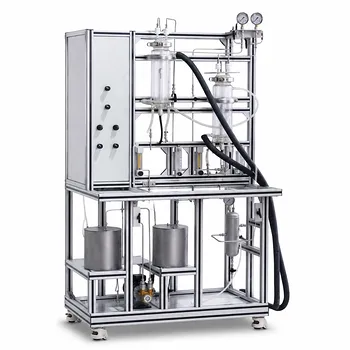
A flat-plate photoreactor is preferred for treating highly turbid or refractory wastewater because its thin, planar geometry minimizes the distance light must travel through the opaque medium. This configuration overcomes the fundamental problem of light extinction in optically thick fluids. By forcing the contaminated liquid into a shallow channel—often just millimeters deep—it ensures that UV photons can reach the target molecules even when the feed is heavily laden with light-scattering solids and dissolved chromophores.
In wastewater with high optical density, light penetration depth collapses to a few millimeters. A flat-plate photoreactor solves this by literally shrinking the reactor's depth to match that penetration limit, allowing treatment to proceed where annular or immersion-lamp reactors would fail.
The Physics of Light Limitation in Turbid Water
How Optical Thickness Paralyzes a Traditional Photoreactor
Wastewater from industrial and remediation pilot plants often contains suspended solids, emulsified oils, and refractory organics that act as optical barriers. Every particle or molecule can absorb and scatter photons. The cumulative effect is a fluid with an extremely high attenuation coefficient, where light intensity drops by orders of magnitude over a few centimeters.
In a conventional annular reactor—where a lamp sits inside a cylindrical vessel—the radiation must cross a radial path length determined by the vessel diameter. For practical reactor volumes, this path commonly exceeds 5–10 cm. If the fluid's effective extinction depth is only 2 mm, the vast majority of the reactor volume is dark, and photochemical reactions effectively stall.
The Defining Advantage of a Short Radiation Path
A flat-plate reactor switches the geometry. Instead of a thick cylindrical shell, the liquid flows through a narrow slit between two parallel plates, with illumination typically applied through one or both plate surfaces. The radiation path length becomes the channel depth, which can be engineered to match the measured penetration depth of the specific wastewater.
This means that even a feed with less than 5% UV transmittance (T254 < 5%/cm) can be uniformly irradiated, because the optical thickness across the plate gap can be kept below a critical threshold—often just a few millimeters. The photon flux density per unit volume remains high, driving contaminant degradation.
Why This Matters for Refractory and Turbid Feeds
Overcoming the Inability to Pre-Treat
Many refractory streams cannot be economically clarified. Adding a microfiltration or coagulation step upstream of a photoreactor would drive capital costs, generate secondary waste, and often fail against chemically stable emulsions or dissolved recalcitrant compounds. The flat-plate design accepts the turbidity as given rather than fighting it. It shifts the burden from pre-treatment to reactor geometry.
Matching Residence Time to Photon Availability
Photocatalytic or photolytic degradation of refractory contaminants is often rate-limited by photon delivery. When the radiation path is too long, a large fraction of the residence time is wasted in dark zones where no reaction can occur. A flat-plate reactor minimizes this dark volume fraction. Almost every cubic millimeter of the reactor channel lies within the effective light zone, dramatically improving the quantum yield per unit energy input—a critical metric for the economic viability of pilot plants.
Key Engineering Considerations
Reactor Aspect Ratio and Flow Distribution
The thin channel brings its own challenges. Achieving uniform flow distribution across a wide, shallow cross-section requires careful manifold design. Stagnation zones can create hotspots or reduced treatment efficiency. Modern flat-plate photoreactors often incorporate baffling or micro-structured plates to maintain turbulent or laminar plug flow without bypassing.
Material Choice and Fouling Resistance
High-turbidity wastewater increases the risk of surface fouling on the light-transmitting window. The plate material—typically quartz or UV-transparent polymers—must withstand not only radiation but also potential scaling from hardness ions or biofilm formation. Designing for easy cleaning or employing a self-cleaning mechanism (e.g., periodic chemical flush) is often necessary for sustained operation in pilot campaigns.
Understanding the Trade-offs
The Increased Surface Area Footprint
Concentrating the reactor volume into an ultra-thin layer necessarily requires a much larger illuminated surface area to process a given flow rate. A flat-plate photoreactor can occupy significant floor space compared to a compact annular unit. For fixed-footprint pilot trials, this may limit the maximum flow capacity, creating a design tension between optical efficiency and physical footprint.
Pressure Drop and Pumping Costs
A channel depth of only a few millimeters creates a high hydraulic resistance. The resulting pressure drop can demand a more powerful pump and increase operational energy costs. In long-duration pilot studies, this added complexity must be weighed against the avoided cost of pre-treatment. The trade-off usually favors the flat-plate when the alternative—clarification—is technically impossible or prohibitively expensive for a given feed.
Making the Right Choice for Your Pilot Plant
Selecting a flat-plate photoreactor ultimately depends on matching the reactor architecture to the optical character of your specific wastewater. Use the following goal-driven guidance:
- If your primary focus is treating a highly turbid stream without pre-treatment: Choose a flat-plate photoreactor with a channel depth verified to be below the measured attenuation length. This configuration eliminates dark zones and makes phototreatment feasible.
- If your primary focus is minimizing the physical footprint of the pilot plant: Evaluate a flat-plate design stacked in multiple parallel channels or consider a hybrid approach with a minimal in-line clarifier to reduce optical density, allowing a more compact reactor.
- If your primary focus is demonstrating economic viability for scale-up: Prioritize flat-plate reactors for feeds with T254 below 10%/cm, as the improved quantum yield often offsets higher pumping costs and larger footprint in life-cycle cost models.
When turbidity robs your photoreactor of its power, the solution is not clearer water—it is a smarter geometry that meets the light exactly where it can travel.
Summary Table:
| Feature | Flat-Plate Photoreactor | Annular / Immersion Reactor |
|---|---|---|
| Radiation Path Length | Millimeters (Thin flow channel) | Decimeters (Thick cylindrical shell) |
| Turbid Water Performance | High (Minimizes dark zones) | Low (Light blocked within centimeters) |
| Pre-treatment Needs | Minimal (Handles high solids) | High (Requires clarification/filtration) |
| Hydraulic Pressure Drop | Higher (Due to narrow channels) | Lower (Open cylindrical volume) |
Scale Up Your Water Treatment Research with LABPARK
Are you designing pilot studies for highly refractory or turbid wastewater? LABPARK provides advanced Educational and Vocational Unit Operations Pilot Plants across chemical engineering, bioprocess & biotech, and environmental & water treatment. We help universities, research institutes, and enterprises bridge the gap between theory and industrial reality with high-performance, customizable reactor systems.
Demonstrate economic viability and process efficiency for your next project. Contact our technical experts today to find the perfect pilot system!
Related Products
People Also Ask
- What are the key differences in membrane configurations? Choose the Right Unit Operations Pilot Plant
- How Do Pervaporation, Vapor, and Gas Permeation Differ in Pilot Plants? Key Comparison
- What are the structural & performance trade-offs of flat-sheet, spiral-wound, & hollow-fiber membrane modules?
- How do PEI, PVDF, and PSU membranes compare in pilot plants? Find the best fit.
- Pervaporation vs. Vapor Permeation: Handling Suspended Solids in Membrane Pilot Plants