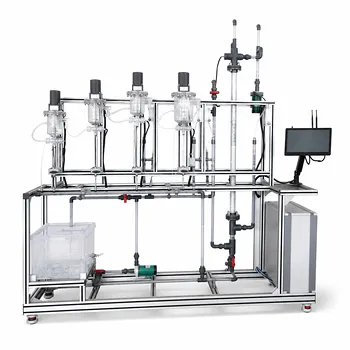
Thermal isolation, precise heating, and integrated sensing are the hallmarks of the suspended-tube microreactor design. For hydrogen production and catalytic reforming, these devices deliver process control that is unmatched by conventional lab-scale reactors. The core advantage lies in suspending the reaction channel to create a massive temperature gradient (often over 2000 °C/mm) that virtually eliminates heat loss to the environment. This physical isolation, combined with on-chip thin-film heaters and resistive temperature detectors, gives engineers the ability to set, measure, and rapidly adjust reaction conditions with exceptional fidelity.
To truly master a high-temperature endothermic reaction like catalytic reforming at pilot scale, you must first understand it in isolation. The suspended-tube microreactor is not just a vessel; it’s a precision instrument that strips away thermal noise so you can observe the kinetics in their purest form.
The Core Design Principle: Thermal Isolation Through Suspension
In any lab-scale study of reforming, the biggest enemy is heat loss. A conventional reactor loses energy to its surroundings, creating hot and cold spots that distort kinetic data and ruin the analogy to larger systems.
How the Suspended-Tube Geometry Prevents Heat Leakage
The reaction tube itself is fabricated from a material with very low thermal conductivity, such as silicon nitride. This tube is made extremely thin-walled and is physically suspended—often across a cavity etched into a silicon substrate. This creates a high-aspect-ratio bridge. Because the tube touches only a minimal support structure rather than a bulky insulator, conductive heat loss is almost entirely cut off. The result is a temperature gradient exceeding 2000 °C/mm directly at the tube edge, meaning the reaction zone can be at 700 °C while the microchip frame remains near room temperature.
Why This Matters for Catalytic Reforming Data
That sharp thermal boundary ensures that the entire power input goes into heating the reactants and driving the endothermic reforming reaction. You get a nearly adiabatic or perfectly heated reaction zone. This eliminates the “thermally smeared” conversion profiles that plague larger, heavily insulated reactors. The data you collect reflects only the chemistry and catalyst behavior, not the shortcomings of your furnace. For a pilot plant engineer, this means scaling decisions are based on true kinetic parameters, not on an artifact of the test equipment.
Precision Heating and Sensing: Closing the Control Loop
A suspended tube alone doesn’t give you control—only isolation. The second layer of sophistication comes from the integrated electronic features built directly onto the microreactor chip.
Thin-Film Heaters for Instant, Programmable Heat Delivery
Instead of relying on a bulky external furnace, suspended-tube microreactors use microfabricated thin-film resistive heaters deposited in direct contact with the reaction zone. The thermal mass of these heaters is negligible, so you can ramp from ambient to reaction temperature in seconds, not hours. For a hydrogen production study, this means you can program a precise temperature ramp for catalyst activation, then hold an isothermal setpoint without overshoot. The speed also enables experiments that mimic the rapid transients a real plant sees during startup or load-following.
Integrated Temperature-Sensing Resistors for Real-Time Monitoring
Right next to the heater, the same fabrication process puts down resistive temperature detectors (RTDs). These are typically platinum films patterned into serpentine traces. Because they are microns away from the catalyst bed, they measure the actual reaction temperature with sub-second response times. This direct, on-chip sensing eliminates the common problem of measuring furnace temperature rather than catalyst temperature. You can use this signal to establish a closed-loop PID control system that maintains catalyst temperature within a fraction of a degree, even when the system must absorb extra heat for a sudden increase in feed flow.
Fluidic Control and Integrated Process Modeling
Beyond perfecting the reaction itself, a pilot plant study needs to model the entire process sequence—including gas purification. The suspended-tube architecture can be designed as a miniaturized process train.
Passive Stop Valves for Safe, Predictable Fluid Routing
Tiny fluidic channels on the chip often include passive stop valves—surface-tension-based features that halt liquid or gas flow until a specific pressure is applied. In a microreactor, these act as automatic shut-off points to safely contain reactants or to sequence the introduction of steam and hydrocarbons during a startup protocol. They require no moving parts, making the system robust and reliable for long-term unattended operation in a pilot unit.
Coupling with Palladium Membrane Purification
A key downstream operation in hydrogen production is the removal of carbon monoxide. Suspended-tube microreactors can be directly interfaced with a microfabricated palladium membrane purification unit. This integration lets the entire test skid—reforming, water-gas shift, and hydrogen purification—fit on a single lab bench. You can study how a change in reforming temperature affects CO slip and, in turn, the permeate purity across the membrane, all in real time. This is process integration at a scale small enough to fit in a fume hood but sophisticated enough to predict full-plant interactions.
Understanding the Trade-offs
No technology is perfect. While suspended-tube microreactors offer unparalleled data quality, engineers must weigh certain limitations.
- Mechanical fragility: The thin silicon nitride tubes are brittle. A sudden pressure spike or an accidental touch during assembly can destroy the reactor. Handling requires a cleanroom-like discipline.
- Limited throughput: These devices are designed for kinetic screening and process modeling, not for producing meaningful volumes of hydrogen. They typically handle flow rates on the order of microliters per minute, so they cannot pilot a full commercial catalyst load.
- Fabrication complexity: Building a chip with integrated heaters, sensors, and suspended tubes is not a commodity service. It demands specialized MEMS fabrication facilities and a lead time that can delay a project.
- Potential for mass transfer blinding: The extremely small channel dimensions can sometimes shift the rate-limiting step from kinetics to mass transfer if not designed carefully. Independent verification that you are measuring intrinsic kinetics is essential.
Making the Right Choice for Your Pilot Plant Study
The decision to use a suspended-tube microreactor depends on what problem you are trying to solve.
- If your primary focus is generating high-fidelity kinetic data for reactor scale-up: This design is the gold standard. You get clean, thermally uncorrupted data that feeds directly into a first-principles model.
- If your primary focus is rapid screening of many catalyst formulations under identical thermal conditions: The fast thermal response and integrated sensing will dramatically increase your experimental throughput while reducing catalyst and utility costs.
- If your primary focus is demonstrable process integration at minimal scale: The ability to couple reforming with a Pd membrane on one compact platform provides a transparent, end-to-end model of an industrial hydrogen train.
- If your primary focus is producing enough hydrogen to test a downstream component (e.g., a fuel cell) for extended periods: A meso-scale microchannel reactor with a larger catalyst volume and higher heat duty will likely serve you better, even if it sacrifices some thermal perfection.
In the end, a suspended-tube microreactor isn’t a production tool—it’s a truth serum for your chemical process. Use it when understanding the reaction is worth more than ingots of hydrogen.
Summary Table:
| Design Feature | Key Benefit | Main Limitation |
|---|---|---|
| Suspended Tube Geometry | High thermal gradient (>2000 °C/mm); prevents heat leakage | High mechanical fragility |
| Thin-Film Heaters | Instant, programmable heating and rapid transients | Complex MEMS fabrication |
| On-Chip RTD Sensors | Real-time, sub-second response temperature control | Localized sensing only |
| Integrated Micro-Valves | Safe, passive fluid routing and process coupling | Limited fluid throughput |
Optimize Your Pilot-Scale Research with LABPARK
Are you looking to enhance process control and thermal management in your laboratory or facility? LABPARK provides state-of-the-art Educational and Vocational Unit Operations Pilot Plants in chemical engineering, bioprocess & biotech, and environmental & water treatment.
Designed specifically for universities, research institutes, and enterprises, our pilot plants enable you to:
- Generate high-fidelity kinetic data for seamless scale-up.
- Achieve precise process control and eliminate thermal noise.
- Model complex, integrated chemical processes at a manageable scale.
Ready to elevate your research capabilities? Contact LABPARK today to find the perfect pilot plant solution for your needs!
Related Products
- Micro-Scale Gas-Solid Catalytic Reaction Educational Pilot Plant
- Residence Time Distribution and Reactor Flow Characteristics Determination Educational Pilot Plant
- Educational Unit Operations Pilot Plant for Intraparticle Diffusion Effective Factor Measurement
People Also Ask
- Why is a multibed configuration necessary for exothermic reactions? Optimize your pilot plant trajectory.
- Fluidized vs. Fixed Bed Reactors: Comparing Heat & Complexity in Pilot Plants
- Why is thermal management a major challenge in methane oxidative coupling? Reactor Solutions for Pilot Plants
- How does the Mears criterion evaluate transport resistance? Key Guide to Intrinsic Kinetics
- How do reactor pilot plants safely study gas-solid reactions? Master kinetics with thermal & flow control.