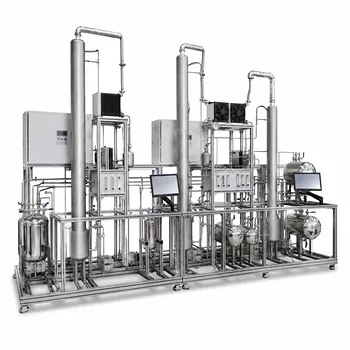
Here is the foundational difference: a sequential hybrid configuration keeps the distillation column and the pervaporation unit as physically separate, linked-in-series equipment, whereas a single-unit integrated system embeds the pervaporation membrane directly inside the distillation column.
At its core, the choice is between a linear, two-step process and a simultaneous, in-situ operation. The integrated configuration physically merges the two unit operations into a single piece of equipment, radically altering mass transfer, energy use, and the footprint of the pilot plant.
The Sequential Hybrid Configuration: Separate but Linked
This design mirrors a classic unit operation approach. It treats distillation and pervaporation as distinct, consecutive tasks.
How the Process Chain Works
In a sequential setup, the distillation column operates as a standalone unit. Its overhead distillate stream, rather than going to a final product tank, becomes the feed for the membrane unit.
The pervaporation (PV) unit is a separate module containing the membrane. The distillate contacts one side of the membrane, while a vacuum or sweep gas on the other side drives the permeation of water vapor.
This modularity makes it easier to independently optimize each step. You can tune column reflux and membrane surface area without their functions physically interfering.
The Underlying Separation Mechanism
The column first creates a vapor stream enriched in the more volatile component. The PV unit then performs a final polishing separation based on chemical affinity, not just volatility.
Because the two steps are decoupled, any upset in the column does not immediately destroy the membrane’s driving force. However, the process requires interconnecting piping, pumps, and condensers that add thermal losses and capital cost.
The Single-Unit Integrated System: A Unified Approach
This configuration reimagines the boundary between unit operations. The membrane becomes an internal component of the distillation column.
Embedding the Membrane Directly in the Column
In the integrated pilot plant, tubular hydrophilic membranes (often zeolite-based) are placed inside the column, typically in the rectifying section. The membrane sits directly in the vapor path.
As vapor ascends the column, water vapor permeates through the membrane wall and is removed via an internal sweep or permeate vacuum. This happens during the distillation process, not after it.
This instantaneous removal shifts the vapor-liquid equilibrium, allowing the distillation to push past traditional azeotropic limitations without needing a separate downstream unit.
Why It Improves Efficiency and Shrinks the Footprint
The most immediate gain is a reduced energy footprint. By removing water vapor in-situ, you lower the required reflux ratio for the same separation. Less condensing and reboiling demand means lower steam and cooling water loads.
The system also eliminates the shell, piping, and instrumentation of a standalone PV skid. For a pilot plant where space and flexibility are premium, this compactness is a decisive advantage.
Understanding the Trade-offs
While the integrated design is elegant, it is not universally superior. Ignoring its inherent limitations can lead to pilot plant failures.
Sacrificing Independent Control
The sequential hybrid gives you decoupled control. You can run the column at one set of conditions and the membrane at another. In the integrated unit, the membrane is exposed to the column’s internal temperature, pressure, and hydraulic gradients.
Any fouling or damage to a membrane module inside the column requires a full shutdown and potentially invasive disassembly. Maintenance complexity is significantly higher than simply valving off a separate PV skid.
Membrane Robustness and Pilot Plant Reality
The integrated approach demands membranes that can withstand the column’s mechanical and thermal environment. Tubular designs are chosen for their strength, but they still represent a single point of failure that can halt the entire distillation run.
For a pilot plant focused on gathering scale-up data, this intertwined operation can obscure which effect—distillation kinetics or membrane transport—is limiting performance. The sequential hybrid, by keeping them separate, provides cleaner, module-specific data for modeling.
Making the Right Choice for Your Pilot Plant Goal
Your selection turns entirely on what you need to prove with the pilot plant.
- If your primary focus is generating independent, block-box performance data for scale-up: Choose the sequential hybrid configuration. It allows you to characterize the distillation and pervaporation steps in isolation, giving you trustworthy, separable correlations for designing full-scale equipment.
- If your primary focus is validating a radically compact, energy-minimized process for a tight energy budget: Choose the single-unit integrated system. It will demonstrate the maximum synergy and lowest possible utility consumption, even though it sacrifices modularity and maintenance simplicity.
Ultimately, the design difference is not just about plumbing—it's a fundamental choice between modular clarity and intensified synergy, and the right answer is the one that aligns with the pilot plant’s true scientific mandate.
Summary Table:
| Feature | Sequential Hybrid Configuration | Single-Unit Integrated System |
|---|---|---|
| Equipment Setup | Separate distillation column & PV membrane unit | Membrane embedded directly inside the column |
| Control & Tuning | Decoupled; independent control of each unit | Interdependent; operating parameters are coupled |
| Energy Efficiency | Standard; requires reheating & condensing | High; in-situ removal reduces reflux & thermal load |
| Footprint | Larger; requires extra piping, pumps, & skids | Highly compact; minimal footprint |
| Maintenance | Simple; units can be isolated for service | Complex; requires column shutdown & disassembly |
| Best For | Independent data collection & scale-up modeling | Process intensification & energy-minimized footprint |
Ready to design or upgrade your engineering laboratories? LABPARK provides state-of-the-art Educational and Vocational Unit Operations Pilot Plants in chemical engineering, bioprocess & biotech, and environmental & water treatment.
We assist universities, research institutes, and enterprises in selecting, customizing, and implementing the ideal pilot systems to match your research objectives and training curricula.
Contact LABPARK today to receive expert guidance and a tailored proposal for your facility!
Related Products
- Electrolyte Distillation Purification and Formulation Educational Pilot Plant
- Multi-Functional Special Distillation Educational Pilot Plant
- Multi-Modal Distillation Unit Operations Training Pilot Plant
- Continuous Batch Extractive Distillation Educational Pilot Plant
- Multi Functional Membrane Crystallization Educational Unit Operations Pilot Plant
People Also Ask
- Why does simple distillation yield higher efficiency than flash distillation? Key thermodynamic differences.
- How to Integrate Spectroscopy in Distillation Pilot Plants for Advanced Process Control
- How Batch vs Continuous Configuration Affects Distillation Pilot Plant Versatility & Footprint
- How does the feed thermal state influence distillation pilot plant design and utility consumption?
- How to Verify Distillation Boundary Lines & Composition Regions with Pilot Plants