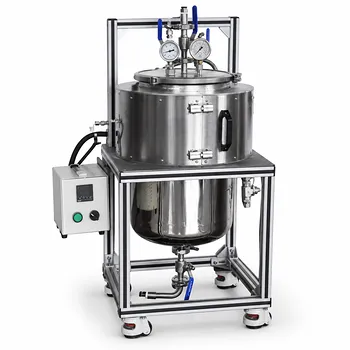
Getting slurry feed right in a pilot plant isn't just about mixing—it's a deliberate sequence of atmospheric batching, reliable pressurization, and unbroken agitation.
You begin by preparing the solid–liquid mixture in an open, atmospheric vessel so every gram is accounted for and the concentration is verified before the slurry ever sees pressure. Once the ratio is locked in, a dedicated pump lifts the slurry to the required reaction pressure, and throughout storage the tank is continuously stirred to prevent settling. This three‑step discipline—batch precision, pump‑driven pressurization, and persistent homogeneity—is what delivers consistent feed concentration and stable, clog‑free transport.
A robust slurry feed subsystem isn’t a single piece of equipment; it’s a choreographed progression from accurate atmospheric makeup through controlled pressurization to continuous agitation. Mastering this progression solves the core challenge: keeping a non‑Newtonian, settling‑prone suspension uniform from the weigh ticket all the way to the reactor nozzle.
The Blueprint for Precise Slurry Feed Systems
Why Atmospheric Preparation Comes First
Mixing solids and liquids under atmospheric pressure simplifies every measurement and handling step.
You can use load cells or weigh scales directly on the mixing vessel, eliminating the buoyancy corrections and safety interlocks that high‑pressure batching demands.
This transparency ensures the solid‑to‑liquid ratio is exactly what your process design calls for—before the slurry touches a pump or pressurization system.
Batch Mode as the Foundation for Concentration Control
Preparing slurry in batch mode makes recipe accuracy non‑negotiable.
Each batch is a self‑contained validation point: you verify the concentration analytically, adjust if needed, and only then release it to the feed system.
This strategy avoids the drift that plagues continuous mixing, where solids feeders or liquid flowmeters can introduce unnoticeable biases that compound over time.
In pilot‑scale environments, where every run feeds critical scale‑up data, that batch‑level certainty is invaluable.
Continuous Agitation: The Gatekeeper of Homogeneity
Even a perfectly prepared batch will stratify in a storage tank if left still.
Settling creates a dense bottom layer, a lean top layer, and an unpredictable concentration profile at the outlet—exactly what you cannot afford during continuous downstream feeding.
Continuous agitation, typically via a properly sized impeller, keeps the solids suspended in a near‑homogeneous state.
The key is designing the tank and agitator as a unit: the impeller diameter, tip speed, and baffle arrangement must produce sufficient bulk flow to overcome the settling velocity of the largest particles in your slurry.
Pressurization That Doesn’t Finish the Slurry
Once the slurry is uniform, transferring it to high‑pressure reaction conditions is a hydraulic task—but one with a twist.
The pump must handle erosive solids, potentially high viscosity, and a tendency to form a stagnant cake at the suction if not properly designed.
Progressive‑cavity or peristaltic pumps are common choices because they deliver a steady, pulse‑free flow without the internal crevices where solids can accumulate.
Pairing the pump with a piping layout that eliminates dead legs and maintains a velocity well above the particle‑settling threshold completes the stable‑transport loop.
Beyond Mixing: Subsystem Integration for Transport Stability
Managing the Thermal Profile Without Creating Dead Zones
Slurries often require temperature control, but standard heat exchangers become fouling magnets.
The practical solution in pilot plant design is to employ shell‑and‑tube exchangers with removable tube bundles or tube sheets, allowing periodic mechanical cleaning.
This design choice—driven by the pilot plant’s training mission—reinforces a critical lesson: heat transfer in non‑Newtonian suspensions demands not only a good heat transfer coefficient calculation but also a mechanical configuration that keeps solids moving and accessible for inspection.
Fluid Dynamics That Prevent Sedimentation
Stable transport is a dance between velocity, particle concentration, and pipe geometry.
If the flow velocity drops below the critical deposition velocity, particles begin to settle in horizontal piping, narrowing the effective cross‑section and eventually causing a blockage.
Pilot‑scale experimentation deliberately teaches how to measure this threshold and how to manage pressure drop—always with an eye toward keeping the slurry turbulent enough to suspend solids but not so energetic that it erodes pipe walls unnecessarily.
Understanding the Trade‑offs
Achieving precise feed concentration and stable transport isn’t a free win; it comes with real design tensions you must consciously balance.
Batch Precision vs. Production Throughput
Batch preparation gives the highest concentration accuracy but introduces a discontinuous rhythm. If your downstream process demands an uninterrupted feed, you’ll need a second storage tank and a staggered batch schedule—adding capital cost and operational complexity.
Agitation Intensity vs. Energy and Particle Integrity
Over‑agitating wastes energy and can fracture fragile crystals, changing the particle size distribution. Under‑agitating invites settling. The sweet spot is the minimum impeller speed that produces a just‑suspended condition, which must be determined for each slurry formulation.
Pump Selection vs. Maintenance Burden
Positive‑displacement pumps keep shear low and flow predictable, but their internal components (stators, hoses) wear out. Centrifugal pumps are simpler to maintain but can struggle with high solids loading and may require a flush system to keep seals clear. The reliability‑maintenance equation shifts with every new slurry.
Velocity vs. Pressure Drop
Higher pipe velocities safeguard against settling but increase friction losses, demanding more pump horsepower and potentially agitating the slurry to the point of air entrainment. The optimal velocity is the lowest one that maintains suspension—a value that must be validated on‑site.
Clean‑in‑Place Flexibility vs. Capital Cost
Removable tube bundles in heat exchangers or breakable pipe connections make cleaning straightforward but raise fabrication costs. A permanently welded, higher‑cost system might be justified if you’ll run the same slurry for months; but in a pilot plant, where formulations change frequently, access for cleaning is king.
Making the Right Choice for Your Pilot Plant Goal
Your operating protocol must reflect what you need the pilot plant to prove or teach. Start with the core mixing‑pressurization‑agitation sequence, then tune the details based on your primary objective.
- If your primary focus is high‑fidelity concentration data for scale‑up: Use batch preparation with gravimetric confirmation, and maintain continuous agitation with a validated just‑suspended impeller speed to feed a representative, documentable slurry stream.
- If your primary focus is demonstrating long‑run transport stability: Design for continuous agitation with an oversized storage tank that can buffer batch preparation, and instrument the transfer line to measure real‑time pressure drop as an early‑warning indicator of sedimentation.
- If your primary focus is operator training and unit operations education: Select heat exchangers with removable bundles and pipe runs with transparent sections, so students can directly observe settling behavior, fouling patterns, and the impact of pump selection on slurry integrity.
When the mixing vessel is calibrated, the pump is matched to the solids’ character, and the storage tank never stops moving, the entire subsystem becomes a dependable, teachable unit—not just a feeder, but a foundation for repeatable, insightful pilot‑scale results.
Summary Table:
| Phase | Operational Strategy | Key Benefit |
|---|---|---|
| Atmospheric Prep | Gravimetric batching in open vessels | Accurate solid-liquid ratios without pressure corrections |
| Batch Mixing | Self-contained validation before feeding | Eliminates concentration drift over time |
| Agitation | Continuous stirring with sized impellers | Maintains homogeneity and prevents particle settling |
| Pressurization | Positive-displacement pumps & no-dead-leg pipes | Pulse-free, stable transport without blockages |
Optimize Your Chemical Engineering Lab with LABPARK
Looking to teach or research advanced fluid dynamics and unit operations? LABPARK provides state-of-the-art Educational and Vocational Unit Operations Pilot Plants in chemical engineering, bioprocess & biotech, and environmental & water treatment. Designed specifically for universities, research institutes, and enterprises, our systems help students and researchers master complex processes like solid-liquid mixing and slurry transport.
Ready to upgrade your laboratory capabilities? Contact us today to request a quote and see how our tailored pilot plants can benefit your institution!
Related Products
- Hot Filtration Educational Unit Operations Pilot Plant Laboratory System
- Two-Dimensional Fluidization Hydrodynamics Educational Pilot Plant for Unit Operations Training
- Multi-Stage Stirred Tanks in Series Residence Time Distribution and Mixing Performance Determination Educational Pilot Plant
People Also Ask
- How to Determine Specific Cake (r) & Filter Medium (Rm) Resistance Using Filtration Pilot Plant Data
- How can researchers identify and resolve filter medium blinding? Optimize Your Pilot Plant Runs
- How to select solid-liquid separation equipment for pilot plants? A Step-by-Step Guide
- Why Demo Constant-Rate to Constant-Pressure Filtration on a Pilot Plant? Key Practical Insights
- How do Buchner funnels & leaf filters differ in filtration scale-up? Key Differences Explained