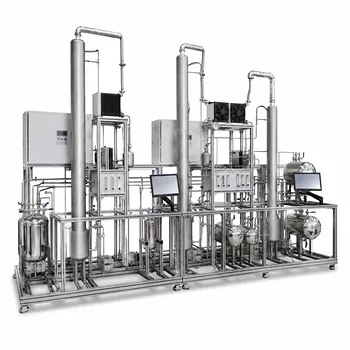
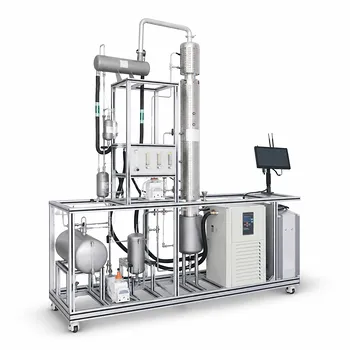
For a quick “yes or no” decision, the primary differentiator is your operating mode and thermal constraints.
Azeotropic distillation thrives in batch operations—common in academic and multi-purpose pilot plants—because you can simply charge the entrainer with the feed. Extractive distillation, meanwhile, requires continuous solvent addition and is inherently suited for steady-state, continuous runs. While azeotropic distillation often operates at a lower temperature profile (protecting heat-sensitive compounds), extractive distillation can be more energy efficient and offers a broader choice of separating agents.
The core insight is this: Choose azeotropic distillation when you value batch flexibility and must avoid thermal degradation of your products—even though you’ll pay an energy penalty for vaporizing the entrainer. Choose extractive distillation when you need continuous operation, wish to minimize energy consumption, and can tolerate a high-boiling solvent and its associated bottom temperature. In a pilot setting, both configurations serve as modular platforms to study entrainer recovery, mass transfer, and process dynamics—but your selection must hinge on how your lab operates and what your mixture can withstand.
Understanding the Separation Challenge
Why Regular Distillation Fails
When your mixture’s components boil within a few degrees of each other or form an azeotrope, standard fractional distillation becomes impractical. The relative volatility is too low—often below the economic threshold of 1.1—to achieve acceptable purity without an enormous number of stages and reflux.
A pilot plant for this scenario must therefore alter the mixture’s phase behavior by introducing a third component.
The Role of the Entrainer or Solvent
Both azeotropic and extractive distillation leverage an added agent to break the azeotrope or dramatically shift relative volatilities.
The key difference lies in what that agent does: in azeotropic distillation, the entrainer is chosen to form a new, low-boiling azeotrope with one component and leave the column overhead. In extractive distillation, a high-boiling, non-volatile solvent selectively interacts with one component and exits from the bottom.
Comparing the Two Configurations in a Pilot Plant
Operation Mode: Batch vs. Continuous
Azeotropic distillation is the natural choice for batch campaigns. Because the entrainer is simply charged into the still pot together with the feed, you avoid the complexity of a continuous solvent feed system. This makes it exceptionally flexible for academic labs where each run might explore a different mixture or entrainer.
Extractive distillation, by contrast, demands a continuous, precisely metered solvent stream near the top of the column. While achievable in a pilot plant, it forces a continuous operating philosophy that may not align with exploratory or teaching schedules.
Thermal Sensitivity of Your Products
A commonly misunderstood point: azeotropic distillation usually runs at a lower overall temperature than extractive distillation. The entrainer forms a minimum-boiling azeotrope that pulls the column top temperature well below the boiling points of the original components. This is often the deciding factor for heat-sensitive biochemicals or monomers.
Extractive distillation, although it can keep the overhead temperature near the boiling point of the light component, subjects the bottom product and the solvent to higher temperatures—risking degradation if your compounds are thermally fragile. If your primary reference states the opposite, it likely conflates energy efficiency with temperature level; the two are not the same.
Energy Consumption
Here the advantage flips: extractive distillation is more energy efficient because the solvent stays in the liquid phase. You expend energy mainly on heating and pumping, not on vaporizing a large entrainer stream.
In azeotropic distillation, you must boil the entrainer repeatedly—vaporizing it, condensing it, and recycling it. That latent heat demand increases steam and cooling-water loads, which matters when you’re scoping a process for scale-up.
Solvent Selection and Process Flexibility
Extractive distillation opens a wider window for solvent selection. Because the solvent does not need to form an azeotrope with the feed components, you can choose molecules that simply exhibit strong selective interactions—like water, high-boiling glycols, or compounds from the same homologous series as your bottoms product.
Azeotropic distillation, on the other hand, is constrained to entrainers that form a heterogeneous, low-boiling azeotrope with the target component. This can limit your options, though for classic separations like ethanol-water (using benzene or cyclohexane) the entrainer is well established.
Pilot Plant Reconfiguration and Learning Objectives
Modern teaching pilot plants feature modular columns, decanters, and solvent recovery loops.
In azeotropic mode, you’ll set up a decanter after the condenser to split the organic and aqueous phases, recycle the entrainer back to the first column, and send the water-rich phase to a second column. In extractive mode, the bottom stream of the primary column goes to a solvent recovery column where the solvent is recovered and recycled.
Swapping between these configurations on the same rig lets you compare mass transfer efficiencies, analyze the impact of reflux ratio and solvent-to-feed ratio, and physically trace each stream—an invaluable hands-on experience for researchers and students.
Understanding the Trade-offs
No single design fits every experiment. You must weigh the following trade-offs:
Batch simplicity vs. continuous throughput. Azeotropic setups excel in ad‑hoc trials but struggle to represent a production-scale continuous process. Extractive rigs mirror industrial practice better, but they demand a steady feed supply and longer equilibrium periods.
Temperature protection vs. energy cost. Azeotropic columns shield heat-sensitive products with their lower temperature profile, but you pay for that protection with higher utility loads. Extractive columns conserve energy but can expose heavy components to thermal stress.
Solvent flexibility vs. solvent compatibility. Extractive distillation’s generous solvent options can tempt you to overlook that the solvent will co-exist with your bottoms product. Any side reactions or degradation must be ruled out. Azeotropic distillation’s entrainer list is shorter but often includes well-characterized, safe choices like toluene or cyclohexane.
Column complexity and liquid‑liquid handling. Azeotropic pilot plants require robust decanters and careful level control, while extractive systems need precise solvent dosing and large-volume solvent storage. Both introduce operational challenges that are excellent teaching tools, but they require different instrumentation and safety precautions.
Making the Right Choice for Your Research Goal
Every decision should tie directly to what you aim to learn and how your lab operates.
- If your primary focus is fundamental batch studies or teaching flexibility: Set up the azeotropic configuration. You’ll be able to switch mixtures and entrainers quickly, run short experiments, and give students hands-on experience with decantation and recycling without the overhead of continuous solvent feed.
- If your primary focus is mimicking industrial continuous processes: Assemble the extractive distillation setup. A continuous feed and solvent stream let you study steady-state profiles, solvent-to-feed ratio optimization, and energy integration practices that mirror real-world column operation.
- If your primary focus is handling heat-sensitive or high-value compounds: Favor azeotropic distillation. Its lower operating temperature across the column protects thermally labile molecules far more effectively, even though your energy bill will climb.
- If your primary focus is minimizing energy consumption for a scalable design: Choose extractive distillation. The absence of entrainer vaporization slashes utility demands, making it the more attractive option when you’re generating scale-up data for an energy-conscious process.
Your pilot plant is more than a separation device—it’s a flexible platform for exploring phase equilibria, mass transfer, and solvent recovery. By aligning your choice of configuration with your laboratory’s operational rhythm and your mixture’s thermal personality, you transform a simple separation task into a powerful research tool.
Summary Table:
| Feature | Azeotropic Distillation | Extractive Distillation |
|---|---|---|
| Operating Mode | Primarily Batch (highly flexible for labs) | Continuous (demands steady-state runs) |
| Thermal Profile | Lower temperatures (protects heat-sensitive compounds) | Higher bottom temperatures (risk of degradation) |
| Energy Efficiency | Lower (latent heat needed to vaporize entrainer) | Higher (solvent remains in liquid phase) |
| Solvent Selection | Restricted (must form low-boiling azeotrope) | Broad (based on selective interactions) |
| Key Equipment | Decanter, liquid-liquid separator | Continuous dosing pump, solvent recovery column |
Optimize Your Unit Operations with LABPARK
Are you looking to configure the ideal distillation setup for your research or curriculum? LABPARK provides premium Educational and Vocational Unit Operations Pilot Plants in chemical engineering, bioprocess & biotech, and environmental & water treatment.
Specially designed for universities, research institutes, and enterprises, our modular distillation rigs allow researchers to easily compare mass transfer, entrainer recovery, and process dynamics in both azeotropic and extractive modes.
Let us help you build a flexible, scalable, and safe learning environment. Contact LABPARK today to request a quote or custom configuration!
Related Products
- Multi-Functional Special Distillation Educational Pilot Plant
- Continuous Batch Extractive Distillation Educational Pilot Plant
- Green Anhydrous Ethanol Purification Extractive Distillation Unit Operations Training Pilot Plant
- Green Anhydrous Ethanol Refining Practical Training Pilot Plant
- Ethyl Acetate Synthesis Unit Operations Pilot Plant for Practical Training
People Also Ask
- Why does simple distillation yield higher efficiency than flash distillation? Key thermodynamic differences.
- How to Verify Distillation Boundary Lines & Composition Regions with Pilot Plants
- How to Integrate Spectroscopy in Distillation Pilot Plants for Advanced Process Control
- Why is the acentric factor important in pilot plants? Fluid property prediction.
- How does double temperature difference control improve distillation pilot plants? Stabilize purity.