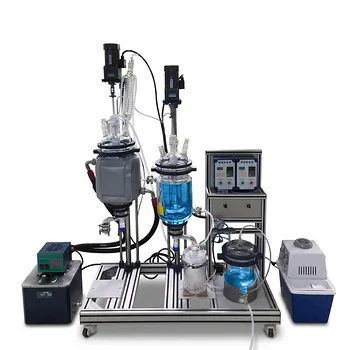
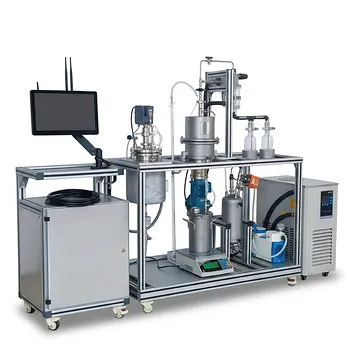
Crystallization mode selection starts with a simple, non-negotiable question: What does your compound’s solubility curve look like? In a unit operations pilot plant, researchers and students should first map the solute’s solubility–temperature relationship in the chosen solvent. If solubility drops sharply on cooling, cooling crystallization is the natural first choice. When that curve is too flat for acceptable yield, antisolvent, evaporative, or reactive crystallization become the workable alternatives. The decision hinges on a thermodynamic reality, but every mode you select also sets up a distinct kinetic and polymorphic landscape—exactly what a pilot plant is meant to explore.
The solubility–temperature curve is your master key. Cooling crystallization works when solubility plummets with temperature; antisolvent, evaporative, and reactive modes step in when cooling alone falls short. But in a pilot plant you are not just recovering mass—you are choosing between thermodynamic and kinetic control, and laying the groundwork for polymorph selectivity, particle size, and scale‑up behavior.
The Solubility Curve: Your First Decision Point
Cooling Crystallization: When Temperature Is Your Lever
Choose cooling crystallization when the compound is highly soluble at elevated temperatures (e.g., >100 mg/g solvent) and nearly insoluble at low temperatures (<20 mg/g). This steep solubility decline lets you generate high supersaturation simply by reducing the jacket temperature. In the pilot plant, it is the most energy‑efficient route and the easiest to control with standard tank or scraped‑surface crystallizers.
Antisolvent Crystallization: When Cooling Hits a Wall
If cooling alone cannot achieve sufficient yield at reasonable dilutions, turn to antisolvent (drowning‑out) crystallization. The test is straightforward: add a miscible non‑solvent and confirm that the compound’s solubility drops by more than 50%. This mode enables high recovery even when the solubility–temperature curve is shallow, but it adds complexity—the pilot plant must handle precise antisolvent addition and often scraped‑surface cooling to avoid fouling.
Reactive Crystallization: For the Truly Insoluble
When the final product is essentially insoluble in all candidate solvent systems, soluble precursors are reacted to form the solid phase directly. Reactive crystallization is common for ionic salts or pH‑sensitive compounds. In the pilot plant, mixing intensity and residence time become critical because supersaturation is generated locally at the feed point, not uniformly throughout the vessel.
Evaporative Crystallization: Driving Mass Recovery Beyond Solubility Limits
Use evaporative crystallization when the solute’s solubility changes little with temperature or when you need to increase yield beyond what cooling alone can deliver. By removing solvent—often under vacuum—you elevate the solute concentration above the solubility limit. In pilot‑scale training, this mode vividly demonstrates how vacuum systems and heat transfer area dictate both productivity and crystal size.
Beyond Yield: Polymorph Control and Kinetic vs. Thermodynamic Pathways
Thermodynamic Control with Slurry Crystallization
Slurry crystallization is the most effective tool for inducing a solvent‑mediated transformation to the most thermodynamically stable polymorph. It works best with a solvent that provides an appreciable solubility (above about 8 mM) to allow faster transformation kinetics. In your pilot plant, this means operating at near‑equilibrium conditions with a long holding time to let the stable form nucleate and grow while metastable crystals dissolve.
Kinetic Control and Ostwald’s Rule of Stages
Cooling and evaporation techniques typically operate under kinetic control. The rapid creation of supersaturation often follows Ostwald’s law of stages: the least stable polymorph nucleates first and may later transform. A pilot plant equipped with in‑situ probes lets you watch this unfold. Choose this pathway when you want to study transformation rates or when the target polymorph is the kinetic product, but be prepared for batch‑to‑batch variability.
Seeding Strategy: From Primary Nucleation to Controlled Growth
Unseeded Operation: The Metastable Gamble
In unseeded mode, the system is driven beyond the metastable limit to trigger primary nucleation. The resulting crystal size distribution is often broad and unpredictable. Use this mode only when your goal is to map the metastable zone width or when seed crystals of the desired form are unavailable.
Seeded Operation: Staying Within the Safe Zone
Introducing seeds within the metastable zone shifts the dominant mechanism from nucleation to growth. The pilot plant’s real‑time temperature and concentration sensors allow you to follow the desupersaturation profile and confirm that uncontrolled secondary nucleation has been suppressed. This is the route to reproducible particle size and polymorph identity—critical for validating kinetic models at scale.
Translating Mode to Pilot Plant Hardware
Tank, Scraped Surface, and Circulation Crystallizers
Your mode choice dictates the equipment configuration. Simple tank crystallizers suit small‑scale cooling or antisolvent batches. Scraped surface crystallizers prevent fouling during antisolvent or cooling of viscous organics. For evaporative or vacuum adiabatic cooling, slurry circulation (DTB) or mother‑liquor circulation (Oslo) crystallizers provide the residence time and fluidization needed to grow large, uniform crystals.
Melt vs. Solution Crystallization Modules
In a modern teaching pilot plant, integrating both melt and solution modules is invaluable. Melt crystallization operates near the freezing point and is driven purely by supercooling—ideal for high‑purity organic purification. Solution crystallization relies on supersaturation and mass transfer. Running both side by side demonstrates the difference between heat‑transfer‑driven and mass‑transfer‑driven solid–liquid separation, a foundational concept in unit operations.
Understanding the Trade-offs
Yield vs. Purity vs. Particle Size
A mode that maximizes yield (e.g., fast evaporative crystallization) often compromises crystal purity or size uniformity. Antisolvent addition can trap solvent if not controlled. Seeding improves particle size but demands a perfectly matched seed polymorph. Every mode forces you to prioritize.
Operational Complexity and Energy Costs
Cooling crystallization is simple and energy‑lean. Evaporative crystallization requires vacuum and steam, raising cost and complexity. Reactive crystallization demands fast mixing and precise stoichiometry. Antisolvent recovery adds a distillation step. Choose the simplest mode that meets your experimental objective—don’t over‑engineer a pilot‑scale study.
The Solvent Selection Trap
Solvent choice is a primary driver of polymorph selectivity and yield. A solvent that stabilizes a particular molecular conformation in solution can nucleate the corresponding conformational polymorph. But a high‑boiling solvent that gives excellent solubility may be nearly impossible to remove downstream. Pilot‑scale screening must balance crystallization performance with solvent removal feasibility.
How to Design Your Pilot Plant Experiment
- If your primary focus is maximizing yield with minimal equipment complexity: Start with a steep‑solubility solute and cooling crystallization in a jacketed tank crystallizer. Use seeded operation to keep the process within the metastable zone.
- If your primary focus is isolating a specific polymorph: Use slurry crystallization in a solvent that provides >8 mM solubility to promote solvent‑mediated transformation to the stable form, and monitor the phase transition with in‑situ Raman or turbidity probes.
- If your primary focus is studying crystallization kinetics: Run unseeded cooling or evaporative experiments and acquire real‑time desupersaturation data to validate nucleation and growth models—accept the trade‑off of broader particle size distribution.
- If your primary focus is testing a compound with a flat solubility curve: Pair antisolvent addition with a scraped‑surface crystallizer to prevent fouling, and design a solvent‑recovery loop to evaluate full‑process economics.
- If your primary focus is demonstrating industrial relevance: Include both melt and solution crystallization modules. Melt crystallization offers a direct contrast in driving force (supercooling vs. supersaturation) and trains students on high‑purity organic separations.
By letting the solute’s thermodynamic personality dictate your mode choice—and then applying kinetic control deliberately—you transform your pilot plant from a simple demonstration unit into a precision instrument for discovery and scale‑up.
Summary Table:
| Crystallization Mode | Solubility Curve / Trigger | Typical Pilot Plant Hardware |
|---|---|---|
| Cooling | Steep solubility drop as temperature decreases | Jacketed tank, scraped-surface crystallizer |
| Antisolvent | Flat curve; solubility drops >50% with non-solvent | Scraped-surface cooling, precise dosing pump |
| Evaporative | Flat curve; solvent removed to exceed solubility limit | Vacuum system, DTB or Oslo crystallizers |
| Reactive | Highly insoluble product formed from soluble precursors | Stirred tank, local feed mixing control |
Scale Up Your Chemical Engineering Training with LABPARK
Are you looking to equip your laboratory with advanced, reliable training systems? LABPARK provides state-of-the-art Educational and Vocational Unit Operations Pilot Plants in chemical engineering, bioprocess & biotech, and environmental & water treatment.
We help universities, research institutes, and enterprises bridge the gap between theory and industrial practice. Our pilot plants allow students and researchers to master crystallization modes—from cooling to evaporative modules—with real-time control and precise monitoring.
Contact our experts today to find or customize the perfect pilot plant solution for your institution!
Related Products
- Potassium Salt Thermal Dissolution and Crystallization Separation Educational Unit Operations Pilot Plant
- Multi Functional Membrane Crystallization Educational Unit Operations Pilot Plant
- Supercritical High-Gravity Flash Evaporation Educational Unit Operations Pilot Plant
People Also Ask
- What are the benefits of integrating online PAT tools like ATR-FTIR into crystallization unit operations pilot plants?
- How do crystallization pilot plants improve student learning? Shift from manual observation to process control.
- Why is precise temperature control critical in crystallization pilot plants? Key to Scale-Up Success
- Control Crystallization Pilot Plant Secondary Nucleation: 4 Key Adjustments
- What key factors should be considered when configuring a crystallization unit operations pilot plant?