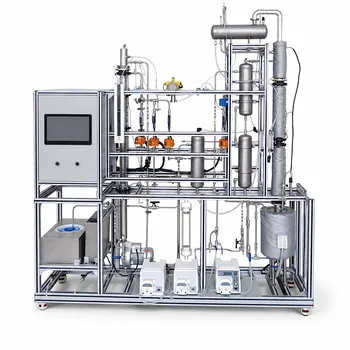
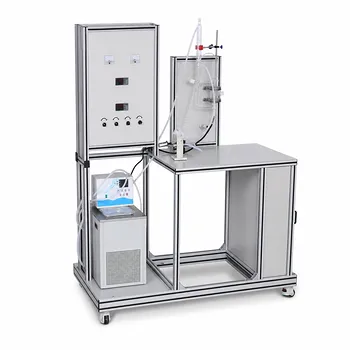
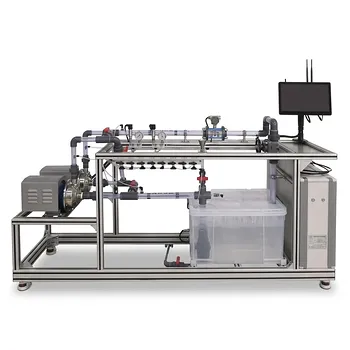
Vacuum generation is not just a peripheral utility—it's a critical process variable that defines whether you can safely distill a heat-sensitive compound or dry a crystal without thermal degradation. In chemical engineering pilot plants, vacuum is demonstrated by integrating different pump technologies directly into the process. For low-to-medium vacuum (roughly 10 mmHg), reciprocating positive displacement pumps and liquid ring pumps are commonly used. When the demonstration requires high gas flows or deeper vacuum (down to 0.1 mmHg), steam ejectors take center stage, showcasing how steam expansion can pull extreme suction. The pilot plant setup includes vacuum-rated sealing, pressure sensors, and modular piping so that students and engineers can study working principles, sizing, and energy efficiency under real operating loads.
Vacuum generation in a pilot plant is far more than flipping a switch. It is demonstrated through a hands-on comparison of positive displacement, liquid ring, and steam ejector technology—each chosen to teach the relationship between pressure, flow, and energy cost, so that engineers learn to match the right vacuum source to the process demand.
Why Vacuum Is Essential in Chemical Engineering Pilot Plants
The Process Drivers: Distillation, Drying, and Filtration
Many unit operations simply cannot run at atmospheric pressure. In pilot-scale distillation, lowering the boiling point by applying vacuum prevents thermal degradation of heat-sensitive materials—think fatty acids or pharmaceutical intermediates.
Similarly, vacuum drying removes moisture at low temperatures, preserving product quality. And vacuum filtration accelerates liquid-solid separation by increasing the pressure differential across the filter medium.
Pilot plants must demonstrate exactly how vacuum influences these processes, because the pressure window determines product purity and yield.
Pressure Ranges and Their Practical Meaning
The term “vacuum” covers a wide spectrum. A pilot plant showing medium vacuum around 10 mmHg is replicating conditions for many organic distillations where lowering the boiling point just 50–100°C makes the process safe.
When the target is 0.1 mmHg or lower, the demonstration typically shifts to high-vacuum distillation or molecular distillation, often requiring a different pumping strategy entirely.
Students learn that pressure is not a single setpoint; it’s a dynamic variable that changes with vapor load, leaks, and condenser efficiency.
Equipment Typically Featured for Vacuum Generation
Reciprocating Positive Displacement Pumps
These piston-driven pumps physically sweep gas out of the system, achieving robust low-to-medium vacuum. In a pilot plant, they demonstrate the classic mechanical vacuum principle—volume expansion to reduce pressure.
They are often used when the gas stream is clean, because reciprocating pumps are sensitive to liquid slugs and particulate contaminants. Their energy draw is closely linked to the compression ratio, making them excellent for teaching sizing calculations.
Liquid Ring Pumps
A liquid ring pump uses a rotating impeller and a service liquid (usually water) to create a moving ring that compresses gas. They can handle wet vapor loads without damage, making them ideal for processes where condensables are present.
In demonstration, students watch how changes in seal-water temperature affect ultimate vacuum. These pumps are a workhorse for vacuum filtration and moderate vacuum distillation in pilot-scale setups, showing a clear trade-off between simplicity and ultimate pressure.
Steam Ejectors for High-Flow, Deep Vacuum
When the process demands high gas throughput and vacuum levels down to 0.1 mmHg, a steam ejector is the go-to. It operates by expanding high-pressure steam through a converging-diverging nozzle, entraining and compressing the process gas.
Pilot plants feature them to illustrate how a simple venturi device can pull a deep vacuum without moving parts. This demonstration often includes the entire steam-jet system: motive steam boiler, intercondensers, and aftercondensers, highlighting the relationship between steam pressure, vacuum level, and water consumption.
How a Pilot Plant Demonstrates the Full Picture
Integration into a Unit Operation
The demonstration is never a standalone pump on a skid. A typical versatile unit operations pilot plant integrates the vacuum source directly into a distillation column or dryer.
Vacuum-rated seals, gaskets, and flanges are visible to show how air in-leakage is prevented. Adjustable feed points and collection vessels under vacuum let students explore batch vs. continuous modes while monitoring pressure at each stage.
This direct integration makes the abstract concept of “vacuum” feel tangible: you see the boiling point drop on the temperature sensor as the pressure gauge falls.
Sensor Networks and Control Loops
Modern pilot plants are heavily instrumented. Pressure transmitters, thermocouples, and flow meters feed data to a distributed control system.
Students learn to tune control loops that modulate pump speed or ejector motive steam to hold a precise vacuum setpoint, even when the process load changes. This real-time data is what connects theory (vacuum pump sizing equations) to practice (energy consumption per kg of product).
Studying Sizing and Energy Efficiency
The pilot plant’s flexibility allows variable-speed drives on mechanical pumps and adjustable steam valves on ejectors. By systematically varying the process vapor load—like increasing the reboiler duty in a distillation column—learners see how pump capacity must be matched to the air and vapor load.
They can calculate the specific energy consumption (kWh per kg of vapor removed) and compare the steam ejector’s utility cost against the mechanical pump’s electrical cost, laying the foundation for a true total-cost-of-ownership analysis.
Understanding the Trade-offs
Mechanical Pumps: Reliability vs. Sensitivity
Reciprocating and liquid ring pumps are straightforward to operate, but they come with constraints. Reciprocating pumps cannot tolerate liquid slugs; a sudden carryover can damage valves. Liquid ring pumps consume seal water and lose efficiency if the water temperature rises.
Both are limited in ultimate vacuum compared to steam ejectors, so they suit medium vacuum applications but cannot economically pull below a few mmHg.
Steam Ejectors: Deep Vacuum, High Utility Cost
Steam ejectors deliver high capacity and very low pressures, but they require a dedicated steam supply and substantial cooling water for intercondensers. Their energy efficiency is low when compared to mechanical pumps in the medium vacuum range.
Pilot-scale demonstrations often highlight this: the ejector’s steam rate spikes if the cooling water temperature creeps up, teaching that a system is only as good as its utility support.
System-Level Pitfalls
Even the best vacuum pump will underperform if the process is full of leaks. Pilot plants intentionally introduce small air bleeds to show how in-leakage degrades vacuum and increases energy use.
Condenser performance also becomes critical—if the condenser doesn’t knock down enough vapor before the pump, the vacuum pump ends up handling extra vapor load, which can double its size. The demonstration makes it clear: vacuum is a system, not a component.
Making the Right Choice for Your Pilot Plant Goal
Your selection of vacuum equipment in a pilot plant should match the specific learning or process objective. Use these goal-based guidelines to frame your demonstration:
- If your primary focus is separating heat-sensitive materials: Feature a liquid ring pump or steam ejector integrated into a vacuum distillation column, emphasizing temperature control and low-pressure boiling point depression.
- If your primary focus is high-throughput operations like large-scale drying: Demonstrate a steam ejector system to show how high gas loads are handled without massive mechanical pumps, while studying the impact of motive steam pressure.
- If your primary focus is teaching mechanical pump fundamentals and energy efficiency: Use a reciprocating positive displacement pump with a variable-speed drive, and run experiments that quantify electrical consumption per cubic meter of gas evacuated at different pressures.
- If your primary focus is handling wet or corrosive vapor streams: Select a liquid ring pump and explore how seal-liquid temperature and composition affect performance, while discussing materials of construction.
The most powerful educational pilot plants combine multiple technologies side by side, so that the trade-offs become not just a lecture slide, but a visceral, data-driven experience.
Summary Table:
| Technology | Vacuum Range | Key Advantage | Typical Application |
|---|---|---|---|
| Reciprocating Pump | Low-to-medium (~10 mmHg) | High mechanical efficiency | Clean gas streams, dry systems |
| Liquid Ring Pump | Medium | Handles wet vapor loads | Vacuum filtration, distillation |
| Steam Ejector | Deep vacuum (down to 0.1 mmHg) | High gas flow, no moving parts | High-vacuum distillation, drying |
Bring Hands-On Process Control to Your Lab
Looking to equip your students or research team with industry-grade pilot systems? LABPARK provides premium Educational and Vocational Unit Operations Pilot Plants in chemical engineering, bioprocess & biotech, and environmental & water treatment. Designed for universities, research institutes, and enterprises, our modular systems demonstrate critical processes like vacuum generation with real-time data tracking.
Ready to upgrade your facility? Contact LABPARK today to request a customized technical proposal!
Related Products
- Multi-Functional Special Distillation Educational Pilot Plant
- Carbon Dioxide Absorption and Desorption Educational Pilot Plant for Carbon Capture Studies
- Binary System Vapor Liquid Equilibrium Data Determination Educational Unit Operations Pilot Plant
- Supercritical High-Gravity Flash Evaporation Educational Unit Operations Pilot Plant
- Centrifugal Pump Performance Determination Educational Unit Operations Pilot Plant
People Also Ask
- How does operating pressure influence Methylal/Methanol VLE? Discover its impact on distillation
- Why does simple distillation yield higher efficiency than flash distillation? Key thermodynamic differences.
- Why is thermodynamic consistency testing critical? Validate pilot plant VLE data to avoid costly design errors.
- How Batch vs Continuous Configuration Affects Distillation Pilot Plant Versatility & Footprint
- How does double temperature difference control improve distillation pilot plants? Stabilize purity.