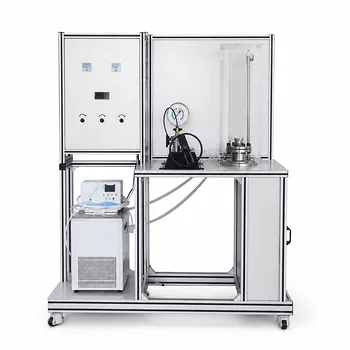
The most direct way to experimentally determine the effective diffusivity of a porous catalyst pellet is the steady-state Wicke-Kallenbach method. In this technique, a single pellet is sealed in a diffusion cell where two gas streams of different composition flow past its opposite faces at equal temperature and pressure. The net diffusive flux through the pellet is measured by analyzing the composition change of the exiting streams, directly yielding the effective diffusivity without the need for a chemical reaction.
The Wicke-Kallenbach method is the foundational steady-state experiment for measuring effective diffusivity in porous catalysts. It works by isolating pure diffusion as the only transport mechanism, turning a complex mass-transfer problem into a straightforward flux measurement.
The Core Principle of Steady-State Diffusion Measurement
The central idea is to create a controlled environment where the only driving force for gas movement through the pellet is a concentration gradient. By eliminating pressure and temperature gradients, the measured flux becomes a direct function of the pellet's pore structure.
How the Wicke-Kallenbach Cell Works
A cylindrical or spherical pellet is mounted in a gas-tight holder, dividing the cell into two separate chambers. An inert carrier gas (like helium) flows through one side, while a test gas (like nitrogen or argon) flows through the other.
The two streams are isobaric and isothermal. This prevents any bulk, pressure-driven flow, ensuring that transport occurs exclusively by diffusion. Any transfer of gas from one stream to the other must happen through the pellet's internal pore network.
From Measured Flux to Effective Diffusivity
By analyzing the outlet concentrations, you calculate the net molar flux of the diffusing species. Fick’s first law for a steady-state, one-dimensional slab then gives the effective diffusivity:
J = - D_e * (ΔC / L)
Where J is the measured flux, ΔC is the concentration difference across the pellet, and L is the pellet thickness. The calculated D_e captures the combined effects of the pellet's void fraction and tortuosity, the two key structural parameters that govern transport in a real porous catalyst.
Why Steady-State Methods Matter in Catalyst Design
Knowing D_e is not just an academic exercise. It’s the critical parameter that tells you whether your catalyst is truly performing as designed or is crippled by mass-transfer limitations.
Distinguishing Knudsen from Molecular Diffusion
In large pores, molecules collide with each other, a process described by molecular diffusion. In pores smaller than the gas's mean free path, molecules collide more often with the pore walls. This is Knudsen diffusion.
The Wicke-Kallenbach method can be operated with different gas pairs and at varying pressures to probe which mechanism dominates. The effective diffusivity you measure is actually a combined term, often described by the Bosanquet relation:
1/D_e = 1/D_{Ae} + 1/D_{Ake}
Here, D_{Ae} is the effective molecular diffusivity and D_{Ake} is the effective Knudsen diffusivity. This decomposition is essential for predicting how a catalyst will behave under reaction conditions.
The Alternative: The Differential Reactor Method
A completely different approach for estimating D_e involves measuring the reaction rate for pellets of different sizes. By crushing larger pellets into smaller ones, you eliminate internal diffusion limitations. When the activity stops increasing with further size reduction, you have found the intrinsic reaction rate.
The effectiveness factor of the larger pellet is then the ratio of its observed rate to this intrinsic rate. However, this method is indirect, requires a kinetic model, and fails for catalysts with non-uniform active phases, like eggshell catalysts. The Wicke-Kallenbach method avoids these complications by measuring diffusion in isolation.
Understanding the Trade-offs of Steady-State Diffusion Cells
No experimental method is perfect, and the Wicke-Kallenbach cell has well-known limitations that every researcher should consider. These challenges often dictate when an alternative technique becomes necessary.
The Critical Sensitivity to Sealing Leaks
The method’s greatest weakness is its extreme sensitivity to leaks around the pellet’s edge. Any bypass flow, even a tiny one, will dominate the measured flux and render the data useless. Sealing a pellet in a rigid cell without fracturing it or leaving a gap is a delicate art, especially with brittle materials.
Viability at High Temperatures
The sealing problem becomes exponentially more difficult at high temperatures. Thermal expansion differences between the pellet, sealing material, and cell body almost guarantee leaks. For this reason, the Wicke-Kallenbach method is largely limited to near-ambient temperature studies, making it ill-suited for simulating real reactor conditions.
The Problem of Dead-End Pores
A steady-state method only measures transport through pores that create a continuous pathway from one face of the pellet to the other. It is completely blind to dead-end pores that branch off the main network. These pores provide catalytic surface area but contribute nothing to the steady-state flux, causing the measured D_e to represent an incomplete picture of the true pore structure. Transient methods, like the chromatographic pulse response technique, can capture the gas held in these dead-end cavities.
Making the Right Choice for Your Measurement Goal
The Wicke-Kallenbach method is one tool among several. Your choice depends entirely on the specific information you need and the conditions you must simulate.
- If your primary focus is a direct, model-free measurement of transport diffusivity at ambient conditions: Use the Wicke-Kallenbach cell. It provides the cleanest separation of diffusion from other transport phenomena.
- If your primary focus is measuring effective diffusivity at high temperatures and pressures: Avoid the steady-state cell and opt for a transient chromatographic pulse response method, which does not require perfect sealing and can accommodate a packed bed.
- If your primary focus is accounting for the role of dead-end pores in your catalyst: Reject the steady-state method outright. A transient technique that measures uptake or pulse dispersion is essential for capturing the gas inventory in these blind pores.
- If your primary focus is predicting the effectiveness factor of a working catalyst: Combine a Wicke-Kallenbach measurement with a differential reactor study to decouple the structural properties of the pellet from the intrinsic reaction kinetics.
The true power of the steady-state experimental approach is its simplicity: by making diffusion the sole actor on your laboratory stage, you can directly observe the property that governs so much of chemical reactor design.
Summary Table:
| Method | Principle | Key Advantage | Major Limitation |
|---|---|---|---|
| Wicke-Kallenbach | Steady-state counter-diffusion across pellet | Direct, model-free measurement | High sensitivity to leaks & high temperatures |
| Chromatographic Pulse | Transient response in a packed bed | Handles high temperatures; detects dead-end pores | Requires complex mathematical modeling |
| Differential Reactor | Reaction rate analysis at various pellet sizes | Simulates active reaction conditions | Indirect; fails for non-uniform catalysts |
Elevate Your Chemical Engineering Lab with LABPARK
Are you looking to demonstrate advanced mass-transfer concepts like effective diffusivity to your students or research team? LABPARK provides premium Educational and Vocational Unit Operations Pilot Plants in chemical engineering, bioprocess & biotech, and environmental & water treatment. Designed specifically for universities, research institutes, and enterprises, our equipment helps you bridge the gap between theory and hands-on industrial practice.
Ready to upgrade your laboratory? Contact our engineering experts today to find the perfect pilot plant solution for your institution!
Related Products
- Educational Unit Operations Pilot Plant for Intraparticle Diffusion Effective Factor Measurement
- Carbon Dioxide PVT Curve Determination Educational Unit Operations Pilot Plant
People Also Ask
- How do educational unit operations pilot plants bridge theory and design? Bridge the Engineering Gap
- How do educational unit operations pilot plants address safety and waste management when scaling up?
- Why is the chemical plant startup schedule crucial? De-risk scale-up with pilot plants.
- How do deviations in estimating latent heat impact pilot plant thermal systems? Avoid hardware mis-sizing.
- Why Compare Predicted and Experimental Excess Enthalpy? Key to Accurate Pilot Plant Scale-up