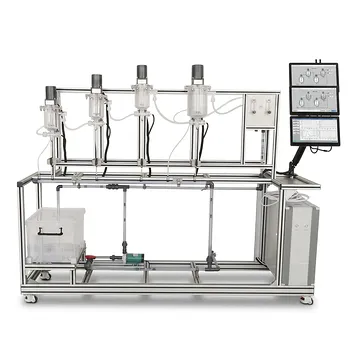
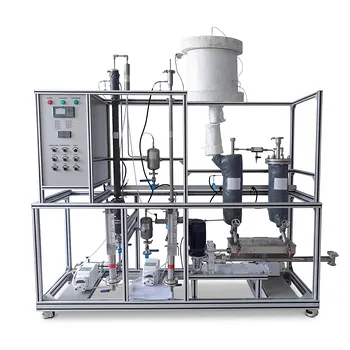
Short residence times and optimized tube geometries are the primary levers for maximizing olefin yields in steam cracking. By physically constraining how long the hydrocarbon feedstock is exposed to high temperatures, tube configurations like split-coil designs directly suppress secondary reactions that would otherwise consume the target ethylene and propylene. In chemical engineering unit operations pilot plants, this industrial reality is scaled down using micro-tubular reactors with precise temperature and flow control, allowing students and researchers to systematically manipulate residence time by adjusting feed rates and steam-to-oil ratios to map the direct kinetic path to higher selectivity.
While the chemistry of cracking demands high temperatures to break bonds and form olefins, the core challenge is thermodynamic: heat also accelerates destructive secondary reactions. The solution isn't simply adding more heat, but managing the physical dimensions of the reactor—specifically tube diameter, length, and branching—to create a millisecond-scale thermal contact time that "freezes" the reaction at the most profitable point.
The Unbreakable Couple: Time and Temperature in Olefin Production
The production of light olefins is a kinetic race against time. The reactor's physical design is the racetrack, and its configuration dictates who wins.
Primary vs. Secondary Cracking Chemistry
Thermal cracking is a cascade of free-radical reactions. Primary reactions are the desired high-yield steps where large naphtha or ethane molecules break down directly into ethylene and propylene.
Secondary reactions are the yield-killers. The newly formed olefins, if left in the hot zone too long, will further crack into methane, dehydrogenate into acetylene, or polymerize into heavy fuels and coke. These reactions consume your target product and physically foul the reactor.
Why Residence Time is the Kinetic Controller
The rate of primary cracking is faster than most secondary reactions, but not exclusively so. The fundamental strategy is to exploit this rate difference. By operating at extremely high temperatures (kinetically favoring primary cracking) and then quenching the reaction after a precisely short residence time (0.05 to 0.4 seconds), you maximize the yield of the desired intermediate.
A high temperature/low residence time strategy allows the primary reactions to run to near-completion while starving the secondary reactions of the time they need to become significant. The physical tube geometry is the instrument that enforces this timing.
How Tube Geometry Functions as a Process Variable
Residence time is not just a setpoint on a flowmeter; it's a fixed property of the reactor's physical design. The pilot plant allows you to change the "hardware variable" and observe the kinetic result.
The Split-Coil: A Study in Heat and Momentum
A simple, long, large-diameter tube is inefficient. It has a low surface-area-to-volume ratio, limiting heat transfer, and a long path length, guaranteeing high residence times and promoting secondary reactions.
Split-coil configurations (like 4-4-2-1 or 2-1 branching) solve this. They start with multiple small-diameter parallel tubes at the inlet. This maximizes heat flux into the cold feed, rapidly bringing it to cracking temperature. As the gas expands and cracking progresses, the parallel tubes merge into progressively fewer, larger-diameter tubes. This design strategy manages pressure drop and residence time simultaneously. It provides high heat transfer where it's most needed and a shorter, more controlled thermal contact time overall.
Millisecond Furnaces: The Extreme Frontier
For maximum selectivity, the industry trend moves toward millisecond reactors. This is achieved by drastically shrinking the internal tube diameter (e.g., from 127mm down to 28.6mm) and length. This geometry forces residence times down to an extreme 0.05–0.10 seconds.
In a pilot plant, replacing a standard coil with a micro-tubular, small-diameter coil provides a direct, observable lesson. The result is a measurable jump in ethylene yield, often by 1%–2% absolute—a massive economic gain in industrial terms. The physical tube acts as the final control element for yield.
Using a Unit Operations Pilot Plant to Decode the Process
An educational pilot plant translates these abstract kinetic principles into operational cause-and-effect. It’s a physical simulator for the reaction's governing equation.
Mapping the Kinetic Curve Through Feed Variation
The pilot plant's primary power is in decoupling variables. By keeping the tube geometry constant and systematically increasing the feed rate, the operator is directly decreasing the residence time (the space-time in the reactor).
Students can collect product samples over a range of flow rates, performing gas chromatography to plot ethylene and propylene yields against calculated residence time. The peak of this curve on a pilot plant chart is the visual proof of concept for a kinetic-limited reaction. It demonstrates that beyond a certain flow rate, quenching occurs too early, while below it, secondary reactions dominate.
Temperature Profiling and the Quenching Point
A pilot plant reactor with multiple temperature sensors along its length is not just a heater; it’s a diagnostic tool. These sensors map the coil outlet temperature (COT) profile, showing where the endothermic cracking reactions peak.
By shifting the location of the hottest zone or adjusting the steam dilution ratio (which lowers hydrocarbon partial pressure and suppresses secondary polymerization), an operator sees an immediate downstream effect on olefin selectivity. The pilot plant makes the concept of "reaction severity" tangible, quantified by the relationship between propylene-to-ethylene ratios and the methane yield at different depth-of-cracking setpoints.
Understanding the Trade-offs: Selectivity vs. Operability
A pilot plant focused purely on yield is an incomplete lesson. The true function of a unit ops trainer is to demonstrate the cost of high selectivity: coking.
The Coking Penalty of Process Intensity
The same small-diameter, short-residence-time tubes that deliver peak yields also create a severe coking problem. The high surface-to-volume ratio and extreme heat fluxes accelerate the deposition of carbonaceous material on the tube's inner wall.
This creates a direct, measurable trade-off in a pilot plant campaign. A standard cracking coil might run for 40-45 days before requiring a decoking cycle (a steam-air burn to remove coke). A millisecond, high-selectivity coil replicates an industrial reality where the run-length collapses to 7–15 days. The pressure drop across the reactor begins to climb, and the measured tube skin temperature must be increased to maintain the same process fluid temperature, creating a classic process control challenge that students must monitor and manage.
The Flow Distribution Challenge
In a branched or split-coil configuration, the pilot plant reveals the challenge of coking-induced maldistribution. If one of the small parallel inlet tubes cokes faster, its flow resistance increases. This diverts more feed to cleaner tubes, accelerating coking in those already-flow-limited channels and creating a non-uniform residence time distribution that ironically degrades the very yield selectivity it was designed to improve.
Making the Right Choice for Your Pilot Plant Study
The tube configuration you select or analyze must align directly with the operational lesson or research objective. An effective pilot study uses geometry as the primary experimental variable.
- If your primary focus is demonstrating fundamental kinetic principles: Use a simple, single, small-diameter tube. This isolates the residence time variable cleanly without the confounding effects of flow maldistribution, making the yield-vs-time curve unambiguous.
- If your primary focus is industrial process optimization and yield maximization: Implement a split-coil or micro-tubular design to achieve millisecond-scale residence times. Study the correlation between increasing temperature above 800°C while using high steam dilution (0.4–0.6 steam-to-oil ratio) to push selectivity limits, and measure the resulting 1%–2% ethylene yield gains.
- If your primary focus is plant operability and run-length economics: Directly compare a standard larger-diameter coil against a small-diameter millisecond coil. Measure the pressure drop increase over a multi-day campaign to calculate the coking rate, quantifying the trade-off between peak selectivity and the decoking cycle frequency.
- If your primary focus is hydrodynamic behavior and flow assurance: Use a reactor with transparent or easily segmented split-coil sections. Introduce a known coking precursor and, through individual section pressure drop and temperature measurements, map how non-uniform coke deposition leads to maldistribution and a gradual loss of product selectivity.
The reactor tube is not merely a container for the reaction; it is the most powerful physical variable you have for controlling the kinetic destiny of a hydrocarbon molecule.
Summary Table:
| Tube Configuration | Key Characteristics | Pilot Plant Study Focus |
|---|---|---|
| Single, Small-Diameter | Simple flow, uniform heat | Isolating kinetic curves (residence time vs. yield) |
| Split-Coil (Branching) | Variable diameters, managed pressure drop | Industrial scale-down, heat transfer optimization |
| Millisecond Coil | Ultra-short residence time (0.05–0.10s) | Maximizing ethylene yields vs. monitoring coking rates |
Bring Industrial Process Kinetics to Your Laboratory
To master steam cracking and reaction engineering, students and researchers need hands-on experience with real-world process variables.
LABPARK provides state-of-the-art Educational and Vocational Unit Operations Pilot Plants in chemical engineering, bioprocess & biotech, and environmental & water treatment. Specifically designed for universities, research institutes, and enterprises, our pilot plants deliver the precise temperature control, flow management, and configuration flexibility required to simulate advanced industrial reactions.
Ready to enhance your teaching or research capabilities? Contact LABPARK today to get a custom solution for your lab!
Related Products
- Methane Cracking Educational Unit Operations Pilot Plant
- Multi-Stage Stirred Tanks in Series Residence Time Distribution and Mixing Performance Determination Educational Pilot Plant
- Steam Methane Reforming Hydrogen Production and Purification Educational Pilot Plant
People Also Ask
- How do ethane vs naphtha cracking influence teaching pilot plant analytical configurations? Key Design Guide
- How can flow-NMR be integrated with pilot plant reactors to monitor kinetics? A Complete Guide
- How do cracking temperature and residence time affect olefin yield? Pilot Plant Guide
- How are utility consumption rates integrated into chemical pilot plant economic evaluations?
- How should OSBL investments be estimated? Key Steps to Avoid Budget Overruns in Pilot Plant Projects