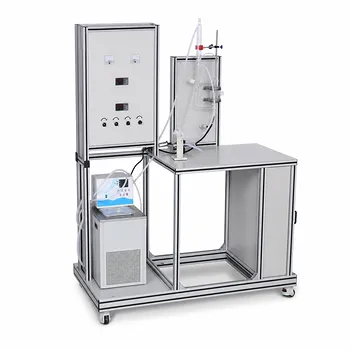
The purge method transforms a simple bubbling tube into a powerful, non-invasive liquid level sensor. In a training system, a slow stream of compressed gas is fed down a dip tube into the tank. By regulating the flow so that bubbles just begin to escape, the back-pressure in the tube exactly equals the hydrostatic pressure at the tube’s outlet—and that pressure, read on a manometer, directly yields the liquid level via a straightforward fluid statics formula.
The bubbling method teaches students to measure liquid level in aggressive or sealed environments without ever exposing the instrument to the process fluid. It turns a core chemical engineering principle—hydrostatic equilibrium—into a tangible, hands-on diagnostic tool, bridging theory and real-world safety constraints.
Understanding the Measurement Principle
The method relies on a clean physical equilibrium. Once that equilibrium is established, the rest is pure calculation.
How Hydrostatic Equilibrium Drives the Reading
Gas flows down the tube against the liquid head. The regulator is adjusted until gas just overcomes that head.
At the moment bubbles emerge, the gas pressure inside the tube and the hydrostatic pressure at the tube opening are balanced. No pressure is lost because the flow rate is negligible except to form individual bubbles.
That equilibrium pressure is what the manometer senses. It directly represents the weight of the liquid column above the tube outlet.
The Manometer Connection and the Math
A U-tube manometer filled with a manometric fluid (like mercury) connects to the gas purge line. The height difference (R) on the manometer links to the liquid level (h) by the density ratio.
For a tank open to atmosphere, the relationship simplifies to: [ h = \frac{p_{Hg}}{\rho} R ] Here, (p_{Hg}) is the density of the manometer fluid, and (\rho) is the density of the liquid in the tank. This single equation lets students predict or verify the tank level.
No electrical signal is required. The method is fundamentally a direct mechanical illustration of the hydrostatic paradox: pressure depends only on depth and density, not on tank shape.
Why Educators Rely on the Purge Method
The real power of this experiment isn't just measuring level—it's building intuition for safe process design and indirect measurement.
Teaching Safe Handling of Hazardous Fluids
Many industrial fluids are corrosive, toxic, or radioactive. The purge method physically isolates the instrument (manometer or transmitter) from the fluid using a continuous gas barrier.
Students learn that you don’t need a sensor inside the tank. A simple dip tube and a controlled gas supply can provide reliable data without risking sensor damage or contamination.
This introduces the principle of purging for instrument protection, a practice used in countless real plants for pH probes, pressure taps, and analytical sample lines.
Reinforcing Fluid Statics Through Hands-On Design
Setting bubble rate is a delicate process. Too fast, and friction losses in the tube create pressure errors. Too slow, and the system responds sluggishly.
Students physically tune the regulator while watching the bubble indicator, turning a textbook formula into a real-time diagnostic skill. They learn that measurement quality hinges on proper gas flow, not just the math on paper.
This experience cements an understanding of static pressure measurement that differential pressure (dP) transmitters and bridles build upon in later lessons.
Understanding the Trade-offs
No measurement technique is perfect. Presenting the purge method without its limitations would be incomplete.
Sensitivity to Bubble Rate and Flow Dynamics
The gas flow must be just enough to produce a slow bubble train. If the flow is too high, the pressure drop along the tube adds an error, making the reading higher than the true hydrostatic pressure.
Students must identify the sweet spot where increasing flow further no longer significantly increases pressure. This teaches the concept of pressure drop compensation and the importance of operating a purge system on a “bubble-to-atmosphere” verification routine.
Density Dependency and Calibration Demands
The reading scales directly with the process liquid density. If the liquid composition or temperature changes without correction, the level indication will be off.
For the U-tube manometer, the manometric fluid’s density is also a factor. This gives instructors a natural segue into calibration and the importance of knowing both process fluid properties and instrument reference fluids.
Limitations in Sealed Tanks
While the method works beautifully in sealed tanks by connecting the manometer to the vapor space for a differential reading, it requires careful pressure balancing. A single open-end manometer is not enough; students can then learn differential measurement concepts.
How to Extract Maximum Learning Value
Designing the educational experience around specific goals yields the deepest insight.
- If your primary focus is teaching fluid statics fundamentals: Use this setup as a direct verification lab. Have students predict the manometer reading before bubbling and then compare it to a sight glass, reinforcing the (P = \rho g h) relationship without any electronics.
- If your primary focus is introducing process safety and instrument isolation: Emphasize the configuration with a simulated corrosive fluid (e.g., dyed water) and ask students to design a measurement strategy that keeps all metal sensors out of the tank. The purge tube becomes the obvious, elegant solution.
- If your primary focus is bridging to industrial transmitters: Connect the purge line not just to a manometer, but to a pressure transmitter and controller. Show how the same physical principle scales to electronic data acquisition— and how the simple bubbling calibration can validate a dP transmitter in the field.
The purge method’s elegance lies in its pure demonstration of pressure equilibrium. By mastering it, students don't just learn a level measurement technique—they internalize a universal strategy for making difficult measurements safely and simply.
Summary Table:
| Feature | Details |
|---|---|
| Core Principle | Hydrostatic equilibrium (back-pressure of gas equals liquid head pressure) |
| Primary Benefit | Isolates measuring instruments from hazardous, corrosive, or toxic process fluids |
| Key Math Formula | $h = \frac{\rho_{Hg}}{\rho} R$ (for U-tube manometer setups) |
| Critical Calibration | Sensitivity to gas flow (bubble rate) and process fluid density changes |
Elevate Your Chemical Engineering Lab with LABPARK
Hands-on experience with unit operations like liquid level measurement is crucial for preparing the next generation of engineers. LABPARK provides premium Educational and Vocational Unit Operations Pilot Plants in chemical engineering, bioprocess & biotech, and environmental & water treatment.
We help universities, research institutes, and enterprises bridge the gap between classroom theory and industrial reality. Ready to enhance your curriculum with advanced training systems? Contact us today to discuss your lab requirements!
Related Products
People Also Ask
- Why correlate VLE pilot plant data using Wilson, NRTL, and UNIQUAC? Achieve Accurate Column Scale-Up
- For VLE Experiments: Fugacity vs. Activity Coefficient Method Selection Criteria
- How do pilot plants assist in teaching & researching non-ideal VLE? Bridge Theory & Physical Validation
- How to Model VLE for Supercritical & Unstable Components? Pilot Plant Methods
- Why is accurate VLE data critical? Optimize Unit Operations & Process Scale-Up