Temperature control in catalytic converter pilot plants is a balancing act between reaction kinetics and thermodynamics. The configuration of internal heat exchangers versus cold gas quenching fundamentally shapes this balance. Internal heat exchangers provide indirect interstage cooling while recovering heat to preheat feed gases, preserving reactant concentration and maximizing conversion potential. Cold gas quenching, by injecting cooler gas directly between catalyst stages, offers a simpler mechanical design but dilutes the reactant stream, which can shift equilibrium and reduce overall conversion. Both methods directly determine the reactor’s thermal profile, conversion efficiency, and the operational trade-offs that pilot plants are built to demonstrate.
While internal heat exchangers offer superior thermodynamic efficiency by avoiding dilution, they demand meticulous sealing and add capital cost. Cold gas quenching simplifies construction but forces a compromise between temperature control and reactant concentration. Pilot plants serve as the definitive platform to quantify these trade-offs and train engineers to optimize real-world reactor designs.
The Two Core Cooling Strategies in Catalytic Converters
The Role of Internal Heat Exchangers
Internal heat exchangers recover heat indirectly between reaction stages. Hot, product-laden gas leaving one catalyst bed flows through a heat exchanger, where its thermal energy preheats the incoming cold feed. This step cools the process stream without introducing any foreign gas.
Because no additional gas is added, the partial pressure of the reactant (e.g., SO₂) remains unchanged. Maintaining a high reactant concentration sustains a greater thermodynamic driving force for conversion, allowing the reaction to approach equilibrium more closely. This is especially valuable for reversible exothermic reactions like SO₂ oxidation to SO₃.
However, indirect cooling comes with a demanding engineering requirement: leak‑tight sealing. In SO₂ oxidation service, any SO₃ leakage into the preheat section can combine with moisture and cause severe sulfuric acid corrosion. The seals and materials must withstand both high temperatures and aggressive chemical environments, elevating both capital cost and maintenance complexity.
The Principle of Cold Gas Quenching
Cold gas quenching injects a cooler gas—often fresh air or recycled, cooled process gas—directly between catalyst beds. The cold stream mixes with the hot reaction mixture, lowering its temperature almost instantly. The approach is mechanically simple: no dedicated heat exchanger surfaces or coil bundles are required.
This simplicity comes at a chemical cost: dilution. The added quenching gas reduces the partial pressure of the reactant entering the next catalyst stage. A lower reactant concentration shifts the equilibrium away from product formation and can decrease the maximum attainable conversion unless compensated by a larger reactor or additional catalytic stages.
Nevertheless, quenching is often preferred in early-stage pilot demonstrations because it is easy to install and control. It avoids the corrosion risks of internal exchangers and teaches students the direct connection between concentration, temperature, and conversion.
How Configuration Dictates Temperature Control and Reaction Performance
Thermal Profile Stability and Hot Spot Mitigation
Internal heat exchangers enable a more uniform axial temperature profile. Because heat is transferred gradually and evenly through a metallic wall, the downstream catalyst bed receives a well‑tempered inlet gas. This smooth profile helps avoid destructive hot spots that can sinter the catalyst or damage the reactor shell.
Cold gas quenching, in contrast, can create steeper temperature gradients. If the mixing between the quench stream and the main process gas is incomplete, portions of the catalyst bed may experience cold zones. These cold spots slow the reaction locally, reducing average conversion efficiency and potentially creating uneven catalyst aging.
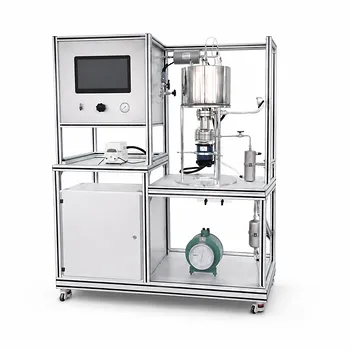
Pilot plants equipped with jacketed reactors and high‑precision thermal sensors make these effects visible. Operators can measure the bed temperature at multiple axial positions and directly observe how a quench‑induced cold zone, or a poorly designed exchanger, distorts the temperature front.
Impact on Conversion and Equilibrium Attainment
Maintaining reactant partial pressure is a core advantage of internal heat exchangers. With no added diluent, the driving force for conversion stays high through each subsequent stage. This allows the pilot plant to achieve per‑pass conversions that are closer to the thermodynamic limit.
Quenching inherently reduces the reactant partial pressure. For a fixed number of catalyst stages and a given residence time, this dilution pushes the equilibrium outlet composition further toward the reactants’ side. To compensate, industrial designs often increase the total number of stages or catalyst volume, but the pilot plant reveals that the thermodynamic penalty is real and measurable.
When selectivity is also a concern, temperature control becomes even more critical. In chemistries where a desired product has lower activation energy than an undesired side reaction, a carefully managed temperature profile—often starting low and increasing later—can boost selectivity. Internal exchangers, by offering precise interstage temperature control without concentration loss, give more freedom to implement such profiles compared to a dilution‑heavy quench scheme.
Understanding the Trade-offs Between the Two Methods
Simplicity vs. Thermodynamic Efficiency
Choosing a cooling method means trading installation complexity against chemical potential. A cold gas quench system is straightforward: a simple piping spool with injection nozzles. It avoids the space, weight, and sealing challenges of a heat exchanger. In educational pilot plants, this simplicity allows quick reconfiguration and visual demonstration of the dilution effect.
An internal heat exchanger configuration demands a more complex mechanical design but protects the reaction’s thermodynamic power. For reactions where conversion directly dictates process economics—such as sulfuric acid manufacture—the efficiency gain justifies the higher upfront investment. The pilot plant quantifies that gain by showing the difference in SO₂–SO₃ conversion between the two setups under identical inlet conditions.
Hydrodynamics and Flow Distribution
Internal exchangers can disrupt fluid flow if not designed carefully. Bundles of tubes or coils between catalyst beds must include flow distributors to avoid channeling. Uneven flow leads to maldistributed residence times and underutilized catalyst, which the pilot plant’s residence time distribution studies can expose.
Quench systems face their own mixing challenge. The cold injected gas must be evenly dispersed into the radial cross‑section of the main stream. Without proper nozzle design or static mixers, temperature stratification can form. Pilot plants demonstrate this by mapping the radial temperature profile at the inlet of the next catalyst bed, reinforcing the importance of mixing design alongside the cooling method.
Safety and Thermal Runaway Response
In a highly exothermic reaction, losing cooling capacity can lead to a rapid temperature excursion. With an internal exchanger, a bypass around the exchanger or a failure in the cooling side can cut off the primary heat sink. With quenching, a valve failure or insufficient quench flow similarly removes the cooling mechanism.
Pilot plants integrate cascade control strategies—such as cascading bed temperature with coolant flow or quench flow—to reject disturbances before they cause runaway. While not inherent to the cooling configuration itself, the choice of cooling method influences which control loops are most effective. Educational units deliberately simulate cooling failures to train operators on safe shutdown procedures for both system types.
The Educational Imperative: Why Pilot Plants Need Both Configurations
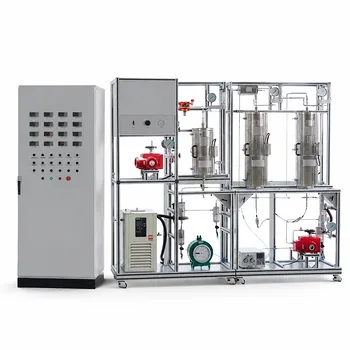
Pilot plants that offer side‑by‑side comparison of internal heat exchange and quenching deliver an unmatched learning experience. Students can operate the same reaction with both methods and directly measure temperature profiles, pressure drops, and outlet compositions. This hands‑on exercise crystallizes abstract thermodynamic and kinetic principles.
Beyond conversion numbers, the pilot plant reveals practical constraints. It teaches how corrosion mechanisms force material selection for exchangers, how quench flow ratios must be optimized to avoid excessive dilution, and how both methods interact with the reactor’s dynamic controllability.
This dual‑configuration demonstration mirrors the decisions made when scaling up an industrial converter. Engineers must weigh the capital and maintenance costs of an all‑exchanger train against the performance penalty of quenching. The data generated on the pilot unit becomes the foundation for cost‑optimized reactor design.
Making the Right Choice for Your Pilot Plant or Process Demonstration
Once you understand the fundamental physics, the choice of configuration aligns with your specific demonstration or research objective. Use these goal‑oriented guidelines to steer your decision:
- If your primary focus is demonstrating maximum thermodynamic conversion: Choose internal heat exchangers to preserve reactant partial pressure and give students a clear view of how close a catalyzed reaction can come to equilibrium in a multi‑stage system.
- If your primary focus is simplicity, rapid setup, and teaching the dilution effect: Implement cold gas quenching to quickly show how increasing quench flow drives conversion downward, creating a vivid, memorable lesson on concentration driving forces.
- If your primary focus is comparing industrial economics: Equip the pilot plant with both configurations. Have students calculate the required catalyst volume and achievable conversion for each, linking the cooling method directly to capital and operating expenses.
- If your primary focus is safety and controllability studies: Combine each cooling method with advanced cascade temperature control schemes. Use the pilot plant to benchmark how each configuration responds to disturbances, and train operators to manage thermal excursions specific to that design.
By mapping the cooling configuration to a clear educational or research goal, you transform the pilot plant from a mere piece of equipment into a powerful learning instrument that builds deep, intuitive expertise.
Summary Table:
| Feature | Internal Heat Exchangers | Cold Gas Quenching |
|---|---|---|
| Cooling Method | Indirect interstage heat recovery | Direct injection of cool gas |
| Concentration | No dilution; preserves partial pressure | Dilutes reactants; lowers equilibrium |
| Temp Profile | Uniform axial profile; less hot spots | Steeper gradients; risk of cold spots |
| Complexity | High (demands leak-tight sealing) | Low (simple piping and nozzles) |
Optimize Your Reactor Training and Research with LABPARK
Are you looking to demonstrate advanced temperature control strategies in your curriculum or research? LABPARK provides state-of-the-art educational and vocational unit operations pilot plants in chemical engineering, bioprocess & biotech, and environmental & water treatment. Whether you need to compare heat exchange and quenching configurations or model complex reaction kinetics, our pilot plants deliver industrial-grade accuracy for universities, research institutes, and enterprises.
Contact LABPARK today to find the perfect pilot plant solution for your lab!
Related Products
- Internal Circulation Gradient Free Catalytic Reaction Educational Pilot Plant
- Methanol Synthesis and Catalyst Performance Evaluation Educational Unit Operations Pilot Plant
- Micro-Scale Gas-Solid Catalytic Reaction Educational Pilot Plant
- Multi Functional Catalytic Reaction and Reactor Evaluation Educational Unit Operations Pilot Plant
- Crude Benzene Hydrogenation Educational Unit Operations Pilot Plant
People Also Ask
- Why is thermal management a major challenge in methane oxidative coupling? Reactor Solutions for Pilot Plants
- Why is a multibed configuration necessary for exothermic reactions? Optimize your pilot plant trajectory.
- Fluidized vs. Fixed Bed Reactors: Comparing Heat & Complexity in Pilot Plants
- How to choose a 1D or 2D model for simulating a fixed-bed reactor? The Mears Criterion Decoded.
- How can researchers use Mears criteria in a catalytic reactor pilot plant to determine transfer resistance?