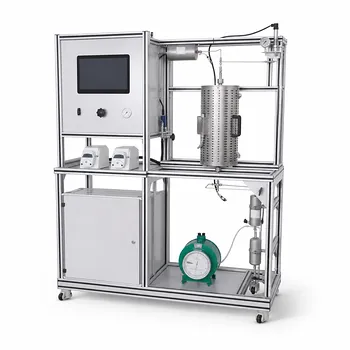
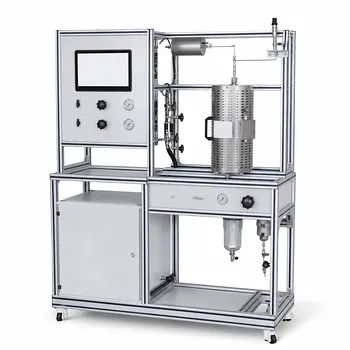
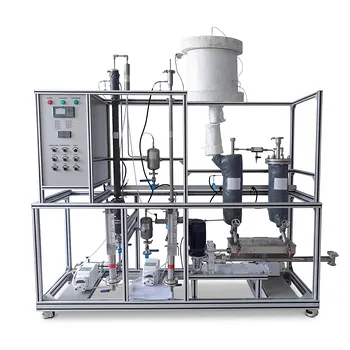
Pressure dictates the separation-efficiency energy-consumption seesaw in a demethanizer. High operating pressure eases the deep cryogenic load but worsens the underlying vapor-liquid equilibrium, requiring more theoretical stages. Low pressure sharpens relative volatility—making separation easier—but demands extreme refrigeration temperatures that send energy consumption soaring. A pilot-scale column equipped with adjustable pressure, cryogenic cooling capability, and precise thermal instrumentation lets you experimentally map this trade‑off and find the point where purity goals and utility costs intersect.
Demethanizer pressure is a lever that trades thermodynamic difficulty for refrigeration intensity. High-pressure operation reduces the coldest refrigeration requirement at the expense of relative volatility, while low-pressure operation improves separation but forces the system toward -140 °C and a costly cascade refrigeration loop. Pilot columns with full pressure‑ and temperature‑range control allow you to quantify this relationship directly.
The Pressure–Separation Trade‑off in Demethanizers
Operating pressure fundamentally resets two competing variables: the overhead temperature and the relative volatility between methane and ethylene. This inversion defines every design decision.
How High Pressure Eases Refrigeration but Hurts Separation
A demethanizer run at 3.0‑3.2 MPa significantly elevates the overhead temperature. The warmer condenser reduces—or even eliminates—the need for the lowest‑temperature refrigeration stage.
However, this comes at a thermodynamic cost. At higher pressure, the relative volatility between methane and ethylene shrinks. The components look more alike in the vapor phase, meaning a tray must work harder to achieve the same degree of separation. More stages or more reflux are required to reach target purity.
Why Low Pressure Delivers Sharper Cuts at Steeper Energy Costs
Dropping the column pressure to 0.6‑0.7 MPa unmasks the natural difference in volatility. Methane and ethylene separate more readily, so the column can achieve the same purity with fewer stages or lower reflux.
The price is thermal. Overhead temperatures plummet toward -140 °C. Reaching that level demands a cascade refrigeration system—often methane‑ethylene‑propylene—whose compressors consume enormous amounts of shaft work. The energy bill can dwarf the savings from a shorter column.
Energy Consumption: The Cascade Refrigeration Challenge
The refrigeration system is the primary energy sink, and its configuration is directly dictated by the chosen demethanizer pressure.
Quantifying Compressor Load at Different Pressure Levels
Every degree of cryogenic cooling comes from compression. At low pressure, the refrigeration cascade must lift heat from the -140 °C overhead all the way to a cooling‑water rejection temperature. That multi‑stage compression train sees its power demand spike sharply as the lowest required temperature falls.
With high‑pressure operation, the overhead can often be condensed by the propylene stage alone, bypassing the methane and ethylene compressors entirely. The shaft‑power savings are immediate and dramatic.
The Link Between Overhead Temperature and Utility Demand
Overhead temperature acts as a proxy for energy intensity. An overhead near -100 °C can be served by a simple ethylene‑propylene cycle, whereas -140 °C pulls in a low‑temperature methane loop that multiplies both capital and operating cost.
In pilot experiments, measuring the compressor’s energy input at each pressure setting makes this relationship tangible. The data transforms an abstract thermodynamic principle into a direct cost curve.
Studying These Dynamics in a Pilot‑Scale Column
Translating industrial demethanizer conditions to the laboratory requires a column that can safely span the full pressure‑temperature envelope and capture the critical process variables.
Essential Hardware: Pressure‑Rated Vessels and Cryogenic Jackets
Industrial demethanizers operate in extremes—for example, 131 K (-142 °C) at around 9 bar. To simulate that reality, a pilot column must use specialized metallurgy and pressure‑rated vessels for high‑pressure runs up to 3.2 MPa, and vacuum insulation or cryogenic cooling jackets for low‑temperature studies at the other end of the range.
This dual‑capability design ensures the same rig can explore both the high‑pressure/low‑energy and low‑pressure/high‑efficiency regions without compromising safety or controllability.
Instrumentation: Tracking Temperature Profiles and Energy Input
The temperature gradient from reboiler to condenser is the primary signal of separation performance. Advanced thermal sensors—thermocouples or resistance temperature detectors placed every few trays—capture the profile shift as pressure changes.
Equally important is the energy‑side measurement: logging compressor power consumption and coolant flow rates turns pressure‑sweep experiments into a complete energy‑balance picture. Students or engineers can then plot separation purity against specific energy consumption to find the break‑even point.
Experimental Design: Mapping the Optimal Pressure Window
A systematic protocol starts at a mid‑point pressure and steps upward and downward. At each steady state, the column achieves stable temperature profile and product compositions, then energy data is recorded.
The resulting curves—purity versus pressure and energy versus pressure—intersect at the zone where further pressure reduction grants only marginal purity gain for a disproportionate energy penalty. That window is the teachable moment of the pilot study.
Understanding the Trade‑offs
No single pressure setting eliminates compromise. Recognizing the inherent tensions keeps you from chasing a false optimum.
The Purity vs. Energy Dilemma
Low pressure yields a more efficient separation—you can hit 99.9% methane rejection with a shorter column—but at the cost of a cascade that guzzles power. High pressure slashes the refrigeration bill but demands more capital in column height or diameter to compensate for lost relative volatility. The economically optimal point nearly always lies somewhere in between.
Practical Limits: Material Constraints and Safety
Beyond thermodynamics, the hardware draws a line. Achieving -140 °C requires brittle‑fracture‑resistant steels and robust insulation, while 3.2 MPa pressure mandates thicker vessel walls and relief systems. A pilot column that tries to cover both extremes must be designed for the worst case, which raises the rig’s cost and complexity—mirroring the very trade‑off seen at industrial scale.
Making the Right Choice for Your Pilot Study
Your study objective determines where you set the pressure focus. Tailor your experiment accordingly.
- If your primary focus is demonstrating maximum ethylene purity: Run at the lowest practical pressure—around 0.7 MPa—to exploit the widest relative volatility, and measure how purity improves even as the overhead dives below -130 °C.
- If your primary focus is analyzing energy‑cost minimization: Start at 3.0 MPa and quantify the step‑change drop in compressor power when the methane refrigeration stage becomes unnecessary, then benchmark the purity trade‑off.
- If your primary focus is teaching the fundamental phase‑equilibrium vs. refrigeration link: Sweep pressure from 0.6 MPa to 3.2 MPa, recording temperature profiles and energy data at each step, so the inverse relationship between volatility and cryogenic load becomes an experimental fact.
By methodically varying pressure in a well‑instrumented pilot column, you transform an abstract optimization problem into a hands‑on experience that reveals the sweet spot where separation performance and energy efficiency truly balance.
Summary Table:
| Operating Parameter | Low-Pressure Operation (0.6–0.7 MPa) | High-Pressure Operation (3.0–3.2 MPa) |
|---|---|---|
| Relative Volatility | High (Easier separation) | Low (Harder separation, requires more stages) |
| Overhead Temperature | Extremely cold (down to -140 °C) | Warmer (around -100 °C) |
| Refrigeration System | Complex cascade loop (Methane/Ethylene) | Simpler loop (Propylene/Ethylene) |
| Compressor Energy Load | High energy consumption | Lower energy consumption |
Bring Industrial Distillation Dynamics to Your Lab with LABPARK
To effectively teach or research complex thermodynamic trade-offs like demethanizer pressure optimization, you need reliable, industry-grade hardware.
LABPARK designs and manufactures high-performance Educational and Vocational Unit Operations Pilot Plants in chemical engineering, bioprocess & biotech, and environmental & water treatment. Specifically tailored for universities, research institutes, and enterprises, our pilot-scale columns feature advanced pressure-rated vessels and precise cryogenic thermal tracking to make process optimization tangible.
Ready to upgrade your laboratory capabilities? Contact LABPARK today to discuss your pilot plant requirements!
Related Products
- Ethylbenzene Dehydrogenation Educational Unit Operations Pilot Plant
- Carbon Dioxide Hydrogenation Methanol Synthesis Educational Unit Operations Pilot Plant
- Steam Methane Reforming Hydrogen Production and Purification Educational Pilot Plant
People Also Ask
- What parameters & reactor configurations are needed for ethylbenzene dehydrogenation pilot plants?
- Why is steam dilution critical in dehydrogenation? Pilot Plant Control Guide
- Isothermal vs Adiabatic Reactors: Key Differences in Ethylbenzene Dehydrogenation Pilot Plants
- How do pilot plants help students verify material balances? Bridge Theory with Real-world Data
- Why is the steam-to-feedstock ratio critical in catalytic dehydrogenation? Learn the 3 key roles of steam.