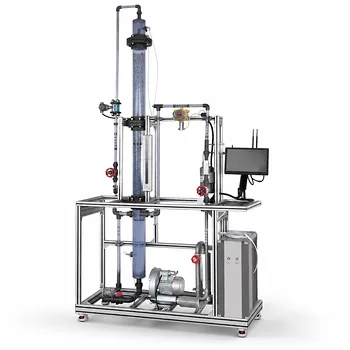
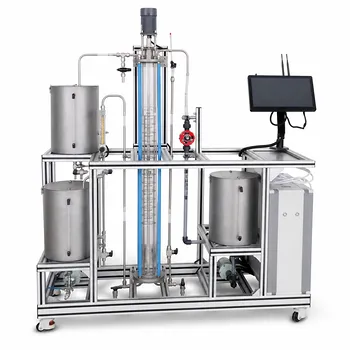
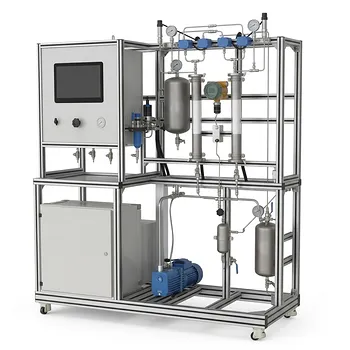
Low liquid holdup in packed columns means they reach steady state in minutes—ideal for quick lab demonstrations. High liquid holdup in plate columns makes startup slower but adds thermal mass that stabilizes temperature profiles, a double-edged sword for heat-sensitive materials.
The core trade-off is speed versus stability: packed columns offer rapid startup and minimal thermal degradation risk because they hold very little liquid, while plate columns take longer to stabilize but their larger holdup buffers against flow fluctuations, buying you operational consistency at the cost of longer thermal exposure.
Understanding Liquid Holdup and Startup Dynamics
The startup time of a distillation or absorption column in a pilot plant is directly determined by how much liquid the column must accumulate and distribute before it reaches a stable operating condition. This liquid inventory—called liquid holdup—creates a fundamental divergence between packed and plate columns.
What Is Liquid Holdup?
Liquid holdup is the volume of liquid retained on the column internals during normal operation. It consists of two components: static holdup (the liquid permanently held in pores, crevices, and surface films even after flow stops) and dynamic holdup (the actively flowing liquid that depends on gas and liquid rates). The sum of these two defines the total inventory that must be established during startup and that governs residence time during operation.
Packed Columns – Quick Start, Minimal Waste
Packed columns typically operate with a liquid holdup of less than 6% of the column volume. This small inventory means the column requires very little time to fill and reach hydraulic and thermal equilibrium. The result is a startup that can be completed in minutes—perfect for a laboratory class where multiple experiments or rapid control adjustments are needed.
The short residence time of liquid also means the feed spends minimal time at elevated temperatures. For heat‑sensitive materials (monomers, pharmaceuticals, natural extracts), this dramatically reduces the risk of thermal degradation, polymerization, or unwanted side reactions. The column becomes a low‑thermal‑stress environment because the liquid passes through so quickly.
Plate Columns – Slower But Steadier
Plate columns carry a higher liquid holdup—typically 8% to 12% of the column volume—because each tray retains a significant depth of liquid. During startup, every tray must accumulate its operating inventory, and the liquid must cascade down the column to establish stable composition and temperature profiles. This process is inherently slower, often taking tens of minutes to an hour in a pilot‑scale unit.
That longer fill time translates directly into longer thermal exposure of the feed. If the material is thermally labile, the risk of product loss or hazardous decomposition increases, making plate columns less forgiving for heat‑sensitive chemistries unless additional safeguards (like lower operating temperatures) are in place.
Thermal Safety in Heat‑Sensitive Applications
Thermal safety in a pilot plant is not just about avoiding decomposition—it’s about controlling the temperature‑time history that every kilogram of feed experiences. Liquid holdup is the multiplier that sets this history.
Residence Time and Thermal Degradation
The average liquid residence time is proportional to the liquid holdup divided by the liquid flow rate. Because packed columns have roughly half the holdup of a comparable plate column, they expose the process fluid to heated surfaces for only half the time (all else equal). This shortened exposure directly lowers the cumulative thermal dose, which is critical when dealing with compounds that follow Arrhenius‑type degradation kinetics.
Moreover, in packed columns, the liquid flows as thin films over the packing, which keeps the thermal boundary layer thin and promotes rapid heat transfer to or from the column wall. This helps avoid hot spots and quickly dissipates any heat generated by absorption or reaction, further improving thermal safety.
How Holdup Shapes Temperature Profiles
In plate columns, the deeper liquid pools on each tray act as small heat reservoirs. While this can buffer the column against sudden flow or temperature disturbances—preventing sharp deviations from the desired profile—it also means that during startup, the column takes longer to reach a uniform temperature distribution. If the feed is introduced before the column is fully thermally conditioned, pockets of overheated liquid can persist, creating a hidden thermal hazard.
Packed columns, with their low holdup, exhibit less thermal inertia. They respond almost instantly to changes in heating or cooling, allowing operators to quickly bring the column to the target temperature profile and then maintain it with tighter control. The downside, however, is that packed columns are more susceptible to rapid temperature swings if the heating or liquid flow is momentarily interrupted, because there is no large liquid volume to dampen the disturbance.
Understanding the Trade-offs
Choosing between a packed and a plate column for a lab pilot plant is a decision about which operational risks you are willing to manage. Both holdup levels bring distinct advantages and pitfalls.
When Low Holdup Becomes a Liability
The very feature that makes packed columns thermally safe—their low liquid inventory—also makes them vulnerable to operating instability. A momentary drop in liquid feed rate can quickly dry the packing, causing a sudden loss of mass transfer and a spike in vapor temperature. Without the buffering effect of a large liquid holdup, these transients propagate rapidly through the column and can damage temperature‑sensitive internals or lead to product off‑spec in seconds.
In contrast, the high holdup on plate trays absorbs these fluctuations. The liquid mass on each tray acts like a thermal and compositional flywheel, giving the operator time to correct the disturbance before the entire column deviates from steady state. This stability is invaluable in educational settings where students are learning manual control or in research runs where flow variations are inherent to the experimental protocol.
Pressure Drop and its Indirect Impact on Safety
Although not the primary focus, it’s worth noting that excessive liquid holdup in packed columns—caused by flooding or poor distribution—can suddenly increase pressure drop, restricting gas flow and potentially causing a dangerous back‑pressure event. A properly designed packed column avoids this, but the risk highlights why understanding holdup is critical for safe pilot plant operation.
Making the Right Choice for Your Pilot Plant Goal
The answer to “packed or plate?” depends entirely on what you are trying to achieve—or avoid—in the laboratory.
- If your primary focus is rapid experimentation with heat‑sensitive compounds: Choose a packed column. The low holdup gives you fast startup, quick equilibrium, and minimal thermal degradation risk, allowing you to test multiple conditions in a single lab session without destroying your product.
- If your primary focus is demonstrating stable, steady‑state operation or handling feeds with variable flow rates: A plate column is the better fit. Its larger holdup buffers against disturbances, providing a forgiving platform for teaching process control or for research where steady data is more valuable than speed.
- If your primary focus is carrying out slow reactions that benefit from longer contact time: Plate columns provide the necessary liquid residence time for reactions to approach equilibrium, whereas the short residence time in a packed column might require an impractical column height.
Ultimately, liquid holdup is the silent governor of your column’s startup speed and thermal safety envelope. By matching the holdup characteristics to your material’s temperature tolerance and your experiment’s stability requirements, you turn a hydrodynamic detail into a deliberate design choice that protects both your product and your schedule.
Summary Table:
| Parameter | Packed Columns | Plate Columns |
|---|---|---|
| Liquid Holdup | Low (< 6% of column volume) | High (8% to 12% of column volume) |
| Startup Time | Rapid (minutes) | Slower (up to an hour) |
| Thermal Degradation Risk | Low (short liquid residence time) | Higher (longer exposure to heat) |
| Process Stability | Low (sensitive to flow changes) | High (buffers against disturbances) |
| Best For | Heat-sensitive materials & fast runs | Teaching process control & slow reactions |
Equip Your Lab with the Right Pilot Plant
Whether you need rapid startup for chemical engineering classes or stable controls for advanced research, LABPARK has you covered. LABPARK provides high-quality Educational and Vocational Unit Operations Pilot Plants in chemical engineering, bioprocess & biotech, and environmental & water treatment. Tailored for universities, research institutes, and enterprises, our pilot plants deliver the safety, reliability, and precision your laboratory demands.
Contact LABPARK today to discuss your custom pilot plant specifications!
Related Products
- Packed Bed Absorption Educational Unit Operations Pilot Plant
- Absorption and Desorption Educational Unit Operations Pilot Plant
- Multimodal Absorption and Desorption Pilot Plant for Unit Operations Training
- Educational Rotary Disc Liquid-Liquid Extraction Pilot Plant
- Continuous Batch Extractive Distillation Educational Pilot Plant
People Also Ask
- How Do Flow Regimes Transition in Packed Bed Pilot Plants? Key Scale-up Insights
- How does reactant concentration determine absorption column control? Gas-film vs. dual-film.
- How is the packing height of an absorption column calculated? Master HTU & NTU Concepts
- How does static vs. operating holdup affect pilot plant calibration? Avoid Critical Scale-Up Errors
- Why is counter-current flow selected for gas absorption? Maximize Pilot Plant Efficiency