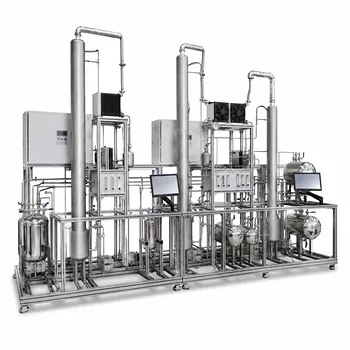
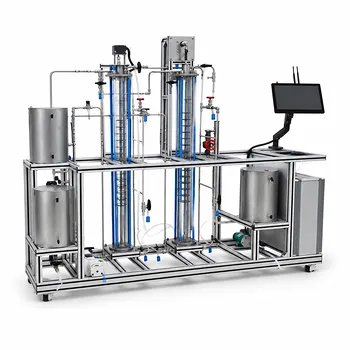
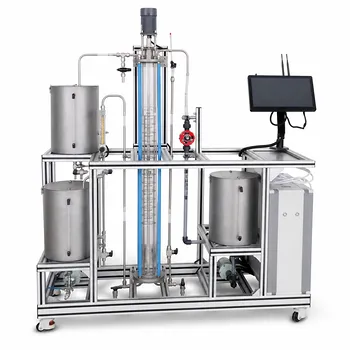
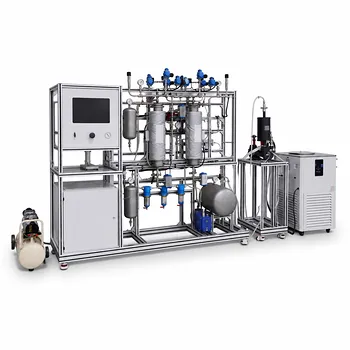
A multi-column azeotropic distillation configuration beats the ethanol-water separation deadlock by introducing an entrainer that forms a new heterogeneous ternary azeotrope. The first column yields pure ethanol as the bottom product while the top vapor, containing the entrainer and all the water, condenses and splits in a decanter. A solvent-rich phase recycles to maintain the azeotrope, and two additional columns recover the entrainer and discharge clean water.
A minimum-boiling azeotrope creates a thermodynamic ceiling—vapor and liquid become identical in composition—so simple distillation cannot produce anhydrous ethanol. A multi-column setup bypasses this limit by shifting the distillation region with an entrainer and exploiting liquid-liquid phase separation, a principle that pilot plant training transforms from textbook theory into observable, controllable operation.
Why a Single Column Fails: The Azeotropic Trap
A standalone distillation column cannot concentrate ethanol beyond the azeotropic composition because the mixture exhibits a positive deviation from Raoult’s law. Understanding this limitation is the first step to appreciating the multi‑column solution.
The Minimum-Boiling Azeotrope and Positive Deviation
Ethanol (boiling point 78.3 °C) and water (100 °C) form a minimum-boiling azeotrope that boils at 78.2 °C, lower than either pure component. At this point the vapor has exactly the same composition as the liquid, freezing further enrichment. No matter how many theoretical stages a column provides, it can never cross the azeotropic boundary through conventional rectification alone.
Distillation Boundaries Restrict Product Purity
Ternary phase diagrams show that distillation boundaries enclose separate regions. The mass‑balance line for feed, distillate, and bottoms cannot leap across these boundaries; if the feed lies on one side of the boundary, pure components on the other side remain inaccessible. For ethanol‑water, any feed richer in ethanol than the azeotrope can only produce the azeotrope as the top product and pure ethanol as the bottom, so anhydrous ethanol requires sneaking past the barrier.
The Multi-Column Solution: Breaking the Azeotrope with an Entrainer
Adding a third component—an entrainer like benzene—creates a new ternary minimum-boiling azeotrope that boils below the ethanol-water azeotrope. A sequence of three columns then exploits this shifted equilibrium and a decanter-induced phase split to shatter the separation limit.
Column 1 – The Ethanol Recovery Column
The ethanol‑water feed meets the entrainer (and recycled solvent) in the first column. Because the new ternary azeotrope (ethanol‑water‑benzene) has the lowest boiling point, it travels up the column as vapor. Virtually all the water leaves overhead, and pure, anhydrous ethanol—often fuel‑grade—is drawn from the bottom.
The Decanter – Exploiting Heterogeneous Phase Splitting
The condensed overhead from Column 1 is not a single liquid; it forms two immiscible phases at the decanter temperature. A solvent‑rich upper phase (mainly benzene with some ethanol) is pumped back to Column 1 as reflux and feed supplement, sustaining the azeotrope formation. An aqueous lower phase (water with trace organics) is forwarded to the second column, effectively stripping water from the recovery loop.
Columns 2 and 3 – Entrainer Recovery and Water Purge
The second column separates any remaining entrainer from the water‑rich phase, sending the entrainer back to the system. A third column polishes the final water stream to remove the last traces of organics, yielding a waste water product that meets discharge standards. Together, the three columns and decanter form a closed‑loop entrainer circuit, with ethanol exiting from one bottom and water exiting from another.
Pilot Plant Training: Where Theory Meets Operational Reality
Replicating this three‑column sequence in a unit‑operations pilot plant transforms an abstract thermodynamic loophole into a hands‑on, data‑rich learning environment.
Visualizing Phase Separation and Reflux Dynamics
Transparent glass columns and decanters let students directly observe the cloudy condensate splitting into two clear layers. Watching the interface level rise and fall when the recycle rate changes makes the concept of heterogeneous azeotropic distillation instantly tangible.
Real-Time Data for Mass and Energy Balances
Temperature and pressure sensors at every key stage feed a data‑acquisition system. Learners can sample streams, measure compositions, and calculate complete mass balances, verifying that the ethanol exiting the bottom matches the ethanol in the feed—minus the tiny losses carried into the water purge.
Optimizing Recycle Streams and Entrainer-to-Feed Ratios
The pilot plant allows systematic variation of the entrainer flow rate, reflux ratio, and decanter temperature. Students quickly discover the sweet spot where the water‑rich phase becomes nearly free of entrainer while the solvent‑rich loop stays lean of water—an exercise directly applicable to reducing operating cost in full‑scale plants.
Understanding the Trade-offs
Azeotropic distillation’s ability to produce anhydrous ethanol comes with real-world costs and complexities that training must address.
Energy Penalty vs. Purity Requirements
Vaporizing the entrainer adds a significant energy load compared to simple distillation. Every kilogram of entrainer recycled must be boiled overhead, making energy integration and heat‑recovery schemes critical topics in pilot plant studies.
Batch vs. Continuous Flexibility
Multi‑column azeotropic systems can be operated in batch mode, offering flexibility in academic labs where feedstocks change often. Extractive distillation—another method that uses a non‑volatile solvent—is better for continuous operation but struggles in batch settings; pilot plants allow side‑by‑side comparison of both strategies.
Entrainer Selection and Process Safety
Benzene is the classic textbook example, but its toxicity drives modern research toward safer entrainers like cyclohexane or pentane. A training pilot plant can test multiple entrainers, linking chemical hazard assessment directly to process design decisions.
Complexity of Operation and Control
Running three columns with multiple recycles demands careful control of temperatures, levels, and flow ratios. Pilot plant training builds the operational intuition needed to troubleshoot phase inversion, entrainer loss, or column flooding before they become costly mistakes at industrial scale.
Making the Right Choice for Your Pilot Plant Training Objectives
The value of a multi‑column azeotropic distillation setup depends on what you want to learn.
- If your primary focus is fundamental thermodynamics education: Use a glass-column pilot plant with ethanol‑water‑benzene (or a safer analog) to let students see the decanter split and map the distillation boundary in real time.
- If your primary focus is process optimization research: Instrument the plant heavily and run design‑of‑experiment campaigns on entrainer ratio, reflux policy, and feed preheating to develop energy‑efficient operating envelopes.
- If your primary focus is operator training for industrial scale‑up: Simulate common upsets—such as a cold decanter, a recycle pump failure, or a composition shift in the feed—so operators learn to maintain anhydrous ethanol quality without shutting down.
- If your primary focus is comparing separation technologies: Configure the same pilot plant for extractive distillation and azeotropic distillation alternately, enabling direct measurement of the energy and capital trade‑offs under identical feed conditions.
By bridging rigorous thermodynamic theory with the hands‑on manipulation of a multi‑column, multi‑phase system, pilot plant training turns the ethanol-water azeotrope from a problem on paper into a separation solution you’ve run—and optimized—with your own hands.
Summary Table:
| System Component | Key Function | Output / Product |
|---|---|---|
| Column 1 (Recovery) | Introduces entrainer to break azeotrope | Pure anhydrous ethanol (bottoms) |
| Decanter | Promotes liquid-liquid phase splitting | Solvent-rich recycle & aqueous phase |
| Columns 2 & 3 (Purge) | Recovers solvent & polishes water stream | Clean waste water & recycled entrainer |
Bring Advanced Distillation Concepts to Life with LABPARK
Looking to bridge thermodynamic theory and hands-on operational reality for your students or researchers?
LABPARK provides state-of-the-art Educational and Vocational Unit Operations Pilot Plants in chemical engineering, bioprocess & biotech, and environmental & water treatment for universities, research institutes, and enterprises. Our highly instrumented, visual distillation pilot plants help learners master complex recycle dynamics, mass balance calculations, and real-world troubleshooting.
Ready to upgrade your laboratory capabilities? Contact LABPARK today to request a customized configuration and quote!
Related Products
- Multi-Functional Special Distillation Educational Pilot Plant
- Multi-Modal Distillation Unit Operations Training Pilot Plant
- Continuous Batch Extractive Distillation Educational Pilot Plant
- Continuous Sieve-Plate Distillation Pilot Plant for Unit Operations Laboratory Education
- Dual-Mode Rectification Pilot Plant for Practical Training Unit Operations
People Also Ask
- Why does simple distillation yield higher efficiency than flash distillation? Key thermodynamic differences.
- How does double temperature difference control improve distillation pilot plants? Stabilize purity.
- How to Integrate Spectroscopy in Distillation Pilot Plants for Advanced Process Control
- How to Verify Distillation Boundary Lines & Composition Regions with Pilot Plants
- Why is the acentric factor important in pilot plants? Fluid property prediction.