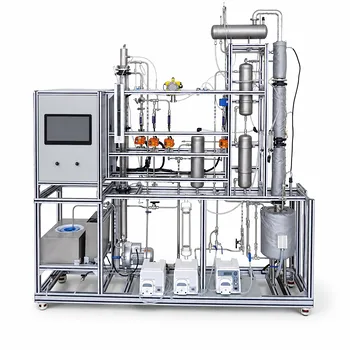
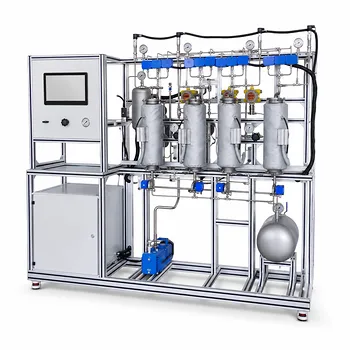
Here’s the core mechanism in a single sentence: a pilot-scale carbonation tower physically recreates the industrial counter-current reactor by flowing ammoniacal brine downward while pushing CO₂-rich gas upward through a segmented column, giving researchers direct control over absorption kinetics, multi-point gas injection, and thermal behavior.
Counter-current flow isn’t just a design choice—it’s the thermodynamic engine that makes the process viable. The pilot tower demystifies exactly how varying gas strengths, stage-wise contact, and heat removal synergize to precipitate sodium bicarbonate without choking the column.
The Counter-Current Principle in Action
Chemical absorption isn’t brute force; it’s a game of maintaining the strongest possible driving force at every meter of the column.
Why Counter-Current Flow is Non-Negotiable
When you contact a lean gas with a rich liquid in the same direction (co-current), the concentration difference collapses quickly.
You get rapid initial absorption, then a long, inefficient tail.
Counter-current flow keeps the highest CO₂ concentration at the bottom, meeting the most reactive, ammonium-rich brine just before it exits.
At the top, the now partially stripped gas encounters fresh brine feed, polishing the last traces of CO₂ from the exit gas.
This logarithmic concentration profile maximizes the total mass of CO₂ transferred per unit volume of the column, which directly translates to higher bicarbonate yields.
How the Pilot Column Physically Achieves This
The pilot-scale tower is a transparent, multi-stage column packed with structured packing or bubble-cap trays.
Brine enters through a distributor at the top and gravity-flows downward, while gas is sparged at the bottom through a sintered plate or nozzle.
Each internal stage provides a discrete zone for gas-liquid disengagement and re-contacting, preventing back-mixing.
Pressure tappings and sampling points on every stage let you measure gas composition and liquid pH in real time, building a true vertical profile of the absorption reaction.
This is how you move from textbook theory to a tangible mass balance.
Simulating Real-World Gas Streams with Multi-Point Injection
Industrial soda ash plants rarely use a single, pure CO₂ stream. The pilot column’s genius is its ability to replicate that complexity.
Mimicking Kiln Gas vs. Pure CO₂
The primary reference shows the column can accept two gas feeds: a mid-column gas simulating lime-kiln off-gas (~40–43% CO₂) and a bottom gas with >90% CO₂ concentration.
This mirrors the Hou process, where lower-concentration gas still carries useful reactant and must be utilized.
You inject the lower-grade gas at a height where the brine’s ammonia-to-salt ratio is already partially reduced, preventing premature nucleation. The high-purity gas at the bottom then drives the final, critical precipitation step, ensuring maximum conversion without wasting CO₂.
Avoiding the Dreaded Column Clogging
Sodium bicarbonate is sticky and loves to form scale on any cool surface.
The pilot tower helps solve this by letting you shift the location of primary precipitation away from sensitive internals.
By staging the gas introduction, you delay the formation of a dense crystal cloud until the brine is in the bottom section, where liquid turbulence and higher temperature keep solids in suspension.
Researchers can test different gas ratios and flow rates to map a safe operating window where yield stays high but the column wall remains clean for hours—a crucial lesson no textbook teaches alone.
Understanding the Trade-offs
Perfect absorption is straightforward in theory; making a filterable, non-scaling slurry is where the real engineering lives.
The Balancing Act Between Absorption Rate and Crystal Size
Push too much CO₂ too early, and you generate a massive supersaturation spike.
That yields thousands of tiny, poorly filterable nuclei that pass through downstream centrifuges.
The pilot column forces you to manage supersaturation profiles: by adjusting the split between mid-column and bottom gas, you can pace nucleation to produce larger, easily dewatered crystals.
This trade-off between absorption efficiency and product particle size is the central optimization problem.
Heat Management: The Hidden Challenge
The carbonation reaction is fiercely exothermic.
Without deliberate cooling, the column would heat up, the gas solubility would plummet, and the driving force would vanish.
Pilot columns incorporate cooling coils or jacket segments between stages to remove reaction heat locally.
Supplementary references emphasize that students learn to correlate temperature spikes with gas feed points, and to see how a poorly placed temperature rise can dissolve already-formed bicarbonate.
Controlling the thermal profile is as important as controlling the gas flows.
Making the Right Choice for Your Research Goal
For a pilot run to be predictive, you must align the column configuration with the phenomenon you’re investigating.
- If your primary focus is understanding the kinetics of CO₂ absorption into ammoniacal brine: Operate with a single, uniform gas feed and vary the liquid flow rate to isolate the mass-transfer coefficient without the confounding effect of multi-point injection.
- If your primary focus is optimizing precipitation yield and crystal size distribution: Use the multi-point gas injection to separate the absorption and nucleation zones, carefully logging the pH drop per stage to map supersaturation.
- If your primary focus is de-risking scale-up and preventing column clogging: Run steady-state experiments with low-grade gas in the middle and high-grade at the bottom, systematically measuring pressure drop and visual fouling on each tray until you find the self-cleaning hydraulic regime.
The pilot-scale carbonation tower isn’t just a tiny version of a factory; it’s the laboratory where you isolate the physics of every stage, turning a seemingly chaotic gas-liquid reaction into a predictable, controllable, and profitable unit operation.
Summary Table:
| Key Feature | Simulation Role | Operational Benefit |
|---|---|---|
| Counter-Current Flow | Flows brine down, CO2 gas up | Maximizes mass-transfer driving force & yield |
| Multi-Point Injection | Injects varying CO2 concentrations | Prevents column clogging & mimics kiln gas |
| Exothermic Heat Control | Uses stage-wise cooling coils/jackets | Prevents gas desorption & crystal dissolution |
| Supersaturation Tuning | Controls gas split ratios | Optimizes particle size & downstream filtration |
Bring Industrial-Scale Realism to Your Lab
Accelerate your research and training with state-of-the-art pilot plants. LABPARK provides premium Educational and Vocational Unit Operations Pilot Plants in chemical engineering, bioprocess & biotech, and environmental & water treatment for universities, research institutes, and enterprises.
Ready to optimize your carbonation, absorption, or reaction processes? Contact our experts today to customize the perfect pilot-scale solution for your facility!
Related Products
- Carbon Dioxide Absorption and Desorption Educational Pilot Plant for Carbon Capture Studies
- Carbon Dioxide Adsorption and Capture Educational Unit Operations Pilot Plant
People Also Ask
- How does operating pressure influence the transition between absorption and desorption in a CO2 pilot plant?
- How do temperature variations affect CO2 transport models in pilot plants? Model vs Reality
- What unit operations are critical for CCUS training pilot plants? Build hands-on engineering expertise.
- How do electrolytes affect phase equilibrium in absorption pilot plants, and how to calculate it?
- Why is critical surface tension key in column internals? Optimize gas absorption pilot plant efficiency