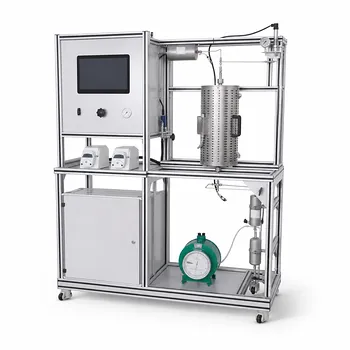
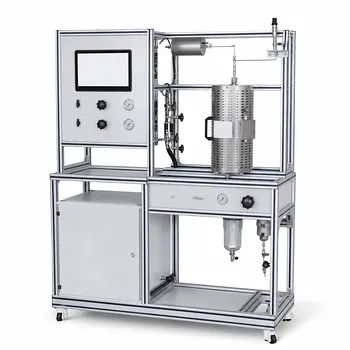
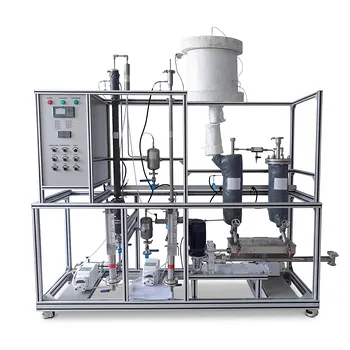
Replicating the harsh environments of industrial demethanizers and de-ethanizers in a pilot plant is not just about scaling down equipment—it is about faithfully capturing the physical extremes that define the separation. The operating pressures (up to 24.5 bar) and cryogenic temperatures (as low as 131 K) directly determine every major design specification of a unit operations pilot plant. Pilot-scale distillation columns must utilize specialized metallurgy and pressure-rated vessels to handle high pressures safely, incorporate vacuum insulation or cryogenic cooling jackets for low-temperature operations, and use advanced thermal sensors to safely replicate industrial mass transfer dynamics.
The extreme industrial operating window—from -142°C to pressures exceeding 24 bar—forces pilot plant designers to select pressure-rated vessels, cryogenic-compatible materials, and precise safety and process monitoring systems. Overlooking any of these constraints does not just compromise experimental accuracy; it introduces serious safety risks and invalidates the core educational or research mission.
The Material Consequences of Cryogenic Temperatures
Demethanizers operate at temperatures that turn common engineering materials brittle and useless. A pilot plant tackling cryogenic separation must first solve the material problem.
Why Demethanizers Demand Vacuum Insulation and Special Alloys
At -142°C, the column shell loses ductility if fabricated from standard carbon steel. Specialized metallurgy—typically austenitic stainless steels or aluminum alloys—is mandatory to maintain toughness.
To prevent excessive heat leak, the pilot column must be enveloped in vacuum insulation or cryogenic cooling jackets. Without these, ambient heat influx would boil off the liquid reflux, collapsing the temperature profile and making meaningful separation impossible.
Avoiding Brittle Fracture: Material Toughness at Low Temperatures
Industrial demethanizers expose materials to a sharp ductile-to-brittle transition. A pilot plant must replicate that environment safely, so material selection moves beyond cost and chemical compatibility to low-temperature impact resistance.
Even gaskets, valve seats, and instrument fittings demand cryogenic rating. A single component failure at these temperatures can cause a cascading loss of containment.
Designing for Pressure: The De-ethanizer Blueprint
High operating pressure radically reshapes the structural and economic design of a pilot column.
Pressure-Rated Vessels and the Economics of Thick-Walled Columns
A de-ethanizer running at 24.5 bar forces the pilot plant designer to treat the column shell as a pressure vessel. That means wall thickness calculations, code stamping, and relief system sizing become non-negotiable.
Operating pressure above 1 MPa significantly increases manufacturing costs because thicker walls require heavier fabrication. At pilot scale, the cost penalty can be disproportionate, forcing a deliberate choice between true industrial fidelity and budget.
How Pressure Affects Separation Difficulty and Refrigeration Load
The industrial choice between high-pressure demethanization (3.0–3.2 MPa) and low-pressure demethanization (0.6–0.7 MPa) is a direct trade-off between refrigeration cost and separation efficiency. A well-designed pilot plant must mirror this flexibility with adjustable pressure controls.
This allows researchers to observe how raising pressure increases condensation temperature—reducing cryogenic load—while reducing relative volatility, making methane-ethylene separation harder. Without this adjustability, the pilot plant cannot teach the core engineering optimization.
The Role of Advanced Instrumentation in a Safe Pilot Environment
Extreme conditions cannot be managed by guesswork. Pilot plants need sensor suites that map every thermal and hydraulic gradient.
Thermal Sensors for Cryogenic-Fidelity Mass Transfer
Accurate, fast-response cryogenic temperature probes are essential to profile the column. Industrial simulation demands multipoint measurements that track the steep temperature gradient from the condenser to the reboiler. This data is the bridge between textbook vapor-liquid equilibrium and real mass transfer dynamics.
Flow Meters and Pressure Sensors to Prevent Flooding
At any scale, vapor velocity that is too high causes flooding, destroying separation. Pilot plants must incorporate differential pressure cells and vapor flow meters to let operators detect the loading point before flooding begins.
These instruments turn the pilot column into an instructional tool: students can deliberately approach flooding, observe the pressure drop spike, and learn corrective actions—all within a controlled, safe environment.
Understanding the Trade-offs
Simulating industrial extremes comes with unavoidable compromises. A trusted design weighs every variable openly.
Realism Versus Capital Cost: How Much Can You Scale Down?
High-pressure, cryogenic pilot plants are expensive. You trade direct industrial mimicry for economy. For example, vacuum operations lower boiling points but increase column diameter due to lower vapor density, while high-pressure designs shrink diameter but require costlier thick-walled fabrication.
Often the best compromise is a moderate-pressure design (0.1–1 MPa) with localized cryogenic sections where the true industrial gradient is needed. This keeps construction costs manageable while preserving the thermodynamic lesson.
Safety Margins and the Challenge of Teaching with Hazardous Conditions
Pilot plants serving educational missions face a dual requirement: fidelity and inherent safety. Cryogenic burns, high-pressure releases, and flammable hydrocarbon inventories escalate risk. The design must incorporate multiple layers of protection, including double-walled piping, rupture disks, and emergency depressurization—features not always visible in the primary reference but demanded by operating reality.
Making the Right Choice for Your Goal
The best pilot plant design is always a function of your specific mission. Use the following goals to guide key specifications.
- If your primary focus is teaching the fundamentals of industrial separation: Choose a column with adjustable pressure and temperature controls, robust safety interlocks, and a wide instrumentation panel that exposes students to the full cause-and-effect chain of pressure-temperature trade-offs.
- If your primary focus is high-fidelity industrial research: Prioritize the metallurgy and pressure rating that exactly match your target demethanizer or de-ethanizer conditions, investing in cryogenic insulation and high-accuracy thermal sensors to reproduce plant data faithfully.
- If your primary focus is process optimization and energy studies: Ensure the pilot plant can operate across a broad pressure range and measure energy consumption at each refrigeration stage, allowing you to map the entire separation efficiency versus utility cost landscape.
- If your primary focus is safe, scaled-down demonstration of extreme conditions: Design for the highest pressure and lowest temperature within a contained, automated safety envelope, accepting a smaller throughput in exchange for manageable risk and student supervision.
Every engineering decision flows from the industrial pressures and temperatures you choose to emulate. Define that battle first, and the pilot plant design will follow.
Summary Table:
| Operational Parameter | Industrial Challenge | Pilot Plant Design Specification |
|---|---|---|
| Cryogenic Temperatures (Down to 131 K) | Material embrittlement, ambient heat leak | Austenitic stainless steel/aluminum, vacuum insulation, cryogenic sensors |
| High Operating Pressures (Up to 24.5 bar) | Structural integrity, safety risks | Pressure-rated vessels, ASME code stamping, advanced relief systems |
| Variable Column Dynamics | Flooding, efficiency trade-offs | Adjustable pressure controls, DP cells, vapor flow meters |
Optimize Your Chemical Engineering Lab with LABPARK
Replicating extreme industrial conditions like cryogenic separation and high-pressure fractionation requires precision-engineered equipment. LABPARK provides premium Educational and Vocational Unit Operations Pilot Plants in chemical engineering, bioprocess & biotech, and environmental & water treatment.
Tailored for universities, research institutes, and enterprises, our systems deliver the perfect balance of educational safety, high-fidelity instrumentation, and rugged durability to prepare the next generation of engineers.
Ready to elevate your training and research capabilities? Contact us today to discuss your custom pilot plant requirements!
Related Products
- Ethylbenzene Dehydrogenation Educational Unit Operations Pilot Plant
- Carbon Dioxide Hydrogenation Methanol Synthesis Educational Unit Operations Pilot Plant
- Steam Methane Reforming Hydrogen Production and Purification Educational Pilot Plant
People Also Ask
- What parameters & reactor configurations are needed for ethylbenzene dehydrogenation pilot plants?
- Why is steam dilution critical in dehydrogenation? Pilot Plant Control Guide
- Isothermal vs Adiabatic Reactors: Key Differences in Ethylbenzene Dehydrogenation Pilot Plants
- How do pilot plants help students verify material balances? Bridge Theory with Real-world Data
- Why is the steam-to-feedstock ratio critical in catalytic dehydrogenation? Learn the 3 key roles of steam.