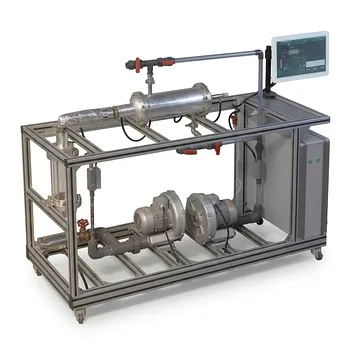
The single greatest physical constraint on a gasketed plate heat exchanger (PHE) in your lab or pilot plant is the gasket itself. It dictates the exact temperature ceiling, the absolute pressure limit, and which chemicals you can safely run through the system. While the metal plates might withstand extreme conditions, the elastomer gasket sealing them will fail rapidly if you ignore its specific material thresholds for heat and solvent exposure.
In laboratory and pilot-scale operations, gasket material limitations are not just a specification on a datasheet—they are the direct, non-negotiable boundary between a successful experimental run and a hazardous leak. The gasket's thermal, pressure, and chemical tolerances define your safe operating window, and these factors are deeply interconnected in ways that a simple spec sheet might fail to highlight.
The Interconnected Limits of Gasket Materials
The operational ceiling of your plate heat exchanger unit is a single chain, and the gasket is its weakest link. Understanding this requires moving beyond memorizing a single number for temperature or pressure and seeing how these limits interact during a real experiment.
How Temperature Defines the Boundary
Gasket materials have strict thermal thresholds that cannot be exceeded without immediate physical consequences. The primary reference material provides the exact ceilings for common options.
For Nitrile Rubber (NBR) , the limit is highly fluid-dependent. It caps at 85°C for water systems but can tolerate up to 140°C for organic or fatty solutions. This split personality is critical for pilot-scale units that may switch between aqueous cleaning cycles and organic synthesis steps.
Ethylene Propylene Diene Monomer (EPDM) offers a higher universal limit, holding stable up to 150°C for most chemical substances. This makes it a standard choice for high-temperature water and steam experiments.
For the most demanding thermal tasks, Fluororubber pushes the ceiling to 175°C and is often essential for hot oil applications. Exceeding these limits causes the elastomer to permanently deform, lose its elastic memory, and begin extruding from between the plates, resulting in a sudden fluid leakage.
The Pressure Constraint is a Gasket Constraint
Why is the pressure limit of a gasketed unit so much lower than a brazed or welded one? The answer lies entirely in the physical sealing mechanism.
A gasket works by filling the microscopic imperfections between two pressed metal plates. Unlike a permanent weld, it provides a mechanical seal that is inherently limited. The entire gasketed assembly is therefore generally capped at an operating pressure below 30 bar.
The supplementary references confirm a typical industrial upper limit, noting that pressures for these units are usually below 1500 kPa (15 bar) , with an absolute maximum of 2000 kPa (20 bar). In a pilot plant, a pressure spike caused by a failed control valve downstream will find the gasket as the first point of release.
The Hidden Variable of Chemical Compatibility
Selecting for temperature and pressure is useless if your process fluid dissolves the seal. The primary requirement for a lab engineer is to consult chemical compatibility tables before a single plate is assembled.
The classic mistake is using NBR with incompatible organic solvents. NBR offers excellent resistance to fats and oils but degrades rapidly when exposed to ketones, chlorinated solvents, or strong acids. This degradation is not just a slow wear mechanism—it can cause a catastrophic blowout during a student experiment.
The supplementary reference adds a historical note, mentioning compressed asbestos gaskets rated for up to 250°C. However, this is now largely obsolete and inapplicable to modern educational settings due to severe health hazards. Modern high-temperature labs would use a reinforced fluoropolymer composite instead.
The Critical Interplay of Limits in Dynamic Operation
A datasheet presents limits in a vacuum. Your pilot plant operates in a dynamic world where these limits are coupled. A gasket’s temperature rating is lowered when it is simultaneously exposed to an aggressive chemical. The thermal energy accelerates the rate of chemical degradation, meaning a gasket rated for 150°C in water might fail at 110°C in a harsh solvent.
Similarly, thermal cycling destroys gaskets faster than steady-state operation. As an elastomer heats up, it expands. The rigid steel plates constrain this expansion, creating internal stress. Repeated heating and cooling of a laboratory unit between experiments work-hardens the gasket material, causing it to crack and lose its ability to bounce back. This is why a unit that holds pressure when first heated might leak violently as it cools down.
Understanding the Trade-offs
There is no universal gasket material. Every choice you make in specifying a unit for a pilot plant involves a compromise between chemical resistance and basic mechanical properties.
-
The Softness Paradox: A very soft gasket (like low-hardness silicone) conforms easily to the plate's groove under low bolt loads, creating a superior initial seal. However, it will extrude out of the groove and blow out under moderate pressure or high temperature. A harder gasket has better mechanical strength but requires much higher, more uniform compression to seal, which is difficult to achieve on a hand-tightened lab frame.
-
The Swelling Safety Gap: Some gasket materials are chemically compatible but absorb a small amount of process fluid, causing them to swell. This swelling can actually improve the seal by filling the groove more tightly. The trade-off is that when the unit is opened for cleaning, the gasket may have become oversize and will be impossible to re-seat without physical damage.
-
Maintenance Burden vs. Flexibility: The primary advantage of the gasketed design—full disassembly for inspection and education—comes at the cost of continuous vigilance. A brazed unit is a "fire and forget" solution with far higher pressure ratings. A gasketed unit is a learning tool that demands the student or researcher check bolt torque and inspect for the early signs of chemical attack before every single run.
Making the Right Choice for Your Pilot-Scale Unit
Gasket selection must be driven by the most extreme condition in your experimental matrix, not the average one. A single cleaning cycle with caustic solution can be more damaging than weeks of running at neutral pH.
-
If your primary focus is safety and longevity in an undergraduate teaching lab: Select EPDM and install a hard-limit controller to prevent the water-bath from exceeding 140°C. Accept the incompatibility with oils because the processing of organics is unlikely in a basic fluids lab.
-
If your primary focus is high-temperature chemical synthesis research: You must specify Fluororubber gaskets and budget for their frequent replacement. Visual inspection for embrittlement should be a mandatory part of the post-experiment shutdown procedure.
-
If your primary focus is rapid cycling between different chemical systems: Invest in multiple, color-coded gasket sets. Dedicating one set of NBR gaskets for oil-based experiments and one set of EPDM for aqueous work prevents cross-contamination and the chemical carry-over that accelerates degradation.
Your gasket is a consumable designed to fail safely before the metal plate does. Treating it as the primary process sensor—by logging its inspection history and replacement frequency—transforms this simple limitation into your most valuable leading indicator of process safety and experimental reliability.
Summary Table:
| Gasket Material | Max Temp (Water) | Max Temp (Organics/Oils) | Key Compatibility | Primary Lab Application |
|---|---|---|---|---|
| NBR | 85°C | 140°C | Good for fats & oils; avoid ketones/acids | Organic synthesis & fatty solutions |
| EPDM | 150°C | N/A | Good for water & steam; avoid oils | High-temperature water systems |
| Fluororubber | 175°C | 175°C | High resistance to acids & hot oils | High-temp chemical synthesis |
Optimize Your Lab's Heat Transfer Safely with LABPARK
Choosing the right plate heat exchanger configuration is crucial for both experimental accuracy and laboratory safety. LABPARK provides premium Educational and Vocational Unit Operations Pilot Plants in chemical engineering, bioprocess & biotech, and environmental & water treatment designed specifically for universities, research institutes, and enterprises.
Let us help you select the ideal equipment and gasket specifications for your unique operational requirements. Contact LABPARK Today to Discuss Your Project!
Related Products
- Shell and Tube Heat Exchanger Heat Transfer Coefficient Determination Educational Pilot Plant
- Comprehensive Multi-Modal Heat Transfer Unit Operations Pilot Plant for Engineering Training
- Three-Tube Heat Transfer Educational Pilot Plant for Unit Operations Training
- Dual Mode Heat Transfer Pilot Plant for Unit Operations Training
- Comprehensive Heat Transfer Coefficient Determination Educational Unit Operations Pilot Plant
People Also Ask
- Why Apply LMTD Correction in Shell-and-Tube Pilot Plants & How to Determine It
- Why adjust baffle spacing in shell-and-tube heat exchanger pilot plants? Master heat transfer & pressure drop.
- How to Estimate Shell-Side Pressure Drop in a Shell-and-Tube Heat Exchanger Pilot Plant: Key Parameters Explained
- How is the fouling factor (Rd) evaluated? Key Pilot Plant Insights for Students
- How is fouling factor demonstrated using shell and tube pilot plants? Practical Lab Guide