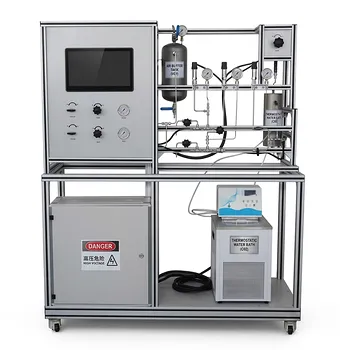
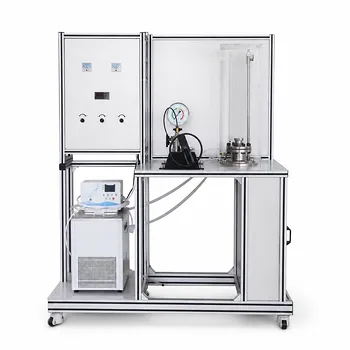
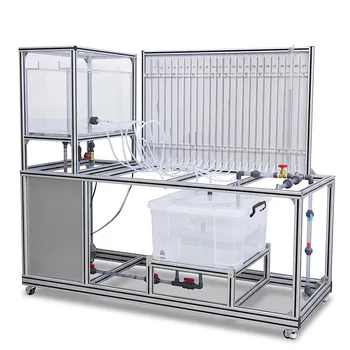
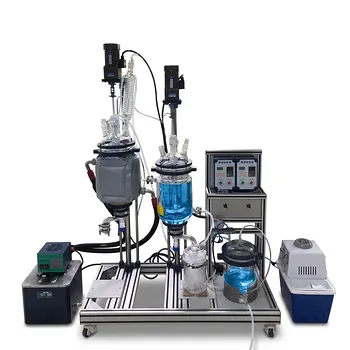
The key to integrating advanced solubility theory lies in transforming the pilot plant from a pure operations exercise into a thermodynamic detective agency. Instead of simply running a crystallization unit, students must be challenged to reconcile their real-world pilot plant data—like unexpected precipitation or yield deviations—with a predictive model built from first-principles equations. This direct confrontation between theory and messy reality is where the deepest learning occurs.
The most powerful educational moment isn't when the equation works, but when it fails. By having students calculate solubility using the full heat-of-fusion and heat-capacity-difference equations, and then observing a systematic deviation in the pilot plant, you force them to think critically about the molecular assumptions hidden within the math. This teaches that a process is not just equipment; it's a physical manifestation of thermodynamic probabilities.
Building the Bridge: From Laboratory Glassware to Thermodynamic Code
The educational leap from a textbook equation to a pilot-scale crystallizer is enormous. The solution is a structured pedagogical sequence that makes the invisible thermodynamic forces visible through instrumentation and comparison. A pilot plant's value isn't just its scale; it's its suite of sensors that let us "see" energy and entropy in action.
The Core Experiment: Comparing Two "Thermodynamic Worlds"
The primary teaching activity is a direct comparison between two data streams. Students first perform solubility measurements in a simple, well-insulated laboratory beaker. This low-complexity environment establishes a baseline.
Then, they run the same crystallization at a pilot scale with integrated temperature sensors and flow meters. The critical third step is the theoretical calculation. Armed with data from thermodynamic databanks—including the standard enthalpy of formation, standard entropy, and the temperature-dependent heat capacity function (Cp = A + BT + CT^2 + DT^-2)—students calculate the ideal solubility.
The core equation for this prediction is based on the rigorous free energy difference. Integrating the thermodynamic databank values allows for the precise calculation of enthalpy and entropy changes from 298 K to the operating temperature, a necessary precursor to finding the equilibrium constant. The final step is the debrief: Why are there deviations between the lab, the pilot plant, and the theoretical model? This question is the engine of understanding.
Making the Abstract Measurable with Maxwell Relations
A common frustration for students is that key properties like entropy (S) and internal energy (U) are ghosts; you can't hook up a sensor to directly read them. This is where the power of Maxwell equations becomes tangible.
When a pilot plant's compressor or reactor generates real-time temperature (T), pressure (P), and volume (V) data, students learn that these are not just operational parameters. They are the inputs to compute the impossible. By writing simple scripts that apply these mathematical relationships to the sensor data, students don't just calculate an entropy change—they feel it. They see an abstract, non-measurable property become a derived value from a pump's discharge pressure and a thermocouple's reading, connecting a second-order partial derivative in a textbook to a physical process.
The Power and Peril of Assumptions: A Teachable Moment
The most important theoretical lesson in scaling up solubility is not the full equation itself, but the consequence of ignoring one of its terms. This is a direct lesson in how a desk-based decision can cause a real-world process upset.
The Trap of Assumption A (ΔCp = 0)
A common thermodynamic simplification, often called Assumption A, assumes the difference in heat capacity between the liquid and solid state (ΔCp) is zero. This makes the free energy calculation much simpler.
From a purely pedagogical standpoint, this is a gift. The assumption systematically overestimates the free energy difference, which leads to a systematic underestimation of solubility. In a pilot plant, a student who relies on this simplified model will predict a safe operating window, only to find the compound precipitates unexpectedly early. The lesson is visceral: a simplified equation predicted the process would work, but the pilot plant's blocked filter proves it didn't. Teaching the full equation, with its heat capacity correction, then becomes the immediate, practical solution to a real problem they've just experienced.
Calibrating Computational Models with Physical Reality
A complementary thread is teaching the limits of purely computational models. A tool like a COSMO-RS virtual solvent screen can rapidly predict relative solubility, a powerful pre-lab exercise.
The pilot plant's role is then to assert the supremacy of physical truth. These models often exhibit systematic deviations, such as overpredicting solubility in polar aprotic solvents. By having students first run a prediction and then physically validate it in the crystallization unit, you teach a healthy skepticism. The physical pilot plant data becomes the gold standard used to calibrate the computational model, a critical skill for industrial scale-up where a wrong simulation can lead to a failed production batch.
Understanding the Trade-offs: Time, Complexity, and Signal Noise
Teaching the full complexity of thermodynamics isn't free. The educational trade-offs must be managed explicitly to ensure the core message isn't lost in the noise.
The Pedagogical Risk of Data Overload
A modern pilot plant can generate a tsunami of data on temperature, pressure, flow rate, and concentration. The risk is that students become mere data collectors, focused on spreadsheet management rather than thermodynamic reasoning.
The solution is to force them to become data skeptics. This means dedicating a portion of the analysis to filtering out instrument noise. A single wayward thermocouple or a poorly calibrated flow meter can create a "deviation" that has nothing to do with a faulty heat-of-fusion value. The class must learn to distinguish a meaningful thermodynamic signal—like the systematic error from Assumption A—from a simple measurement artifact. This analytical skill is arguably as important as the thermodynamic theory itself.
Navigating Between Exothermicity and Safety
When applying these lessons to a reactor unit, the stakes rise significantly. The deep need is not just understanding solubility but predicting the heat of reaction for thermal safety.
Students can use quantum chemical calculations (like DFT) with thermal corrections to predict a reaction’s exothermicity. The pilot plant’s integrated cooling system and temperature sensors then provide the ground truth. The pivotal learning moment occurs when the predicted temperature rise diverges from the measured one. This is not an abstract error; it’s a crucial lesson in scale-up thermodynamics and runaway reaction prevention, teaching students that a neglected heat capacity term in a solver isn't just a math problem, it’s a potential safety incident.
How to Apply This to Your Pilot Plant Curriculum
Integrating these equations is about structuring the inquiry, not just adding more lectures. The pilot plant must become a hypothesis-testing environment for thermodynamic questions.
- If your primary focus is teaching the fundamentals of phase equilibrium: Start with the Assumption A error. Have students run a crystallization using the simplified rule, let them observe the early precipitation in the pilot plant, and then introduce the full equation with ΔCp as the "fix."
- If your primary focus is on process safety and scale-up: Center the exercise on a mildly exothermic reaction. Have students predict the heat load using a thermodynamic databank, then measure the actual heat transfer duty in the pilot reactor, requiring them to account for the difference between theoretical enthalpy and real-world heat loss.
- If your primary focus is on bridging theory with computational modeling: Structure it as a three-stage validation. First, a virtual solvent screen. Second, a physical solubility measurement in the pilot plant. Third, a critical analysis where students identify and quantify the systematic bias of the computational model against their experimental data.
Equipped with this method, the pilot plant ceases to be a miniature factory and becomes the most powerful thermodynamic laboratory your students will ever enter.
Summary Table:
| Focus Area | Practical Experiment | Key Educational Objective |
|---|---|---|
| Phase Equilibrium | Compare simplified model (ΔCp = 0) vs. full equation | Identify deviations and understand unexpected precipitation |
| Process Safety & Scale-up | Compare predicted reaction heat load vs. measured heat transfer duty | Master heat loss calculations and prevent runaway reactions |
| Computational Modeling | Validate virtual solvent screening against physical unit data | Identify computational bias and calibrate predictive models |
Elevate Your Engineering Curriculum with LABPARK
Bridging complex thermodynamic theory with physical reality requires robust, highly instrumented equipment. LABPARK offers state-of-the-art Educational and Vocational Unit Operations Pilot Plants in chemical engineering, bioprocess & biotech, and environmental & water treatment for universities, research institutes, and enterprises.
Our advanced pilot plants provide the real-time sensor data and control systems necessary for students to validate predictive models, analyze deviations, and master industrial scale-up challenges.
Ready to transform your laboratory into a hands-on thermodynamic testing ground? Contact LABPARK today to find the ideal pilot plant solution for your institution!
Related Products
- Throttling Effect Determination Educational Unit Operations Pilot Plant
- Carbon Dioxide PVT Curve Determination Educational Unit Operations Pilot Plant
- Bernoulli Equation Demonstration Unit Operations Pilot Plant
- Potassium Salt Thermal Dissolution and Crystallization Separation Educational Unit Operations Pilot Plant
People Also Ask
- How does kinetic theory explain ideal vs real gas energy differences? Key Pilot Plant Insights
- How are open and closed system boundaries defined when evaluating material balances across educational pilot plant equipment?
- How can selective solvent dissolution and physical property differentials improve pilot-plant recovery?
- How can educational pilot plants be used to teach process safety and risk assessment in chemical engineering curricula?
- Which critical operational criteria should students evaluate when analyzing chemical process units on educational pilot plants? 4 Key Criteria