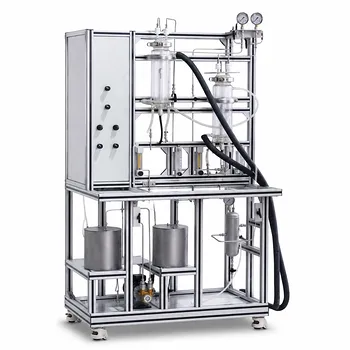
Erosion-corrosion is a dual-threat degradation mechanism where mechanical wear continuously strips away a metal’s protective layer, exposing fresh, highly reactive surface to chemical attack. In pilot plants handling abrasive slurries, mitigation requires a two-pronged strategy: deploying erosion-resistant materials in high-wear locations and optimizing process conditions to reduce mechanical stress, validated by both experimental runs and computational fluid dynamics (CFD).
Pilot plants face a unique intensity of erosion-corrosion due to compact geometries and frequent off-design operation. The most effective mitigation combines hardened metal alloys or sacrificial liners at critical points with operational tuning—reducing turbulence-causing conditions and using CFD to predict erosion hot spots before they cause failure.
Understanding the Mechanics in Pilot Plants
Pilot-scale fluid systems often operate under conditions that amplify erosion-corrosion. High-velocity flows through small-diameter tubing, abrupt changes in direction at elbows, and the presence of suspended solids create a perfect storm of mechanical wear and chemical exposure.
The Synergistic Cycle of Attack
The protective oxide film on common metals is worn away by particle impingement or turbulent eddies. This uncovers bare metal, which corrodes rapidly until the film reforms—only to be stripped again.
In slurry transport, particle velocity and concentration directly control the rate of film removal. Even low corrosion rates become catastrophic when the repassivation cycle is continually interrupted.
Why Pilot Plants Are Particularly Vulnerable
Pilot plants frequently test new fluid compositions and operate across a wide flow envelope. They also contain many flow disturbances—sample ports, instrumentation, and temporary piping—that introduce turbulence and localized high velocity.
These systems are often built with standard materials to reduce cost, leaving them underprotected until the first failure reveals the problem. That makes a proactive approach essential.
Material Selection: The First Line of Defense
Where flow cannot be smoothed, the metal itself must resist the combined attack. The primary reference underscores two practical material strategies.
Erosion-Resistant Alloys for Critical Components
Pump impellers, valve seats, and elbows experience the most intense particle impact. Specifying alloys with high hardness and work-hardening rates can dramatically extend service life.
These alloys maintain their passive film better under impingement because the underlying metal deforms less and supports a more adherent oxide. Common choices for pilot plants include duplex stainless steels and nickel-based alloys, selected based on the slurry’s chemistry.
Sacrificial Physical Barriers
For components that cannot be made entirely from expensive alloys, sacrificial plastic sleeves offer a cost-effective shield. Inserting hard plastic or elastomeric liners at heat exchanger tube inlets or pump suction zones absorbs the mechanical energy before it reaches the metal wall.
This approach decouples mechanical protection from chemical resistance—the sleeve handles the wear, while the base metal only sees a low-velocity fluid film. Sleeves are easily replaced during routine maintenance, making them ideal for pilot plants with changing process fluids.
Process Optimization and Monitoring
Materials alone cannot solve the problem if the flow regime is inherently destructive. The supplementary reference points to operational adjustments that can suppress erosion-corrosion without redesigning the entire plant.
Controlling Hydraulic Parameters
Adjusting flow rate, pump suction head, and fluid composition alters the severity of particle impingement and turbulence. Reducing velocity below the critical threshold for film removal can bring erosion-corrosion to a near halt, even if corrosion persists at a slow, uniform rate.
Pilot plants can deliberately explore these limits: by gradually increasing flow while monitoring weight loss coupons, operators identify the onset velocity where mechanical wear starts to dominate. That data guides safe operating windows.
Detecting and Preventing Cavitation
Cavitation, the formation and violent collapse of vapor bubbles, is an extreme form of mechanical surface attack that often accelerates erosion-corrosion. Adjusting net positive suction head (NPSH) to eliminate cavitation removes a key driver of localized film damage.
In a pilot plant, cavitation can be detected acoustically or via vibration sensors, and its elimination validated by CFD simulation. This proactive approach prevents the pitted surfaces that later become corrosion initiation sites.
The Role of CFD and Experimental Validation
Computational fluid dynamics transforms erosion-corrosion mitigation from a reactive fix to a predictable design exercise.
Predicting Erosion Hot Spots Before They Occur
CFD models can map wall shear stress and particle trajectories through the entire pilot plant flow path. This pinpoints elbows, tees, and fittings where erosion-corrosion will strike first, allowing targeted material upgrades or flow straightening.
These models are especially valuable in pilot plants where physical modifications are frequent—they guide where to place protective sleeves or swap out a pipe section without over-engineering the entire loop.
Validating Mitigation Strategies Experimentally
The supplementary reference highlights that pilot plants are ideal platforms for controlled experiments. Coupon tests, electrochemical probes, and surface profilometry can be run under real process conditions to confirm that a chosen alloy or operational change actually reduces combined material loss.
When experimental data feeds back into the CFD model, the plant becomes a self-improving system: each iteration refines the predictive accuracy and builds an institutional knowledge base for scaling up.
Understanding the Trade-offs and Limitations
No mitigation strategy comes without compromises. Objectively weighing these keeps the pilot plant both robust and cost-effective.
Material Cost vs. Maintenance Downtime
Erosion-resistant alloys carry a higher upfront cost and may require longer lead times. Sacrificial sleeves demand regular inspection and replacement, adding labor. The trade-off balances total lifecycle cost against the criticality of uninterrupted operation.
For a research pilot plant, unplanned shutdowns can invalidate months of data. In that context, the expense of upgrading wear-prone components is often justified. Conversely, a short-term test campaign might accept frequent sleeve changes as the cheaper option.
Operational Limits Imposed by Mitigation
Reducing flow velocity to suppress erosion-corrosion may alter residence time, mixing efficiency, or heat transfer rates, potentially moving the process away from the intended experimental conditions. The pilot plant’s primary purpose—generating accurate scale-up data—must not be sacrificed by overly conservative operating limits.
CFD helps find the sweet spot where velocity is high enough for valid process simulation but below the point where mechanical film damage accelerates exponentially.
Model Accuracy and Validation Effort
CFD predictions of erosion-corrosion are only as good as the particle-fluid interaction models and boundary conditions used. Without experimental validation, a simulation may misidentify hot spots. This requires an upfront investment in instrumentation and model calibration.
However, once validated, the model becomes a durable asset for all future flow modifications, making it a high-return activity for any pilot plant with recurring slurry-flow challenges.
How to Apply These Strategies to Your Pilot Plant
The right mix of material, operational, and analytical defenses depends on your plant’s specific goals and constraints. Start with a clear prioritization.
- If your primary focus is maximizing operational uptime and data continuity: Specify erosion-resistant alloys for all permanent high-wear components and install replaceable plastic sleeves at inlet zones. Use CFD to identify and eliminate cavitation early, ensuring long, uninterrupted runs.
- If your primary focus is rigorous process validation under realistic conditions: Use the pilot plant to map the erosion-corrosion onset velocity experimentally, adjusting flow and suction head stepwise while monitoring weight loss. Validate your CFD model with that data so you can confidently predict behavior at full scale.
- If your primary focus is rapid, low-cost testing of different slurry compositions: Accept the frequent replacement of sacrificial sleeves and standard elbows while running a baseline CFD study to pre-identify the handful of locations needing protection. This avoids overspending on exotic alloys for short campaigns.
A pilot plant is a learning engine. By combining smart material choices with intentional exploration of the flow envelope, you turn erosion-corrosion from a disruptive failure into a well-characterized design parameter.
Summary Table:
| Mitigation Category | Specific Strategy | Primary Benefit |
|---|---|---|
| Material Selection | Use duplex stainless/Ni-alloys & sacrificial plastic sleeves | Protects critical high-wear areas and reduces downtime |
| Process Optimization | Control flow velocity & eliminate cavitation (NPSH adjustment) | Lowers mechanical shear stress and prevents local pitting |
| CFD & Testing | Map shear stress & perform coupon testing | Predicts wear hotspots and validates scale-up models |
Optimize Your Fluid Flow Systems with LABPARK
Prevent costly downtime and accelerate your scale-up research. LABPARK provides state-of-the-art Educational and Vocational Unit Operations Pilot Plants across chemical engineering, bioprocess & biotech, and environmental & water treatment sectors. We empower universities, research institutes, and enterprises with robust systems designed to withstand harsh abrasive slurries and turbulent flows.
Need to design a reliable, erosion-resistant pilot system? Contact our engineering experts today to find the perfect solution for your lab.
Related Products
- Photocatalytic Membrane Separation and Degradation Unit Operations Pilot Plant
- Multi Functional Membrane Crystallization Educational Unit Operations Pilot Plant
People Also Ask
- What are the key differences in membrane configurations? Choose the Right Unit Operations Pilot Plant
- How Do Pervaporation, Vapor, and Gas Permeation Differ in Pilot Plants? Key Comparison
- What are the structural & performance trade-offs of flat-sheet, spiral-wound, & hollow-fiber membrane modules?
- Pervaporation vs. Vapor Permeation: Handling Suspended Solids in Membrane Pilot Plants
- How do PEI, PVDF, and PSU membranes compare in pilot plants? Find the best fit.