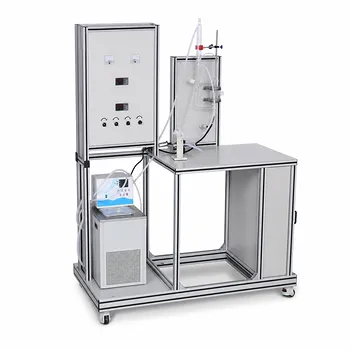
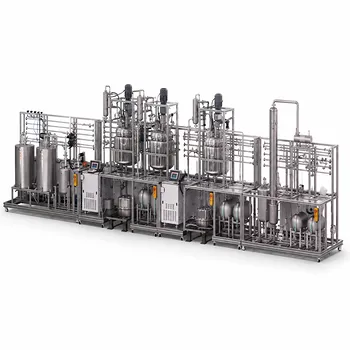
The classroom leap from a solubility curve in a textbook to a churning, glass-walled pilot plant is where chemical engineering theory becomes an unforgettable, tactile skill. Educators can leverage the dramatic, pH-dependent solubility swing of a compound like Venlafaxine HCl not merely as a data point to memorize, but as a dynamic, real-time "process challenge" that forces students to confront and master the messy realities of mass transfer and reactor operations.
Studying the stark solubility profile of a single compound—from over 500 mg/mL in an acidic environment to just 21.6 mg/mL in a basic one—transforms a standard unit operations lab into a rigorous, problem-based learning module. It allows students to directly observe how a controllable thermodynamic variable (pH) dictates kinetic outcomes and separation efficiency, bridging the gap between abstract equation and industrial practice.
Designing the Experiment: From Compound to Curriculum
The core educational value lies in using the known solubility data to create a predictable yet visually compelling experiment. This isn't about discovering new science; it's about operating the plant with a clear, mathematical model in mind and then seeing where reality deviates.
Framing the Problem as an Industrial Separation
Start by presenting students with a realistic, albeit simulated, industrial task. They are not just "running the column"; they are troubleshooting a process to recover a high-value molecule from a complex stream.
Using the Venlafaxine HCl data, the instructor can define a clear objective: separate the target molecule from an aqueous waste stream. The operational challenge becomes immediately apparent: the molecule is practically inseparable in its soluble, protonated state. Students must design the process to intentionally crash it out.
Mastering the pH Control System as a Process Variable
The pilot plant's pH control system ceases to be an abstract loop and becomes the primary unit operation. Students are forced to move beyond a simple setpoint entry.
They must calculate the precise base addition required to shift the solution pH across the molecule's critical precipitation threshold. The gap between "calculated" and "actual" reagent consumption becomes a powerful lesson in buffering capacity, mixing dynamics, and probe response lag. They learn that a stable pH reading is a final symptom of a completed reaction, not an instantaneous command.
Visualizing and Quantifying Precipitation Kinetics
This is where the deep learning solidifies. The solubility plunge from over 500 mg/mL to 21.6 mg/mL is so severe that the precipitation event is a dramatic, visible phenomenon.
Students can observe the immediate clouding as the local pH near the base injection point spikes, followed by the growth of crystalline particles. This makes reaction and crystallization kinetics tangible. The educator can then guide them from qualitative observation ("the solution turns milky") to quantitative analysis: measuring particle size distribution over time, assessing filtration flux rates, and calculating the yield lost to a supersaturated solution that failed to nucleate effectively.
Connecting the Lab to Real-World Reactor Design
A pilot plant exercise with a single-solute model system is a microcosm of an industrial reactor. The lessons extracted here form the foundation of the professional engineer’s intuition.
The Hidden Curriculum: From Solubility to Mass Transfer Coefficients
The surface objective is to precipitate a solid. The deep educational goal is to reverse-engineer the mass transfer limitations of the equipment itself. The known pH-solubility curve provides the driving force (ΔC), but the rate of precipitation reveals the system’s mass transfer coefficient (kLa).
By measuring how quickly the dissolved concentration falls after a pH shift, students can calculate the overall volumetric mass transfer coefficient for the pilot plant's mixing tank. They can then change variables—impeller speed, baffle configuration, base injection point—and instantly see the effect on this coefficient. The solubility data is the known constant that makes solving the mass transfer equation possible.
Understanding the pH-Gradient and Localized Mixing Effects
The dramatic solubility difference also visualizes a critical pitfall: non-ideal mixing. Near the base addition nozzle, the pH is far higher than the bulk reading, creating an intense local supersaturation that drives ultra-fast, uncontrolled nucleation.
This leads to the formation of "fines"—tiny, difficult-to-filter particles that illustrate perfect reaction chemistry but poor reactor engineering. Students learn that a reactor is not just a vessel for a reaction; it’s a hydrodynamic machine where local mixing conditions can define product quality more than the overall thermodynamics. They are forced to engineer a solution, perhaps by diluting the base or relocating the addition point, to manage this gradient.
Understanding the Trade-offs
An objective analysis requires a clear-eyed look at the limitations of this educational model. Trust is built by acknowledging what this experiment does not teach.
- Idealized vs. Real Mixtures: The primary pedagogical limitation is the use of a single-component, synthetic solution. It brilliantly isolates the pH-mass transfer relationship, but it doesn't prepare a student for the competing ion effects, surfactant interference, or co-precipitation challenges of a real industrial liquor.
- The Purity Paradox: Achieving a high recovery yield is easy, but achieving a pharmaceutically pure solid is an entirely different challenge ignored in this simple exercise. The kinetically trapped precipitates can contain high levels of occluded mother liquor, contaminating the final product.
- Oversimplified Thermodynamics: While the pH-solubility curve for a single molecule is clean, it can reinforce a one-dimensional view of process control. Students must be cautioned that in multi-component systems, the effect of pH on solubility is often non-monotonic and competes with other separation drivers.
Making the Right Choice for Your Educational Goal
The depth of your learning objectives should dictate how you deploy this powerful, but specific, teaching tool. It’s a precision instrument, not a broad brush.
- If your primary focus is teaching core thermodynamics and separation fundamentals: Use the quantitative data to build a rigorous pre-lab calculation model. The exercise's goal is to prove the equation's predictive power, with the plant run serving as experimental validation.
- If your primary focus is developing "plant sense" and operational troubleshooting skills: Deliberately sabotage the mixing. Task students with achieving a tight particle size distribution and watch them discover the critical, real-world impact of hydrodynamics on a textbook chemical reaction.
- If your primary focus is on process safety and industrial hygiene: Use the selective precipitation step to introduce a complete process cycle. The solid cake from the filter becomes the feed for a downstream batch dryer, turning a simple solubility test into a holistic, multi-unit operation campaign.
A single, well-characterized pH-solubility curve is not just a chemical property; it's a programmable foundation for building a semester's worth of process intuition.
Summary Table:
| Educational Focus | Practical Application | Student Learning Outcome |
|---|---|---|
| pH Control Systems | Calculate base addition across precipitation thresholds | Master buffering capacity and probe response lag |
| Precipitation Kinetics | Observe clouding and measure particle size distribution | Quantify reaction kinetics and filtration flux rates |
| Mass Transfer | Vary impeller speed and baffle configurations | Calculate overall volumetric mass transfer coefficient ($k_La$) |
| Reactor Hydrodynamics | Adjust reagent injection points and dilutions | Understand localized mixing effects and minimize "fines" |
Elevate Your Engineering Lab with LABPARK
Transform abstract chemical equations into tangible, real-world skills. LABPARK provides high-quality Educational and Vocational Unit Operations Pilot Plants in chemical engineering, bioprocess & biotech, and environmental & water treatment. Specifically tailored for universities, research institutes, and enterprises, our systems empower students to master reactor operations, mass transfer kinetics, and process control.
Ready to enhance your department's hands-on training capabilities? Contact LABPARK today to explore our customizable pilot plant solutions.
Related Products
- Binary System Vapor Liquid Equilibrium Data Determination Educational Unit Operations Pilot Plant
- Supercritical High-Gravity Flash Evaporation Educational Unit Operations Pilot Plant
- Aspirin API Synthesis Unit Operations Training Pilot Plant
People Also Ask
- Why correlate VLE pilot plant data using Wilson, NRTL, and UNIQUAC? Achieve Accurate Column Scale-Up
- For VLE Experiments: Fugacity vs. Activity Coefficient Method Selection Criteria
- How do pilot plants assist in teaching & researching non-ideal VLE? Bridge Theory & Physical Validation
- How to Model VLE for Supercritical & Unstable Components? Pilot Plant Methods
- Why is accurate VLE data critical? Optimize Unit Operations & Process Scale-Up