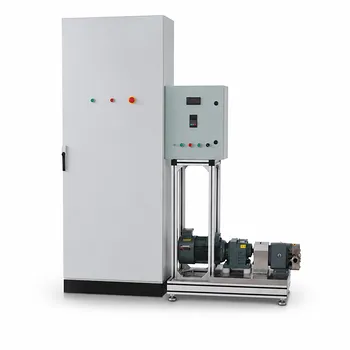
To study and optimize the precipitation of sodium bicarbonate in the Solvay process, a pilot plant must be configured around a jacketed crystallizer with precision temperature control capable of maintaining conditions below 15°C. This core unit is integrated with a chilled coolant loop, real-time temperature and flow sensors, and a feed system for the carbonated brine, allowing researchers to systematically probe how cooling rates, mixing intensity, and seeding affect crystal nucleation, growth, and final product purity.
The defining challenge of the Solvay precipitation step is the narrow solubility window of sodium bicarbonate. A pilot plant that couples a jacketed crystallizer with high-resolution temperature control enables systematic mapping of this window, turning a thermodynamic constraint into an optimization lever for purity and yield.
Why Temperature Control Below 15°C Is Non‑Negotiable
The Solubility‑Driving Principle
In the Solvay process, sodium bicarbonate precipitates from a brine saturated with ammonia and carbon dioxide. The key insight is that NaHCO₃ solubility plummets as temperature drops, and below 15°C the acid carbonate is only slightly soluble. This is the thermodynamic foundation for achieving both high yield and high purity in a single step.
What Happens When the Temperature Drifts
Even a few degrees above the target range sharply reduces the precipitation driving force. Impurities like ammonium chloride can co‑precipitate or liquor entrapment increases, degrading purity. The pilot plant must therefore demonstrate that tight sub‑15°C control is not a luxury but a requirement for reproducible, high‑grade product.
Core Pilot Plant Configuration for the Precipitation Step
The Jacketed Crystallizer with Precision Chilling
The central unit is a jacketed glass or stainless‑steel vessel equipped with a circulating coolant system (chiller) that maintains an internal temperature below 15°C. The jacket design ensures uniform heat removal, and a PID controller adjusts coolant flow to follow programmed cooling profiles. Temperature probes at multiple points (jacket inlet/outlet, bulk liquid, near the wall) allow researchers to quantify heat transfer and identify any cold spots that trigger premature nucleation.
Feed and Reagent Delivery System
The stream entering the crystallizer is a carbonated brine—typically a solution containing NaCl, NH₃, and absorbed CO₂. In a dedicated precipitation pilot plant, this feed can be prepared synthetically to isolate variables. Alternatively, the pilot plant can be integrated with an upstream absorption column, but for focused crystallization studies, a temperature‑controlled feed tank with metering pumps is simpler. CO₂ partial pressure and pH are monitored inline to verify that the solution remains saturated with the key reagents.
Agitation and Slurry Handling
A variable‑speed agitator provides controlled mixing. Gentle, uniform agitation prevents localized supersaturation while keeping crystals suspended. The pilot plant must also incorporate a sample port or continuous slurry withdrawal loop to transfer the precipitated NaHCO₃ to a downstream solid‑liquid separation unit (e.g., a vacuum filter or filter press), enabling material balance closure and particle size analysis without disturbing the crystallization environment.
Instrumentation and Data Acquisition
The configuration is blind without sensors. In addition to temperature, the plant should record pH, conductivity, dissolved CO₂ (optional), agitator torque, and pressure. A real‑time data historian lets researchers correlate cooling ramps with turbidity or focused‑beam reflectance measurement (FBRM) signals that track nucleation onset and crystal size evolution.
Key Process Variables to Investigate for Optimization
Cooling Rate and Its Impact on Crystal Habit
A slow, linear cooling ramp favors steady crystal growth and larger, purer particles. Rapid quenching, by contrast, causes explosive nucleation that entraps mother liquor and contaminants. The pilot plant’s jacket controller can execute stepwise or exponential cooling profiles, making it possible to compare product filterability and purity for each strategy.
Seeding Strategy for Crystal Uniformity
Introducing a small mass of high‑purity NaHCO₃ seed crystals at a controlled temperature shifts the dominant mechanism from nucleation to growth. In the pilot plant, seeds can be injected through a slurry port once the solution reaches its saturation point. Researchers then measure the resulting particle size distribution to build a seed‑to‑yield relationship that suppresses fine formation.
Residence Time and Continuous Operation
Although the primary reference focuses on a batch‑style jacketed reactor, a pilot plant can also be configured as a continuous mixed‑suspension, mixed‑product‑removal (MSMPR) crystallizer. In this mode, feed and slurry removal rates are balanced to maintain a constant inventory, and residence time becomes a primary optimization variable that influences both crystal size and steady‑state purity.
Understanding the Trade‑offs
Purity vs. Yield vs. Energy Cost
Driving the temperature from 15°C toward 5°C boosts yield but dramatically increases the chilling energy per kilogram of product. Moreover, extremely low temperatures can slow mass transfer and the precipitation kinetics, requiring longer residence times. The pilot plant must quantify the energy‑to‑added‑yield ratio to identify the economic optimum.
Mixing Intensity and Crystal Breakage
Higher agitation keeps crystals suspended and enhances heat transfer, yet excessive shear breaks fragile nuclei and generates fines that complicate downstream filtration. Through pilot‑scale experiments, researchers establish the agitation sweet spot where suspension is maintained without measurable secondary nucleation.
Scalability of Jacketed Crystallizers
A lab‑scale jacketed vessel enjoys a high wall‑surface‑to‑volume ratio, leading to fast heat transfer. On scaling up, the volume grows faster than the jacket area, cooling times lengthen, and temperature homogeneity becomes harder to maintain. The pilot plant thus serves as a critical scale‑down tool—its data must be interpreted with dimensionless heat transfer and mixing numbers to ensure industrial relevance.
Making the Right Choice for Your Pilot Plant Study
After defining the core research questions, select the configuration that matches your optimization goal. The following actionable paths link each goal to the appropriate pilot plant feature.
- If your primary focus is maximizing product purity: Use a synthetic carbonated brine feed and implement a slow cooling profile with precise seeding. High‑resolution temperature control (<15°C) and gentle agitation are non‑negotiable.
- If your primary focus is maximizing yield per batch: Investigate end‑point temperatures as low as 5°C while monitoring impurity levels. Pair the jacketed crystallizer with a chiller capable of rapid temperature steps and measure the resulting purity‑yield trade‑off curve.
- If your primary focus is reducing energy consumption: Map the correlation between cooling rate, coolant inlet temperature, and product quality. Use the data to design an optimal cooling ramp that meets purity specs while minimizing compressor load.
- If your primary focus is process scale‑up: Operate the jacketed crystallizer in continuous mode and vary residence time and mixing intensity. Collect crystal size distributions and heat transfer coefficients, then apply dimensionless scaling rules to estimate the performance of an industrial unit.
A well‑configured pilot plant transforms the low‑temperature precipitation of sodium bicarbonate from a textbook constraint into a measurable, optimizable set of unit operations, giving students and researchers a direct, hands‑on path from thermodynamic principle to practical process control.
Summary Table:
| Configuration Feature | Purpose & Function | Key Variable to Optimize |
|---|---|---|
| Jacketed Crystallizer | Maintains temperature below 15°C to control NaHCO₃ solubility | Cooling rate and cooling profiles |
| Feed Delivery System | Delivers carbonated brine feed (NaCl, NH₃, and CO₂) steadily | Reagent saturation and feed rate |
| Agitation System | Suspends crystals uniformly without inducing high shear | Agitation speed vs. crystal breakage |
| Instrumentation | Monitors pH, temperature, conductivity, and turbidity in real-time | Nucleation onset and crystal growth |
Optimize Your Unit Operations with LABPARK
To successfully study and scale up crystallization processes like Solvay precipitation, having the right equipment is essential. LABPARK provides advanced Educational and Vocational Unit Operations Pilot Plants in chemical engineering, bioprocess & biotech, and environmental & water treatment tailored for universities, research institutes, and enterprises.
Our pilot plants feature precise temperature control, automated cooling systems, and robust data acquisition to help you achieve reproducible results and optimize yield.
Contact us today to discover how LABPARK can configure the ideal pilot plant solution for your research and training needs!
Related Products
- Supercritical High-Gravity Flash Evaporation Educational Unit Operations Pilot Plant
- 100L Continuous Loop Hydrogenation Educational Unit Operations Pilot Plant
- Dual-Mode Rectification Pilot Plant for Practical Training Unit Operations
- Quantitative Dosing and Liquid Flow Control Educational Unit Operations Pilot Plant
People Also Ask
- How is the heat transfer area calculated for an evaporation unit operations pilot plant during experimental design? Guide
- How to select educational evaporator pilot plants for thermal & scaling solutions? Complete Guide
- What is the practical significance of Kb in pilot plant evaporation? Master process design.
- How to Select Natural vs. Forced Circulation Evaporators by Feed Type
- How do flash calculations relate to flash evaporation pilot plants? Bridge Theory and Practice