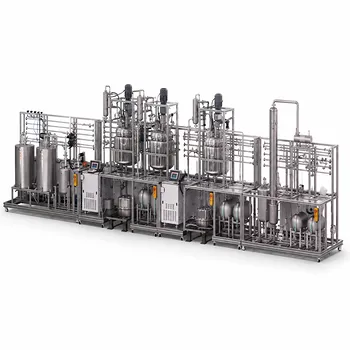
The construction and stabilization of enzyme-based biosensors for sugar detection in a pilot plant setting begins with a hands-on demonstration of co-immobilizing a membrane-bound enzyme and a lipophilic mediator onto a gold electrode.
Students learn this by forming a self-assembled monolayer (SAM) from a blend of hydrophobic long-chain thiols and charged short-chain disulfides, then using detergent dialysis to embed fructose dehydrogenase alongside coenzyme Q6. This single, reproducible protocol teaches the fundamentals of surface chemistry, enzyme physics, and electrochemical characterization—all within the controlled, yet industrially relevant, environment of a bioprocess training facility.
A pilot plant becomes a live laboratory for biosensor stabilization when it shows that signal decay comes from mediator washout, not enzyme death, and that a simple mediator replacement can fully restore function. This deep insight shifts the learner’s focus from merely building a sensor to engineering a robust, regenerable measurement interface for real fermentation monitoring.
Deconstructing the Biosensor Assembly Process
Pilot plants break down complex sensor fabrication into teachable unit operations, each tied directly to bioprocess realities. The primary reference method uses a gold electrode, a mixed SAM, and co-immobilization to create a selective, stable sugar sensor.
The Role of the Self-Assembled Monolayer (SAM)
The sensor’s foundation is a carefully designed SAM. A mixture of a long-chain thiol (octadecyl mercaptan) and short-chain disulfides (cystamine dihydrochloride, 3,3'-dithiodipropionic acid) is assembled on a gold electrode.
The long-chain thiols create a hydrophobic scaffold that mimics a cell membrane and blocks polar interferents like ascorbic acid. The short-chain charged disulfides intentionally introduce molecular defects—tiny, electrostatically active pockets within the monolayer.
These charged pockets are critical. They act as docking sites that pull the enzyme into the film through electrostatic adsorption, ensuring reliable immobilization without the need for harsh chemical crosslinkers that might denature the protein.
Co-Immobilization of Enzyme and Mediator
Once the SAM is in place, fructose dehydrogenase (FDH) and coenzyme Q6 are introduced simultaneously. The detergent dialysis method gently removes excess detergent, forcing the lipophilic mediator and the membrane-bound enzyme to integrate into the hydrophobic monolayer.
This co-localization puts the enzyme’s active site in direct electrical contact with the mediator, which shuttles electrons to the gold electrode. It is a complete, functional system created in one step.
The pilot plant environment allows students to perform electrochemical characterization immediately after immobilization. They can measure the catalytic current upon fructose addition, linking the biochemical event (sugar oxidation) directly to a measurable electronic signal.
Demonstrating Stabilization and Long-Term Robustness
Stability is the bridge between a benchtop curiosity and a process-ready sensor. Pilot plants are uniquely equipped to teach why sensors fail and how to fix them.
The Real Culprit Behind Signal Decay
Students often assume that enzyme denaturation causes activity loss over days. The pilot plant dispels this myth. Controlled aging studies show that the primary failure mechanism is the physical desorption of the lipophilic mediator (coenzyme Q6) from the SAM, not the unfolding of FDH.
This diagnosis is demonstrated through a simple, powerful troubleshooting exercise. When sensor activity drops, the electrode is exposed to a fresh solution of an alternative lipophilic mediator, such as decylubiquinone. Electrochemical activity is rapidly restored, proving the enzyme is still active and the mediator reservoir is the weak link.
Teaching Sensor Regeneration as a Unit Operation
This regeneration step is a core part of the training curriculum. It reframes sensor maintenance as a periodic mediator replenishment, much like replacing a reagent solution in a process analyzer.
The exercise teaches students to think about mediator retention strategies. Within the pilot plant, they can explore how different SAM compositions or mediator structures influence washout rates, directly connecting material science to process uptime.
Integrating Sensors into the Broader Bioprocess Workflow
A biosensor’s true value emerges only when it functions inside a bioreactor. Pilot plants provide the infrastructure to close this loop.
Real-Time Monitoring and Interference Resistance
The SAM-based sensor is specifically designed to resist polar electroactive interferents present in raw fermentation broths and fruit juices. Pilot plant runs on actual media prove this interference resistance, giving students confidence in the sensor’s selectivity beyond idealized buffers.
Furthermore, pilot plants with multi-stage reactors and inline analytics—such as UV-Vis spectrophotometers and pH probes—allow students to study cascading enzyme reactions, like glucose oxidase combined with metal-organic framework catalysts. They can monitor the real-time conversion of glucose to a chromogenic product, optimizing dissolved oxygen and substrate feed rates while the biosensor provides a parallel, independent sugar reading.
From Fabrication to Process Control
This multi-sensor environment teaches a holistic lesson: biosensor construction is only the first step. Stabilization, calibration drift, and interference rejection become tangible process control challenges.
Students learn to correlate electrochemical signals with offline reference measurements (like HPLC), build calibration models, and set alarm thresholds for automatic feeding—all standard pilot plant activities that turn a sensing device into a process analytical technology (PAT) tool.
Understanding the Trade-offs and Common Pitfalls
Every design choice carries a consequence. The pilot plant makes these trade-offs visible and measurable.
- Monolayer Integrity vs. Enzyme Loading: Introducing charged defects is necessary to electrostatically adsorb the enzyme. However, an excessively high density of these defects can compromise the hydrophobic barrier, allowing interferents like ascorbic acid to reach the electrode. Trainees must optimize the thiol/disulfide ratio.
- Mediator Mobility vs. Signal Drift: A lipophilic mediator that moves freely within the SAM is essential for electron transfer, but that same mobility enables its eventual desorption. The sensor’s operational lifetime is therefore a balance between fast response and mediator retention.
- Hands-on Variability: Detergent dialysis and manual SAM preparation introduce variability. A pilot plant’s role is not to eliminate this variability immediately, but to help students quantify it through repeated builds, teaching statistical process control for sensor manufacturing.
Making the Right Choice for Your Training Goals
The specific skills your team takes away depend on the focus you choose within the pilot plant curriculum. Use the following goals to guide the program.
- If your primary focus is mastering biosensor construction: Concentrate on the SAM formation and co-immobilization protocol. This covers surface science, enzyme handling, and electrochemical characterization fundamentals in one reproducible exercise.
- If your primary focus is process monitoring and PAT integration: Deploy the finished sensor in a running bioreactor with inline analytics. Emphasize interference testing, calibration against a reference method, and the use of sensor data for automated control loops.
- If your primary focus is troubleshooting and process economics: Run extended stability studies that force mediator washout, then perform the regeneration procedure. Compare the cost and downtime of sensor replacement versus in-situ reagent replenishment.
- If your primary focus is biocatalytic scale-up: Combine the biosensor build with a multi-enzyme cascade reaction in a series of reactors. This teaches how sensor feedback can optimize substrate feeding and oxygen transfer across unit operations.
The pilot plant transforms an abstract biosensor principle into a portfolio of concrete, measurable competencies that directly serve the biomanufacturing and analytical instrumentation sectors.
Summary Table:
| Training Goal | Method / Process | Key Learning Outcome |
|---|---|---|
| Biosensor Assembly | Co-immobilize FDH & coenzyme Q6 on gold electrode using a mixed SAM | Learn surface chemistry, enzyme immobilization, and electrochemistry. |
| Stabilization & Repair | Diagnose mediator washout and regenerate sensor with decylubiquinone | Understand sensor decay mechanisms and perform in-situ replenishment. |
| Process Integration | Inline bioreactor monitoring & calibration against HPLC reference | Master interference resistance and Process Analytical Technology (PAT). |
Bring Hands-On Bioprocess Training to Your Lab
Ready to equip your students and researchers with real-world skills in biosensor technology and bioprocess control? LABPARK provides state-of-the-art Educational and Vocational Unit Operations Pilot Plants in chemical engineering, bioprocess & biotech, and environmental & water treatment. Designed specifically for universities, research institutes, and enterprises, our pilot plants bridge the gap between theory and industrial practice.
Contact us today to customize your training pilot plant and elevate your educational programs!
Related Products
- Bio-fermentation Ethanol Production Practical Training Unit Operations Pilot Plant
- Natural Product Extraction Unit Operations Training Pilot Plant
- Dual-Mode Rectification Pilot Plant for Practical Training Unit Operations
- Multi Pump Fluid Transport Process Piping Unit Operations Training Pilot Plant
- High-Gravity Emulsification and Mass Transfer Educational Pilot Plant
People Also Ask
- Why Use PTFE & Hastelloy in Chemical Pilot Plants? Prevent Corrosion & Ensure Safety
- Why Compare Predicted and Experimental Excess Enthalpy? Key to Accurate Pilot Plant Scale-up
- Why is the chemical plant startup schedule crucial? De-risk scale-up with pilot plants.
- When to transition from PID to adaptive control in pilot plants? Key process indicators.
- Why must batch and fed-batch fermentation pilot plants be designed to accommodate changing rheological conditions?