Listening to your granulator is the most reliable way to stop a shutdown before it starts. Advanced acoustic chemometrics prevents fluidized bed granulator shutdowns caused by lump formation by mounting non-intrusive accelerometers on the reactor walls and applying multivariate analysis like Principal Component Analysis (PCA) to the captured vibration spectra. This approach detects the subtle, early-stage changes in bed dynamics that signal material build-up on the perforated plate or lump growth, providing operators with a 30-minute (or greater) early warning compared to the brief 10-minute window offered by conventional temperature and pressure sensors.
The true power of acoustic chemometrics lies in converting mechanical vibration into a leading indicator of process health. Traditional sensors only see the result of a problem; acoustic-PCA tracks the onset of layering as it happens, giving researchers and operators ample time to adjust airflow or binder spray and keep the unit running continuously.
The Hidden Cost of Lump Formation in Pilot Plants
Lump formation and bottom-plate fouling are not just operational nuisances—they are the primary triggers for unscheduled, work-intensive shutdowns in fluidized bed granulation pilot plants. These events interrupt long-duration experiments, waste valuable materials, and compromise the data quality needed for scale-up studies.
Why Temperature and Pressure Sensors Aren’t Enough
Classical univariate sensors like thermocouples and pressure transmitters are slow to react. They monitor bulk fluid properties, not the physical state of the bed. By the time a pressure drop indicates severe clogging, the layering cake is already thick enough to force a shutdown, leaving as little as 10 minutes to intervene.
The core failure is delay. These instruments detect the consequence—blocked airflow—not the cause—particle accumulation. In a teaching or research pilot plant, that short window makes it nearly impossible to demonstrate proactive control or teach students about true process optimization.
The Physical Signature of a Problem You Can’t Yet See
Lumps and layering form when granules stick to the bottom plate or to each other instead of fluidizing freely. This changes how particles strike the reactor wall. The energy and frequency pattern of those wall impacts shifts in a measurable way long before the bed collapses.
Acoustic chemometrics directly senses these mechanical interactions, making the invisible buildup visible on a multivariate control chart.
How Acoustic Chemometrics “Hears” Bed Dynamics
The method turns the entire reactor into a sensitive listening device. High-temperature accelerometers clamped onto the vessel’s exterior wall capture the passive vibration signature generated by fluidized granules hitting the wall.
Non-Intrusive Sensing with Clamp-On Accelerometers
These sensors have no moving parts, never contact the product, and require no piping modifications. A single, robust accelerometer can withstand high temperatures and dirty environments typical of pilot-scale granulation. The “clamp-on” nature eliminates contamination risks and makes installation or relocation trivial—ideal for flexible pilot plant configurations.
From Noise to Knowledge with PCA
The raw vibration waveform is too complex for the human eye, but its acoustic power spectrum contains a rich fingerprint of the bed’s state. Applying Principal Component Analysis (PCA) to this spectrum compresses thousands of frequencies into a handful of latent variables. A shift in the PCA score plot reveals a change in the particle-fluidization state—whether that’s the onset of blocking, the growth of a layering cake, or a transient drop in airflow—reliably and with minimal delay.
Because the acoustic method is directly sensitive to bed dynamics, it provides a smoother, faster, and more informative process fingerprint than traditional process variables ever could. The warning arrives 30 minutes or more ahead of a critical shutdown, turning a crisis into a controlled correction.
From Early Warning to Continuous Operation
Integrating acoustic chemometrics into a pilot plant doesn’t just prevent shutdowns—it fundamentally changes how the unit is operated and taught.
Real-Time Multivariate Statistical Process Control (MSPC)
With a PCA model built on normal operating data, operators can set Hotelling’s T² and Q statistic limits to define the acceptable range of bed behavior. When the acoustic signature drifts outside that envelope—indicating lump formation or plate blockage—an alarm triggers. The operator can then lower binder spray rate or increase airflow to break up early clumps, well before gravity wins.
Training the Next Generation of Engineers
For educational pilot plants, this is transformative. Students don’t just read about process deviations; they see them emerging in real time on a score plot. They can link a deliberate parameter change (e.g., too high a binder flow) to the acoustic fingerprint of lump formation, and then correct it. This closes the loop between cause, effect, and mitigation in a way that a sudden pressure alarm cannot.
Understanding the Trade-offs
Acoustic chemometrics is not without its limits, and deploying it successfully requires an honest appraisal of its challenges.
Signal Complexity Requires Chemometric Expertise
A raw acoustic spectrum is highly multivariate and can be influenced by external plant vibrations (pumps, nearby equipment). Robust model building with PCA or Partial Least Squares (PLS) demands careful data collection, pre-processing, and validation. Poor sensor placement or an undertrained model can generate false alarms that erode operator trust.
Calibration and Maintenance of the Model
Like all soft sensors, acoustic chemometric models can drift over time if feed properties or equipment conditions change substantially. The model may need periodic recalibration, and the installation of accelerometers must ensure consistent coupling with the vessel wall. This is not a “set and forget” solution; it requires a mindset of ongoing analytical stewardship.
Not a Replacement for All Sensors
Acoustic monitoring excels at detecting physical changes in the bed, but it does not directly measure temperature, moisture, or binder flow. It should be paired with those traditional measurements for a complete process picture. The value is in providing the layer of information they lack—the physical state of the fluidization.
Making the Right Choice for Your Pilot Plant’s Goals
How you implement acoustic chemometrics depends on what you want to maximize. Use these goal-oriented strategies to guide your decision.
- If your primary focus is maximizing uptime and experimental throughput: Prioritize a simple, robust PCA model trained on historical shutdown events. Integrate the acoustic early warning into the control room with clear, actionable limits. The 30-minute head start will be your single biggest lever for reducing lost production hours.
- If your primary focus is advanced Process Analytical Technology (PAT) research: Use PLS regression to correlate acoustic spectra with granule size, moisture content, or binder distribution. This transforms the single clamp-on sensor into a multi-analyte predictor, enabling deeper kinetic studies and scale-up model validation without invasive probes.
- If your primary focus is operator training and education: Expose the PCA score trajectories prominently. Let students manipulate process parameters and watch the acoustic signature migrate in real time. This builds an intuitive, cause-and-effect understanding of fluidization that no textbook can replicate.
When a granulator can speak, shutdowns become a choice, not a surprise—and every hour saved strengthens the bridge from pilot-scale learning to industrial-scale excellence.
Summary Table:
| Feature | Traditional Sensors (Temp/Pressure) | Acoustic Chemometrics (Accelerometers + PCA) |
|---|---|---|
| Detection Method | Monitors bulk fluid properties | Captures passive wall vibrations from particle impacts |
| Warning Time | Short (~10 mins), often too late | Early warning (30+ mins before shutdown) |
| Sensitivity | Detects consequences (blockages) | Detects early-onset lump formation & layering |
| Installation | Invasive probes contacting product | Non-intrusive, clamp-on sensors |
Enhance Your Unit Operations Lab with LABPARK
Are you looking to eliminate unexpected shutdowns and teach advanced process control in your lab? LABPARK provides state-of-the-art Educational and Vocational Unit Operations Pilot Plants in chemical engineering, bioprocess & biotech, and environmental & water treatment. Designed specifically for universities, research institutes, and enterprises, our pilot plants support advanced PAT integration—like acoustic chemometrics—to give your researchers and students hands-on experience with modern, smart manufacturing technologies.
Contact LABPARK today to discover how our customizable pilot plant solutions can elevate your research capabilities and training programs!
Related Products
- Fluidized Bed Gas Solid Catalytic Reaction Educational Pilot Plant
- Multi-Reactor Educational Pilot Plant for Reaction Engineering Unit Operations
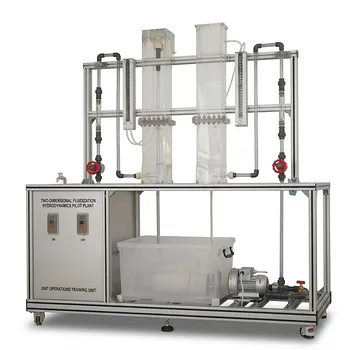
- Two-Dimensional Fluidization Hydrodynamics Educational Pilot Plant for Unit Operations Training
- Multi Functional Catalytic Reaction and Reactor Evaluation Educational Unit Operations Pilot Plant
- Multi-Functional Drying Educational Unit Operations Pilot Plant
People Also Ask
- Why is the bed height-to-diameter ratio (L/dt) critical? Fluidized bed pilot plant selection guide.
- How is the minimum fluidization velocity (U_mf) determined and utilized? A Unit Operations Guide
- How does the Mears criterion evaluate transport resistance? Key Guide to Intrinsic Kinetics
- How do reactor pilot plants safely study gas-solid reactions? Master kinetics with thermal & flow control.
- How do pilot plants demonstrate fluidized-bed reactor advantages over fixed-bed? Find Out Now