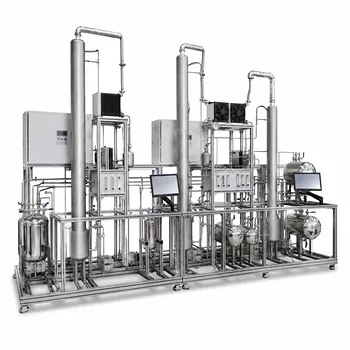
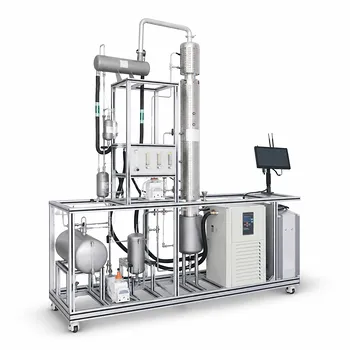
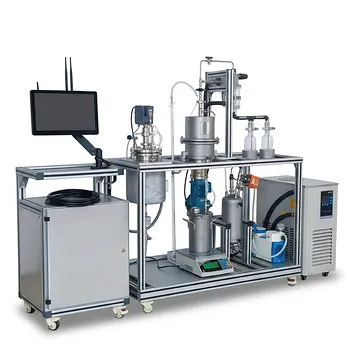
Hybrid distillation-pervaporation systems directly overcome azeotropic barriers by coupling a distillation column with a membrane unit that selectively removes one component, enabling high-purity separations without chemical entrainers. In a typical pilot-plant configuration, the distillation column first concentrates the feed mixture up to its azeotropic composition. The overhead stream—either as a vapor or condensed liquid—is then sent to a pervaporation (or vapor-permeation) module containing a hydrophilic membrane, which selectively pulls water through as a vapor while retaining the dehydrated organic product. This integrated design sharply reduces energy consumption and allows near-total solvent recovery.
The essence of the hybrid setup is a load‑sharing strategy: the distillation column does the bulk separation, and the membrane unit provides the final “polishing” to cross the azeotropic barrier. With smart recycle loops, pilot plants achieve practically 100% recovery and become living textbooks for energy-efficient, entrainer‑free processes.
How the Hybrid Pilot Plant Is Configured
The Distillation Column as the Bulk Separator
The feed, typically an azeotropic mixture like ethanol‑water, enters a continuous or batch distillation column.
The column concentrates the more volatile component (e.g., ethanol) until the overhead vapor reaches a composition just below the azeotrope. At this point ordinary distillation can no longer enrich the product further.
In pilot units, the column is equipped with precise temperature sensors, reflux control, and sampling ports to track the approach to the azeotropic plateau.
Membrane Unit – Pervaporation vs. Vapor Permeation
The near‑azeotropic stream then moves to the membrane separation stage. Two configurations are common:
- Liquid‑phase pervaporation: The condensed distillate is reheated to a controlled temperature and fed as a liquid to the membrane module. The membrane swells on the retentate side, and water‑selective materials like zeolites or polyvinyl alcohol (PVA) preferentially sorb and transport water, releasing it as a vapor on the low‑pressure permeate side.
- Vapor‑permeation: The hot overhead vapor from the distillation column (often around 100 °C) is led directly to the membrane unit without condensation. This eliminates an intermediate cooling‑reheating step and is especially attractive when the column operates at higher temperatures.
The retentate exits the module as a dehydrated, high‑purity organic stream—absolute ethanol, for example—while the water‑rich permeate is condensed downstream by a chilled condenser.
Recycle Streams and Process Integration
To maximize recovery, the permeate (still containing some ethanol) is typically recycled back to the distillation column feed.
This recycle loop creates a closed material cycle: the column keeps feeding the membrane, and the membrane sends back the small amount of solvent that slipped through. The result can be a nearly 100% recovery of the organic component.
Pilot plants often include flow meters, inline composition analyzers, and level sensors to quantify the recycle and demonstrate the dramatic improvement in overall yield compared to standalone distillation.
Why This Configuration Solves the Azeotrope Problem
Thermodynamic Limitation of Distillation
Azeotropic mixtures exhibit identical vapor‑liquid compositions at a specific point, so no further enrichment is possible by normal distillation.
Traditional workarounds—pressure‑swing distillation or azeotropic distillation with an entrainer—add complexity, energy use, and chemical inventory.
Membrane Selectivity as the Key
The membrane bypasses vapor‑liquid equilibrium entirely. It separates based on size sieving and preferential sorption: water molecules are smaller and have a high affinity for hydrophilic membranes, allowing them to permeate while larger organic molecules are retained.
This makes the hybrid system capable of “crossing” the azeotrope in a single membrane pass, delivering a product purity that distillation alone could never achieve.
Energy Efficiency Gains
Only the permeating component (usually water) is vaporized through the membrane; the bulk of the product remains liquid (or condenses as retentate). This dramatically lowers the latent heat demand compared to vaporizing the entire overhead stream.
In a well‑integrated pilot plant, the hybrid configuration can cut total energy consumption by up to 40% relative to an entrainer‑based distillation train, while shrinking the required membrane area because the column handles the easy part of the separation.
Pilot‑Scale Design and Educational Value
Components and Sensors
A typical pilot‑plant setup includes:
- A glass or stainless‑steel distillation column with structured packing or trays.
- A membrane module (plate‑and‑frame or hollow fiber) housed in a temperature‑controlled jacket.
- A vacuum pump and cold‑trap condenser on the permeate side.
- Peristaltic pumps for liquid feed and recycle loops.
- Extensive instrumentation: thermocouples, pressure transducers, conductivity meters (for water content), and in‑situ near‑infrared probes.
These components make the process fully transparent for students and researchers, allowing direct observation of phase behavior, membrane flux, and separation factor.
Operational Parameters and Demonstration of Process Optimization
Pilot units are ideal for exploring the critical interplay of variables:
- Column reflux ratio and boil‑up rate.
- Membrane feed temperature (ambient to ~100 °C) and permeate pressure.
- Feed concentration and recycle ratio.
By adjusting these parameters, operators can map the trade‑off between product purity, energy use, and membrane lifetime. This transforms the pilot plant into a hands‑on process optimization platform that teaches both distillation fundamentals and advanced membrane separation.
Understanding the Trade‑offs and Pitfalls
Membrane Fouling and Stability
Real mixtures often contain trace components (oils, salts, or degradation products) that can foul the membrane surface, reducing flux over time.
Hydrophilic membranes, especially zeolites, can be sensitive to acidic conditions or heavy metal ions. Pilot‑scale trials are essential to gauge long‑term stability before industrial scale‑up.
Added Capital and Operating Complexity
Membrane modules, vacuum systems, and precise temperature control add upfront cost and intricate operating procedures.
The recycle loop, while improving yield, can accumulate impurities. A purge stream or additional guard column may be necessary, complicating the simple narrative of a “single‑step” solution.
Temperature Sensitivity and Scale‑up Challenges
Vapor‑permeation setups require the membrane to withstand the column’s overhead temperature; thermal cycling can accelerate membrane aging.
Scaling up from a pilot unit means dealing with non‑uniform flow distribution in larger membrane stacks and the engineering of robust vacuum systems. What works beautifully in the laboratory often demands careful fluid‑dynamic modelling before industrial deployment.
Making the Right Choice for Your Pilot Plant Goals
The hybrid distillation‑pervaporation configuration is not a one‑size‑fits‑all solution. The specific layout and membrane selection should be driven by your primary objective.
- If your primary focus is researching new membrane materials: Design an interchangeable module with precise temperature‑control and the ability to feed both liquid (pervaporation) and vapor (vapor‑permeation) so you can benchmark separation performance under identical conditions.
- If your primary focus is chemical engineering education: Use transparent glass columns, decanters (if exploring heterogeneous azeotropes), and clearly visible recycle lines to let students visually track mass flows and immediately grasp the impact of membrane selectivity.
- If your primary focus is scaling up an industrial process: Evaluate the total cost of ownership—including membrane replacement frequency, vacuum pump maintenance, and the energy penalty of condensation/re‑heating—and run long‑term fouling tests with the actual process stream to avoid costly surprises.
By aligning the pilot‑plant configuration with your specific goal, you can turn a hybrid distillation‑pervaporation unit into an irreplaceable tool for understanding and conquering azeotropic separations.
Summary Table:
| Configuration | Feed State | Key Mechanism | Advantages in Pilot Plants |
|---|---|---|---|
| Liquid-Phase Pervaporation | Reheated liquid distillate | Hydrophilic membrane absorption & vacuum vaporization | Precise temperature control, stable flow rates |
| Vapor-Permeation | Hot column overhead vapor | Direct vapor feed to membrane without condensation | High energy efficiency, no reheat loop needed |
Accelerate Your Chemical Engineering Research & Education with LABPARK
Looking to demonstrate advanced separations like hybrid distillation-pervaporation? LABPARK designs and manufactures state-of-the-art Educational and Vocational Unit Operations Pilot Plants in chemical engineering, bioprocess & biotech, and environmental & water treatment.
We help universities, research institutes, and enterprises bridge the gap between theory and industrial practice with highly instrumented, safe, and customizable pilot systems.
Ready to upgrade your lab? Contact us today to discuss your project requirements!
Related Products
- Electrolyte Distillation Purification and Formulation Educational Pilot Plant
- Multi-Functional Special Distillation Educational Pilot Plant
- Multi-Modal Distillation Unit Operations Training Pilot Plant
- Multi Functional Membrane Crystallization Educational Unit Operations Pilot Plant
- Continuous Batch Extractive Distillation Educational Pilot Plant
People Also Ask
- Why does simple distillation yield higher efficiency than flash distillation? Key thermodynamic differences.
- How to Integrate Spectroscopy in Distillation Pilot Plants for Advanced Process Control
- How to Configure a Distillation Pilot Plant? Key Steps for Multi-Mode Setup
- How does double temperature difference control improve distillation pilot plants? Stabilize purity.
- Why use non-ideal VLE calculations in distillation pilot plants? Ensure accurate scale-up & purity