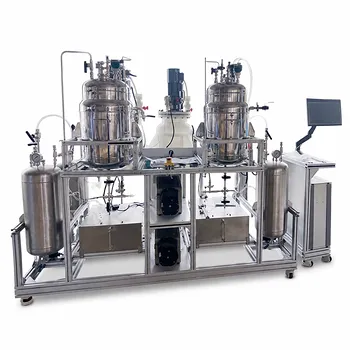
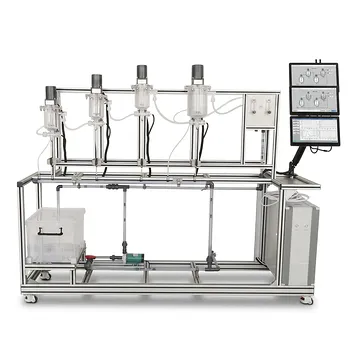
Vacuum protection for liquid storage and buffer tanks is a non-negotiable safety design element in any unit operations pilot plant.
It is critical because even a tiny negative pressure inside an atmospheric tank can generate forces large enough to cause a sudden, structural collapse, or implosion. This protection is achieved simply and reliably by installing vacuum breakers — automatic vent valves that open to admit air the moment the internal pressure dips below atmospheric pressure.
In a pilot plant, an unvented tank being emptied by a pump can experience a pressure drop of just 10 mbar, which translates into a load of hundreds of kilograms on the tank roof. A properly specified vacuum breaker is the only reliable safeguard to prevent catastrophic implosion in such moments.
The Unseen Physics of Tank Implosion
Why a Small Vacuum Creates a Massive Force
The danger comes from the large surface area of a tank’s roof or shell. Pressure, defined as force per unit area, means that a pressure difference of only 10 mbar (about 0.15 psi) applied across a tank roof that measures one square meter produces a net inward force of approximately 1,000 newtons — roughly the weight of a heavy adult.
For larger storage tanks, the numbers become staggering quickly. A 2-meter diameter tank experiences over 3,000 newtons (300+ kg-force) from that same minimal vacuum. It isn’t the pressure magnitude, but the area it acts upon, that makes even a slight vacuum destructive.
The Most Common Trigger in Pilot Plants: Pump Suction
In unit operations pilot plants, the most frequent cause of an accidental vacuum condition is unvented pump suction. When a centrifugal or positive-displacement pump draws liquid out of a closed tank faster than make-up air can enter, the internal pressure drops below atmospheric pressure.
This scenario unfolds silently and quickly if the tank’s vent line is undersized, obstructed, or simply forgotten. The result is what engineers call a partial vacuum, and if the tank wall was not designed for external pressure, it will buckle with little warning.
The Mandatory Engineering Safeguard
How a Vacuum Breaker Automatically Defends the Tank
A vacuum breaker is a purely mechanical valve designed to open when the pressure inside the tank falls below atmospheric pressure by a small set point (often just a few mbar). The simplest designs use a spring-loaded or weighted pallet that remains sealed under normal conditions but lifts off its seat the moment a negative pressure differential develops.
Once open, the valve allows ambient air to rush in and equalize the pressure, instantly neutralizing the implosion risk. When the pressure difference disappears, the pallet reseats. The process is automatic and does not require operator intervention — precisely what’s needed for a pilot plant environment where trainees and researchers may be less familiar with hidden vacuum risks.
Integrating Vacuum Protection into Pilot Plant Design
Vacuum breakers on storage and buffer tanks are not a luxury; they are a primary safety barrier. In any pilot plant where:
- Tanks are used as feed vessels for pumps,
- Cooling of warm liquid or vapor may create a vacuum naturally,
- The plant contains deliberate vacuum systems that could inadvertently connect to an atmospheric tank,
a properly sized vacuum relief device must be installed directly on the tank’s roof nozzle. The vent must be free-draining, resistant to fouling, and periodically inspected to ensure the seating surface doesn’t stick or freeze.
Understanding the Trade-offs
Potential Weak Points of Vacuum Breakers
- Ingress of contaminants: When a vacuum breaker opens, it draws unfiltered ambient air into the tank. For process liquids that are oxygen-sensitive, hygroscopic, or must remain sterile, this may be unacceptable. In such cases, a purge gas system with a back-pressure regulator is used instead of a simple atmospheric vent.
- Undersizing risk: A valve that is too small cannot admit air fast enough to limit the vacuum to a safe level. The sizing calculation must consider the maximum pump withdrawal rate and the pressure rating of the tank.
- Maintenance neglect: A stuck-closed vacuum breaker offers no protection. In pilot plants where equipment is frequently reconfigured, it’s vital to include vacuum breaker function tests in standard startup checklists.
Making the Right Choice for Your Pilot Plant Scale and Process
The core decision is never “if” vacuum protection is needed, but what type best meets your specific operational requirements.
- If your primary focus is general pilot plant safety and simplicity: An atmospheric vacuum breaker with a corrosion-resistant construction, sized for the largest possible liquid withdrawal rate, is the baseline requirement.
- If your primary focus is handling oxygen-sensitive or pure products: Replace the atmospheric vent with a blanketing system that uses inert gas and a pressure/vacuum conservation vent, ensuring the vacuum pallet still opens at a safe low pressure.
- If your primary focus is a plant where intentional vacuum processes run nearby: Always treat any glass, thin-walled metal, or rectangular tank as a potential implosion hazard, and integrate a vacuum breaker even if the tank seems unlikely to see negative pressure.
A pilot plant that demonstrates safe vacuum protection teaches a lesson far more valuable than any process optimization alone: that understanding the invisible force of pressure is fundamental to sound engineering.
Summary Table:
| Aspect | Key Mechanism / Cause | Safety Safeguard & Solution |
|---|---|---|
| Primary Cause | Unvented pump suction or rapid liquid cooling | Creates a destructive internal partial vacuum |
| Key Safeguard | Spring-loaded or weighted vacuum breakers | Automatically opens to admit air and equalize pressure |
| Critical Sizing | Sized according to max pump withdrawal rate | Prevents valve undersizing and structural collapse |
| Alternative Option | Nitrogen blanketing with conservation vents | Protects oxygen-sensitive or sterile process liquids |
Ensure Safety and Reliability in Your Pilot Plant Operations
At LABPARK, we provide state-of-the-art Educational and Vocational Unit Operations Pilot Plants across chemical engineering, bioprocess & biotech, and environmental & water treatment. We serve universities, research institutes, and enterprises worldwide, ensuring every system is engineered with robust, industry-standard safety features—including advanced vacuum protection for liquid storage and buffer tanks.
Don't compromise on process safety. Contact our technical experts today to design a custom, secure, and highly efficient pilot plant solution for your institution.
Related Products
- Water Electrolysis Hydrogen Production and Storage Educational Pilot Plant
- Multi-Stage Stirred Tanks in Series Residence Time Distribution and Mixing Performance Determination Educational Pilot Plant
People Also Ask
- How do chemical engineering pilot plants demonstrate electrolysis? Bridge Theory & Industrial Scale
- Bipolar vs Monopolar Electrolysis: Key Configuration Details to Analyze in Pilot Plants
- Which Electrolysis Pilot Plant Parameters Ensure Safety & Efficiency? Key Controls Explained
- Why is the selection of electrode materials critical when configuring or operating educational electrolysis pilot plants?
- How to update chemometric calibration models in pilot plants? Best practices for process engineers.